

When people think about the 2010 Chicago Blackhawks, the first names that come to mind are Jonathan Toews, Patrick Kane, Marian Hossa and Duncan Keith. Those players were the faces of a team that ended a 49-year Stanley Cup drought.
But the 2010 Blackhawks were much more than their stars.
Patrick Sharp scored 66 points. Kris Versteeg had 44. Troy Brouwer had 43. Brian Campbell even added 40 points from the blue line. Dave Bolland scored 37 points during the regular season, while Andrew Ladd added 38. Chicago had contributors throughout its lineup, which helped the team finish with 112 points before eventually winning the Stanley Cup.
That kind of depth is what the current Blackhawks are trying to build.
Chicago isn’t at the 2010 level yet. Still, the organization is beginning to develop the kind of young talent that could eventually give the team multiple NHL-caliber players throughout the lineup.
The Blackhawks’ Stars Are Already There
The 2010 Blackhawks had two young superstars leading the way.
Patrick Kane | RW
Age: 21 | GP: 82 | G: 30 | A: 58 | P: 88 | +/-: +16
Kane was Chicago’s leading scorer during the regular season, producing 88 points in all 82 games. He led the team with 58 assists, and his 30 goals were also a team high.
At only 21 years old, Kane was already establishing himself as one of the NHL’s most dangerous offensive players. His ability to create offense and score from anywhere in the offensive zone gave Chicago a superstar who could change a game by himself.
Jonathan Toews | C
Age: 21 | GP: 76 | G: 25 | A: 43 | P: 68 | +/-: +22
Toews combined elite offensive production with the defensive responsibilities of a first-line center.
His 68 points ranked third on the team, while his +22 rating was second among Chicago forwards. He also won 57.3% of his faceoffs during the regular season. More importantly, Toews showed he could be trusted in virtually every situation, a fact that became even more evident during Chicago’s Stanley Cup run, when he won the Conn Smythe Trophy.
Patrick Sharp | C/LW
Age: 28 | GP: 82 | G: 25 | A: 41 | P: 66 | +/-: +24
Sharp was one of the biggest pieces of Chicago’s secondary scoring. His 66 points ranked fourth on the team, behind only Kane, Keith and Toews, while his 25 goals tied Toews for second among Blackhawks forwards. His +24 rating also showed that his impact went beyond scoring. Sharp’s ability to play in the top six while contributing in multiple situations gave Chicago another legitimate scoring threat behind its two young stars.
Marian Hossa | RW
Age: 31 | GP: 57 | G: 24 | A: 27 | P: 51 | +/-: +24
Hossa brought a different level of experience and physicality to the 2010 lineup. Despite playing only 57 regular-season games, Hossa scored 24 goals and 51 points. His 0.89 points-per-game pace would have translated to roughly 73 points over an 82-game season. His +24 rating tied Sharp for the team lead among forwards. Hossa gave Chicago a veteran star who could score, play a strong two-way game and create space for Kane and Toews.
Kane led Chicago with 88 points, while Toews added 68. The 1-2 punch of Kane and Toews wasn’t the only offense, as Patrick Sharp produced 66 points behind them, and Marian Hossa had 51 despite playing only 57 games. The current Blackhawks have their own centerpiece in Connor Bedard.
Current Blackhawks Making Strides
Despite the differences between the two eras, the current team is working to grow and improve season after season.
Connor Bedard | C
Age: 20 | GP: 69 | G: 30 | A: 45 | P: 75 | +/-: -18
Bedard’s 75 points in 69 games put him right alongside the production of the 2010 team’s best players. He matched Kane’s 30 goals while doing it in 13 fewer games. The biggest difference isn’t at the top of the roster. It’s what comes after Bedard and the support from the rest of the team.
Tyler Bertuzzi | LW
Age: 30 | GP: 79 | G: 32 | A: 26 | P: 58 | +/-: -16
Tyler Bertuzzi was the 2025-26 Blackhawks’ second-highest scorer. Bertuzzi’s 58 points were a solid offensive season, but the next part of Chicago’s scoring group shows how much work remains. Bertuzzi also provides legitimate secondary scoring around the net. He scored 29 high-danger goals in 2025-26, second-most in the NHL, while leading Chicago with 32 goals. This puts him in the 98th percentile for net-front offense and shows the Blackhawks’ depth and secondary scoring.
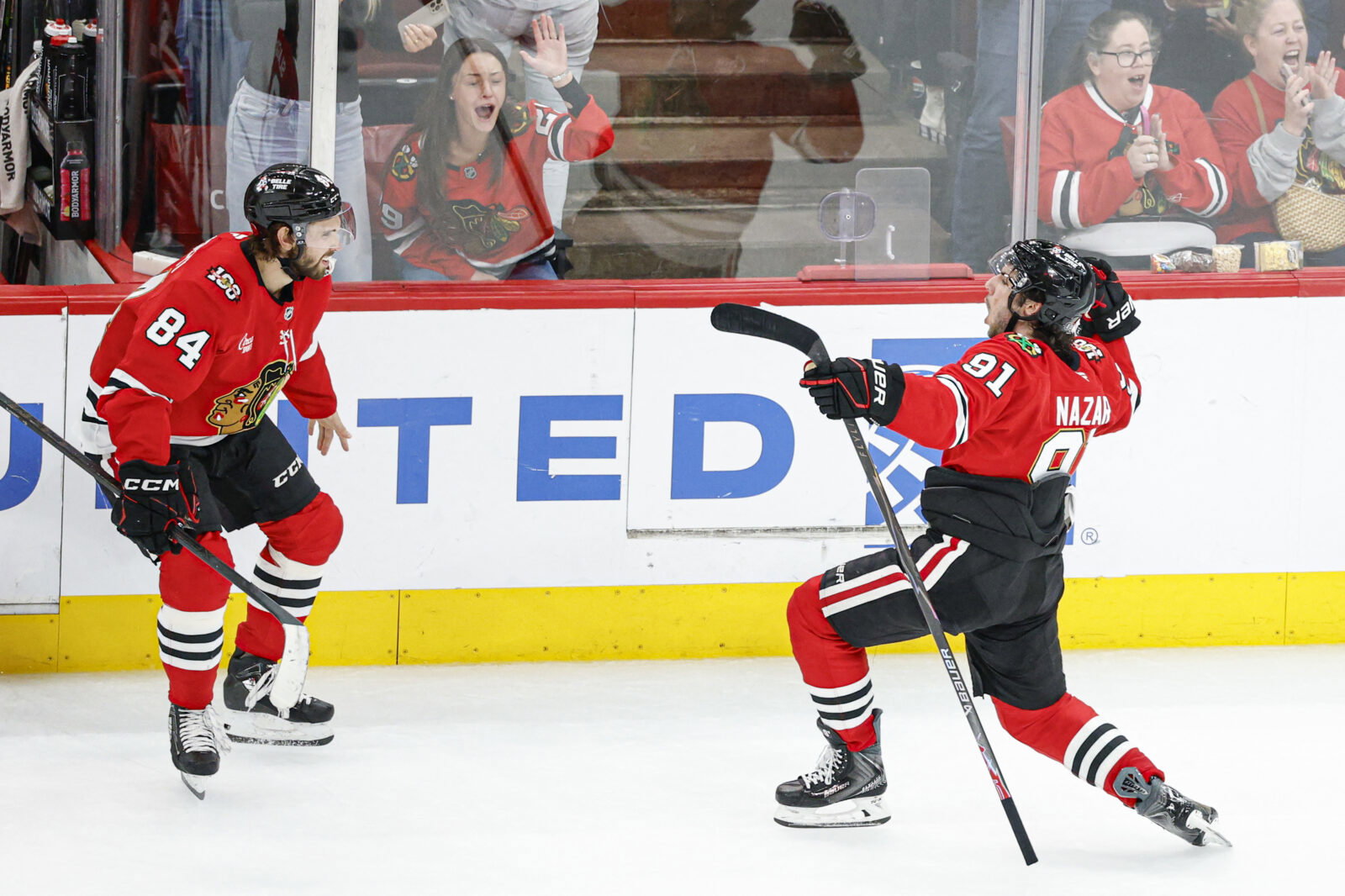
Frank Nazar | C
Age: 22 | GP: 66 | G: 15 | A: 26 | P: 41 | +/-: -21
Nazar’s 41 points are an encouraging sign for a player still establishing himself as a full-time NHL contributor. This is a positive progression, as last season he scored 12 goals and 14 assists for 26 points, adding 15 points. His 15 goals and 41 points in 66 games don’t jump off the page compared with Kane’s 88-point season or Sharp’s 66 points in 2010. But Nazar is only 22 years old and was playing his first full season as an important part of Chicago’s lineup.
Oliver Moore | C/LW
Age: 21 | GP: 51 | G: 5 | A: 14 | P: 19 | +/-: -15
Moore played 51 games and earned a spot on Chicago’s third line. This was an improvement over last season, where only had 4 assists in 9 games. He has shown that he can contribute if he continues to develop in the NHL. The Blackhawks’ offseason analysis similarly identified his development at the professional level as an important part of his future, while noting that he could potentially become a trade piece if Chicago pursues a larger acquisition.
Anton Frondell | C/RW
Age: 19 | 2025-26: 12 GP, 3 G, 6 A, 9 P with Chicago; 2025-26 SHL: 43 GP, 20 G, 8 A, 28 P
Frondell could be the biggest piece of that group. The Blackhawks selected Frondell third overall in the 2025 NHL Draft, and he immediately showed why Chicago viewed him as one of the best players in the draft.
Before joining the Blackhawks, Frondell scored 20 goals and 28 points in 43 games with Djurgårdens in the SHL. Those 20 goals led all SHL rookies, and he became just the fourth 18-year-old in league history to score at least 20 goals in a season. He then added nine points in his first 12 NHL games.
The most important part of Frondell’s profile isn’t simply his production. At 6-foot-1 and nearly 200 pounds, he brings a different style than some of Chicago’s smaller skilled forwards. If Frondell develops into a legitimate top-six forward alongside Bedard, Nazar or another young center, Chicago suddenly has another high-end offensive piece without having to acquire one.
Roman Kantserov | RW
Age: 21 | 2025-26 KHL: 63 GP, 36 G, 28 A, 64 P
Kantserov might be the most intriguing player in Chicago’s system for pure offensive production. The Blackhawks selected Kantserov 44th overall in 2023, and three years later he put together one of the most productive seasons by a young player in KHL history. He scored 36 goals and 64 points in 63 games for Metallurg Magnitogorsk, leading the KHL in goals. Those 36 goals and 64 points were also the most ever recorded in a single KHL season by a player under 22.
That production earned him a three-year entry-level contract with Chicago and put him in position to compete for an NHL job this season. Kantserov is particularly interesting because of how he could fit with the rest of Chicago’s young forwards. His hockey IQ was one of his biggest strengths, and he was expected to play alongside the Blackhawks’ young core.
If Kantserov can translate even a portion of his KHL scoring into the NHL, he could give Chicago something the 2025-26 roster lacked: another young winger capable of creating offense.
Nick Lardis | LW
Age: 21 | 2025-26 NHL: 41 GP, 10 G, 5 A, 15 P; 2025-26 AHL: 35 GP, 18 G, 14 A, 32 P
Then there is Lardis, who might be the best example of Chicago’s depth developing outside of its first-round picks. Lardis was a third-round pick in 2023, but his offensive development has accelerated quickly. He entered professional hockey after scoring 71 goals and 117 points for the Brantford Bulldogs in the OHL during the 2024-25 season.
He followed that up with 32 points in just 35 AHL games during his rookie season in Rockford. His 18 goals led the IceHogs, and he was named the organization’s Rookie of the Year. Lardis also got his first taste of the NHL, scoring five goals in 21 games.
Lardis doesn’t need to become a 90-point superstar. If he eventually develops into a 20-to-25-goal winger who can provide secondary scoring, his role could become extremely valuable on a playoff team. The Blackhawks aren’t trying to recreate the 2010 roster overnight. They are trying to develop enough players so that eventually any of them can contribute instead of being asked to carry the offense.
The 2010 Blackhawks had depth because players such as Sharp, Versteeg, Bolland, Brouwer and Ladd could contribute throughout the lineup. Chicago’s current roster isn’t there yet, but the organization is developing several forwards who could eventually give the Blackhawks a similar second wave of scoring.
The Blue Line Is Where the Comparison Gets Interesting
The 2010 Blackhawks also had remarkable defensive depth.
Duncan Keith | D
Age: 26 | GP: 82 | G: 14 | A: 55 | P: 69 | +/-: +21
Keith finished second on the team in scoring with 69 points and played more than 26 minutes per game. Behind him were Brent Seabrook, Niklas Hjalmarsson and Brian Campbell, giving Chicago several defensemen capable of handling major minutes.
Brian Campbell | D
Age: 30 | GP: 68 | G: 7 | A: 31 | P: 38 | +/-: +18
Campbell was Chicago’s offensive-minded defenseman. Despite missing 14 games, he finished the regular season with 38 points, including 31 assists, while averaging over 23 minutes per game. His ability to move the puck and contribute offensively gave Chicago another weapon from the blue line.
Brent Seabrook | D
Age: 24 | GP: 78 | G: 4 | A: 26 | P: 30 | +/-: +20
Seabrook provided a combination of physicality, defensive responsibility and offensive production. His 30 points weren’t elite for a defenseman, but his +20 rating and more than 23 minutes per game showed how important he was to Chicago’s defensive core. Playing alongside Duncan Keith, Seabrook earned difficult minutes throughout the season.
Niklas Hjalmarsson | D
Age: 22 | GP: 77 | G: 2 | A: 16 | P: 18 | +/-: +9
Hjalmarsson is perhaps the best example of the depth that made the 2010 Blackhawks so good. He wasn’t expected to produce offensively like Keith or Campbell. Instead, the 22-year-old defenseman played 77 games, averaged more than 21 minutes per game and finished with a +9 rating. His ability to handle significant minutes at such a young age allowed Chicago to have a reliable defenseman behind its top pairing.
The Current Blackhawks Are Still Developing That Group
The Blackhawks’ current defensive core is young and developing into a stronger blueline.
Alex Vlasic | D
Age: 24 | GP: 81 | G: 2 | A: 19 | P: 21 | +/-: -16
Vlasic has developed into one of Chicago’s most consistent young defensemen. His 81 games were the most of any Blackhawks defenseman in 2025-26, and he averaged 21:08 per game. While his 21 points don’t stand out offensively, Vlasic’s value comes from his ability to play heavy minutes and provide a steady defensive presence. He represents the type of player Chicago could eventually rely on in a top-four role alongside Byram.
Bowen Byram | D
Age: 25 | GP: 82 | G: 11 | A: 31 | P: 42 | +/-: +15
Byram is the most established offensive defenseman in Chicago’s young defensive group and was traded to the team this offseason. His 42 points were a career high, and his 11 goals and 31 assists were also career bests. He averaged more than 21 minutes per game and finished with a +15 rating. Byram gives Chicago a defenseman who can contribute offensively while also handling significant minutes, something that could become especially important as the team’s younger defensemen continue to develop.
Artyom Levshunov | D
Age: 20 | GP: 68 | G: 2 | A: 22 | P: 24 | +/-: -41
Levshunov’s second NHL season showed some of the offensive potential that made him the second overall pick in the 2024 draft. He finished with 24 points and 22 assists in 68 games, giving him more offensive production than Vlasic and Kaiser. His -41 rating shows plenty of defensive development ahead, but at just 20, Levshunov has time to grow into a much larger role. Chicago already views him as part of its long-term defensive core.
Wyatt Kaiser | D
Age: 23 | GP: 77 | G: 6 | A: 11 | P: 17 | +/-: -16
Kaiser provides another example of the depth developing behind Chicago’s higher-profile prospects. His 17 points weren’t eye-catching, but he played 77 games and averaged 19:37 per game. He also set career highs with six goals and 17 points while leading the Blackhawks’ defensemen in takeaways with 36. Kaiser doesn’t need to become an offensive star to be valuable; if he continues developing into a reliable defensive defenseman, he gives Chicago another NHL-caliber option in its lineup.
The production is nowhere close to what Keith and Campbell provided offensively, but Chicago’s current defense is considerably younger. Vlasic, Levshunov and Kaiser all played significant NHL minutes this season, while the organization also has young defensemen such as Sam Rinzel, Ethan Del Mastro, and others developing behind them.
How Do These Players Grow?
That could be an important step toward building the type of defensive depth Chicago had in 2010. When comparing that with the two Blackhawks teams. Sharp scored 66 points, Hossa had 51, Kris Versteeg had 44, and Brouwer had 43. The 2010 team also had Bolland and Ladd providing secondary scoring while playing important roles throughout the lineup.
The biggest difference between the two teams is that the current Blackhawks have a superstar in Bedard and several young players who could become important NHL contributors. The 2010 Blackhawks already had those complementary players producing at a high level.
The Real Comparison Isn’t Kane to Bedard
It would be easy to make this article about whether Bedard can become as good as Kane or Toews. That isn’t really what made the 2010 Blackhawks special. The more important comparison is between the players behind the stars. In 2010, Chicago could put Kane and Toews at the top of the lineup and still have Sharp, Hossa, Versteeg, Brouwer, Bolland and Ladd behind them.
Today, Chicago has Bedard, Bertuzzi and Nazar at the top of its scoring group, followed by players such as Teuvo Teräväinen, Ryan Donato, and Ryan Greene. The numbers show the gap. The 2010 Blackhawks had six forwards with at least 43 points. The current Blackhawks had only two forwards reach that mark: Bedard with 75 and Bertuzzi with 58. That is not a small difference, but it also shows exactly what Chicago needs to fix.
When you look at how the 2010 roster was built, many players were acquired through trade or free agency. Players like Sharp, Versteeg, Hossa, Campbell and Ladd were all taken from other teams or the free agent market. In comparison, this current Blackhawks roster and its up-and-coming players are made up of players drafted into the organization. The Blackhawks may end up acquiring more players from other teams and the market to keep building their roster in ways that match their 2010 success.
The Prospect Pool Could Change the Equation
The encouraging part is that the Blackhawks don’t have to solve all of those problems through free agency.
Chicago has one of the NHL’s highly regarded prospect pools, and the organization continues to add young players through the draft. The team’s offseason outlook notes that Chicago entered the summer with the No. 4 overall pick and additional draft capital, giving general manager Kyle Davidson another opportunity to add to the organization’s young core, trading for Byram.
That is where players such as Nazar, Moore, and the prospects still coming through the system become important. If even a few of those players develop into 40- to 60-point NHL forwards, the Blackhawks’ depth could look very different in a few years.
The same is true on defense. If Levshunov develops into the top-pair defenseman Chicago expects, Vlasic continues to improve, and another young defenseman emerges alongside them, the Blackhawks could eventually have a six-man defensive group that doesn’t rely on one player to do everything.
Not Exactly 2010 Yet…
The numbers make one thing clear: the current Blackhawks are not at the level of the 2010 team. Bedard’s 75 points compare favorably with Kane’s 88 and Toews’ 68, but the depth behind him doesn’t yet match the supporting cast around those players.
That’s not necessarily a bad thing. The 2010 Blackhawks were a finished product. The current Blackhawks are still developing. The question is whether the young players around Bedard can eventually turn today’s potential into the kind of production Chicago had throughout its championship lineup.
The 2010 team didn’t win because Kane and Toews were the only stars. It won because after Kane, Toews and Hossa, there was still Sharp, Versteeg, Bolland, Brouwer, Ladd, Keith, Seabrook, Hjalmarsson and Campbell.
The current Blackhawks don’t have that level of depth yet. But with Bedard already producing at a star level and players such as Nazar, Moore, Levshunov, Vlasic and the rest of the organization’s prospects still developing, Chicago is beginning to build the foundation.
Despite the draft talent coming through the organization, the 2010 Blackhawks weren’t built on draft capital alone. Key pieces of that roster were added to the team through trades and free agency. Players like Marian Hossa and Brian Campbell were difference-makers added in free agency and trades, respectively. If the current Blackhawks can make some similar blockbuster trades, they will find themselves in a much more competitive position.
The next step isn’t finding another Connor Bedard. It’s finding enough players around him that the roster barely drops off after its best players. If Chicago can do that, then the comparison to 2010 won’t seem so far-fetched anymore.












Leave a comment