

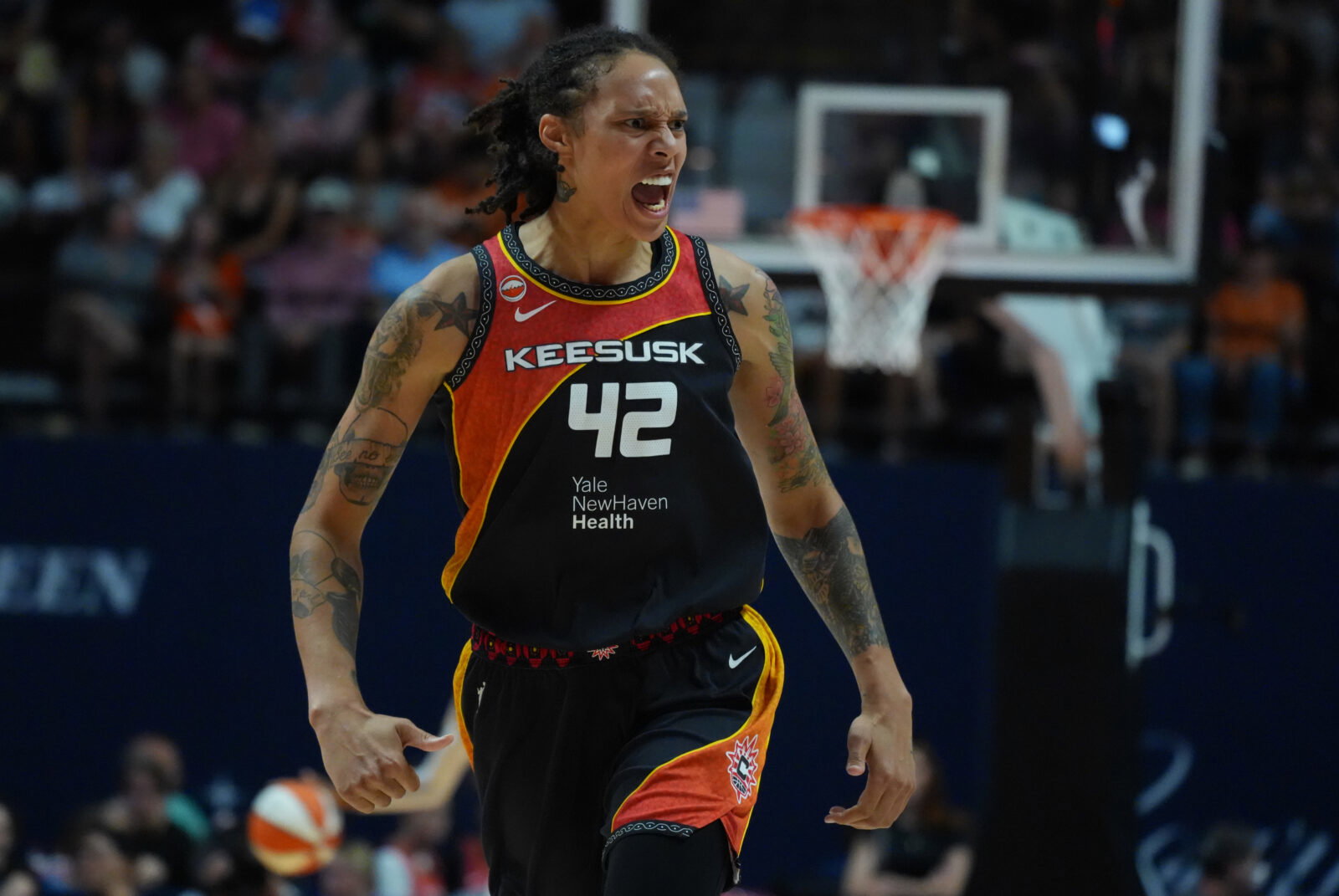
With less than five home games to go, the Connecticut Sun are officially in their “Golden Hour” era. Now that the team is eliminated from playoff contention, there is still a lot to give – especially to give back. While there’s no hope for a future after September 24th, that’s not stopping them from staying in the present. Brittney Griner remains at the forefront of these efforts.
A Season of Giving Back
Throughout August, the Connecticut Sun hosted several give-back initiatives, two of which were largely led by Griner, the Sun’s center. That included the 2026 Heart and Sole Shoe Drive and the “Forever in Play” Initiative.
Griner collaborated with the Connecticut Sun Foundation and the City of Groton to unveil the city’s new playground on August 21. With the foundation’s $15,000, paired with Griner’s own $10,000, the city matched to create a $50,000 total investment.
The Foundation of the Connecticut Sun’s Legacy
“Knowing that there’s not going to be the WNBA in Connecticut anymore, it’s important that we feel like we can leave our mark,” Jen Rizzotti, president of the Connecticut Sun, said.
These are moments that best support the argument that athletes are indeed human. Connecticut is a smaller organization in comparison to the rest of the league. That makes these kinds of actions have an even larger impact.
The team is moving to Houston within a few months. They didn’t have to do this, especially since they won’t see the effect. But they are what made it all happen.
“Trophies collect dust, they rust, they fall apart,” Griner said. “Something like this lasts.”
Using Platforms For Good
Female athletes are never going to be remembered solely for their basketball skills, especially how the media portrays them today. Through media coverage, athletes develop a platform. Griner is the epitome of using her platform for a much more community-based, though large, impact.
“You know with all that ‘fame’ it comes with a price, and I want to do something good,” Griner said.
There’s no denying Griner gains attention through the media in all sorts of ways.
The same athlete who was all over non-sports-related media outlets when a Russian prison released her is the same athlete who made headlines in sports-related media outlets for becoming the league’s all-time leader in blocks.
Yet, despite the center’s athletic success, certain media coverage allows people to remember Griner only for her mistakes.
Across the league, especially this season, athletes gain platforms from non-basketball conversations. This playground unveiling is an example of a non-basketball conversation. Women’s sports is a culture. Griner is an instance of recognizing that women’s basketball isn’t just a game, but not to the point of shifting the league in the wrong direction.
Griner isn’t the only player across the league who chooses to give back. The Atlanta Dream’s forward Angel Reese just recently donated 1,000 backpacks through the Angel C. Reese Foundation.
What a Legacy Really Means
These actions, these good motives, are often turned away from. They’re not there to start drama across the league or get non-sports-related media outlets to give commentary. They’re there to do good. So long as something culture-wise isn’t causing controversy, people don’t care to share an opinion.
But it was never for their opinions in the first place.
The Connecticut Sun will play their last game in Mohegan Sun ever in just under a month, but a lot will be left behind.
“It’s been a priority for us to have good people that care about things beyond the basketball floor,” Rizzotti said. “A lot of this season is emphasizing the team’s legacy. The clickbait on X isn’t what emphasizes a legacy. The tidbits from a press conference that’s used across multiple outlets isn’t what emphasizes a legacy. Actions speak louder than words, and that’s especially true for words across the media.”
“I want to be remembered by my heart,” Griner said.


![Jacksonville Jaguars linebacker Foye Oluokun (23) wraps up Houston Texans running back Nick Chubb (21) during the fourth quarter between the Houston Texans and the Jacksonville Jaguars Sunday September 21, 2025 at EverBank Stadium in Jacksonville, Fla. The Jaguars defeated the Texans 17-10. [Doug Engle/Florida Times-Union]](https://theleadsm.com/wp-content/uploads/2026/08/2026-08-22T003255Z_360144161_MT1USATODAY29638522_RTRMADP_3_JACKSONVILLE-JAGUARS-LINEBACKER-FOYE-OLUOKUN-23-WRAPS-UP-680x624.jpg)








Leave a comment