

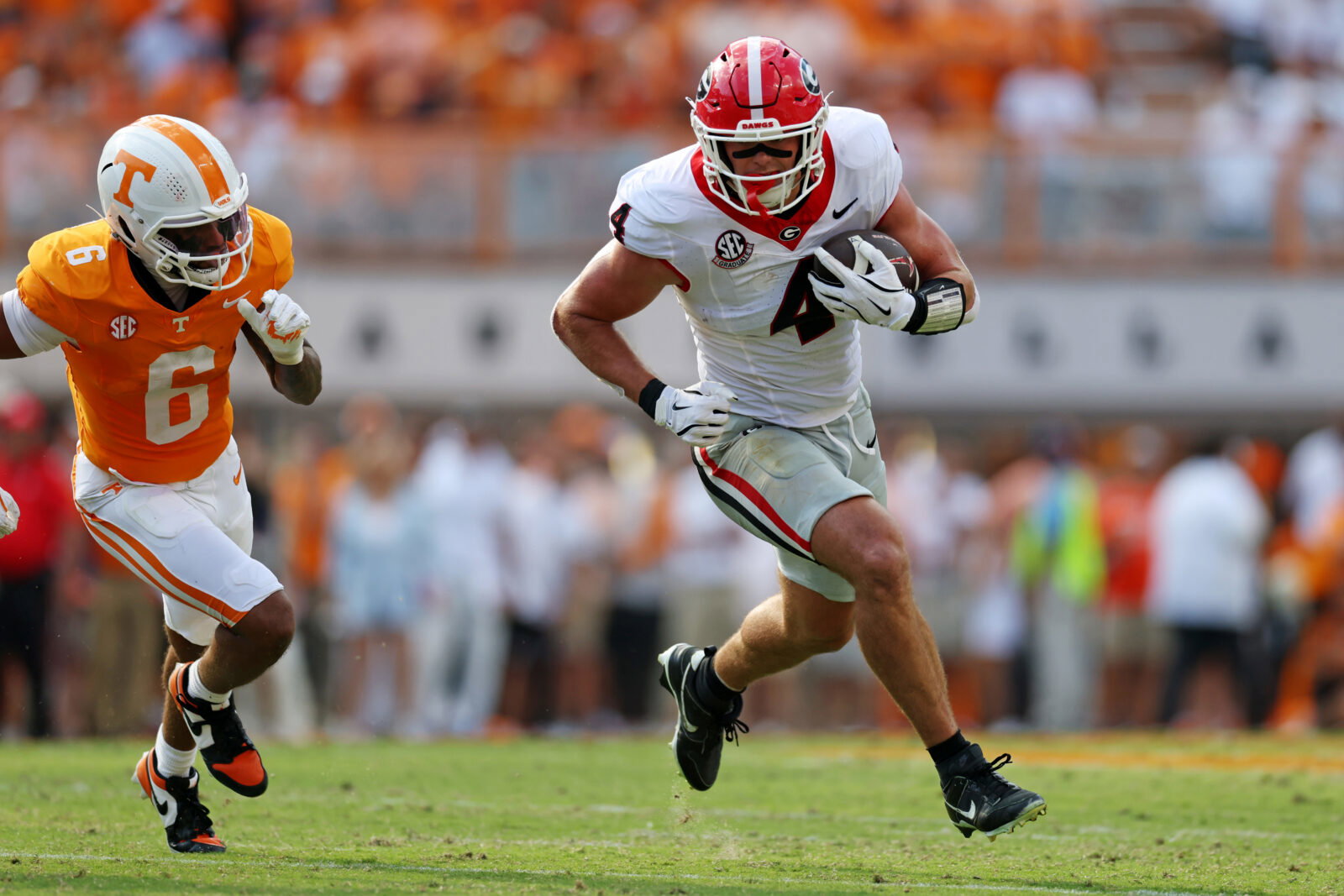
Year in and year out, the headliners of the NFL Draft media cycle are QBs and the players that impact them the most. However, in a draft class with limited stars at those premium positions, more focus will be shifted to the less sexy roles.
Coming off a year in the NFL where TEs and their usage were more important than ever, it’s only fitting that this year’s class is chock-full of talent from top to bottom with a variety of body types and skillsets.
Players like Oregon’s Kenyon Sadiq and Vanderbilt’s Eli Stowers get all the hype because they put up the stats and fantasy points that everyone loves. The problem is that players of that archetype don’t actually get on the field and contribute to their team on a three-down basis due to their inability to block inline.
Three players in this year’s class can’t match the production of their flashier counterparts, but they do bring the traits teams look for when it comes to selecting starter-quality players at the TE position.
Oscar Delp – Georgia (No. 11 TE on the Consensus Board)
Delp is probably the most relevant name nationally of the three, as the Georgia TE has been a key contributor to multiple highly successful Bulldog teams over the past few years. The reason he falls on this list, even given his name value, is the lack of production. Delp was tagged as the next successor to Brock Bowers but never lived up to the hype, with his career-best yardage total coming in 2023, where he topped out at 284 yards.
Despite the lack of production, there’s one big factor that doesn’t show up on the stat sheet that will make teams feel comfortable ignoring his lackluster numbers: his blocking.
While not overly big at 245 pounds (21st percentile) or long with 31⅝-inch arms (6th percentile), his size is functional enough, and Georgia was more than comfortable with leaving Delp inline. He translates his strong first step burst into power at the point of contact and plays with outstanding leverage and technique to work his feet and seal off his assignment.
Delp’s combination of toughness, technique, and flexibility will allow his future NFL coach to trust him with the blocking responsibilities needed to get on the field early in his career.
There is also reason to believe his best past catching days are ahead of him, because Delp is a fantastic athlete. As evidenced by his 4.48 40-Yard Dash time at his Pro Day, Delp can absolutely fly in the open field. While he still needs to improve his route-running polish, players who can block are typically matched up with LBs who will struggle to stick with that type of speed.
Eli Raridon – Notre Dame (No. 8 TE on the Consensus Board)
The phrase “scout the player, not the helmet” is typically sound advice when it comes to evaluating prospects, but in the case of Eli Raridon, it’s fair to ignore it. The next in a long line of talented Notre Dame TEs, he is another player with underwhelming statistical production that is suppressing his talent from the public eye.
At 6-foot-6, 245 pounds, Raridon brings functional size for an inline TE. He combines that with outstanding technique and enough strength through his lower half and core to be a capable blocker when attached to the line of scrimmage. There are some questions about his length, but Raridon’s overall body of work shows a smart, tough blocker with the tools to handle NFL-level DEs.
Raridon leaves Notre Dame with under 700 total yards in his career and zero touchdowns in his senior season, but both his testing and tape indicate there is room for improvement. He posted a stellar 4.62 40-Yard Dash and 36-inch Vertical Jump at the Combine, showing he has the athletic tools to win down the field at the NFL level.
Add in receiving tape that consistently shows him displaying fluid movement skills to create as a route runner and just not getting the ball, and it’s easy to see how his best football is ahead of him.
Sam Roush – Stanford (No. 10 TE on the Consensus Board)
Roush is the player with the best production on this list after putting up a 50-catch, 550-yard season in 2025, but due to playing for a largely irrelevant Stanford team, he was often underdiscussed.
He has been rising up the Consensus Board of late, due to his exceptional Combine, but the reason he makes this list has nothing to do with that and everything to do with, yes, you guessed it, blocking!
Roush checks every box build-wise teams look for in an inline player at 6-foot-5, 265 pounds. Combine that with close to 900 snaps of inline experience, and there is very little projection to his profile. He has the entire toolkit needed to deal with DL one-on-one in the run game, showing the power and core flexibility to wrench defenders out of the hole at the point of attack.
When combined with tremendous range for a player of his size, he is the complete package as a blocker.
Roush also brings the pass-catching ability to be more than just a typical Day-3 blocking TE. His size/athleticism combo makes him a dangerous weapon up the seam and he was one of the better YAC threats in the sport last year, ranking seventh among TEs in that category. His only real blemish was the seven drops in 2025, but that is a notoriously noisy stat that shouldn’t dissuade any team from taking him on Day 2 of the draft.
The Rest of the Bunch
Raridon, Roush, and Delp all possess that ideal combination of blocking ability and receiving upside needed to become impactful starting TEs in this league. That does not mean that they are the only TE prospects who need more of the limelight.
Michigan’s Marlin Klein, Ohio State’s Will Kacmarek, and Washington’s Quentin Moore are three blocking forward TEs who, while they may lack the same receiving ability, will very likely outperform their draft slot as rookies, similarly to players like the Seahawks’ A.J. Barner and the Bills’ Jaxson Hawes did in years past.










Leave a comment