

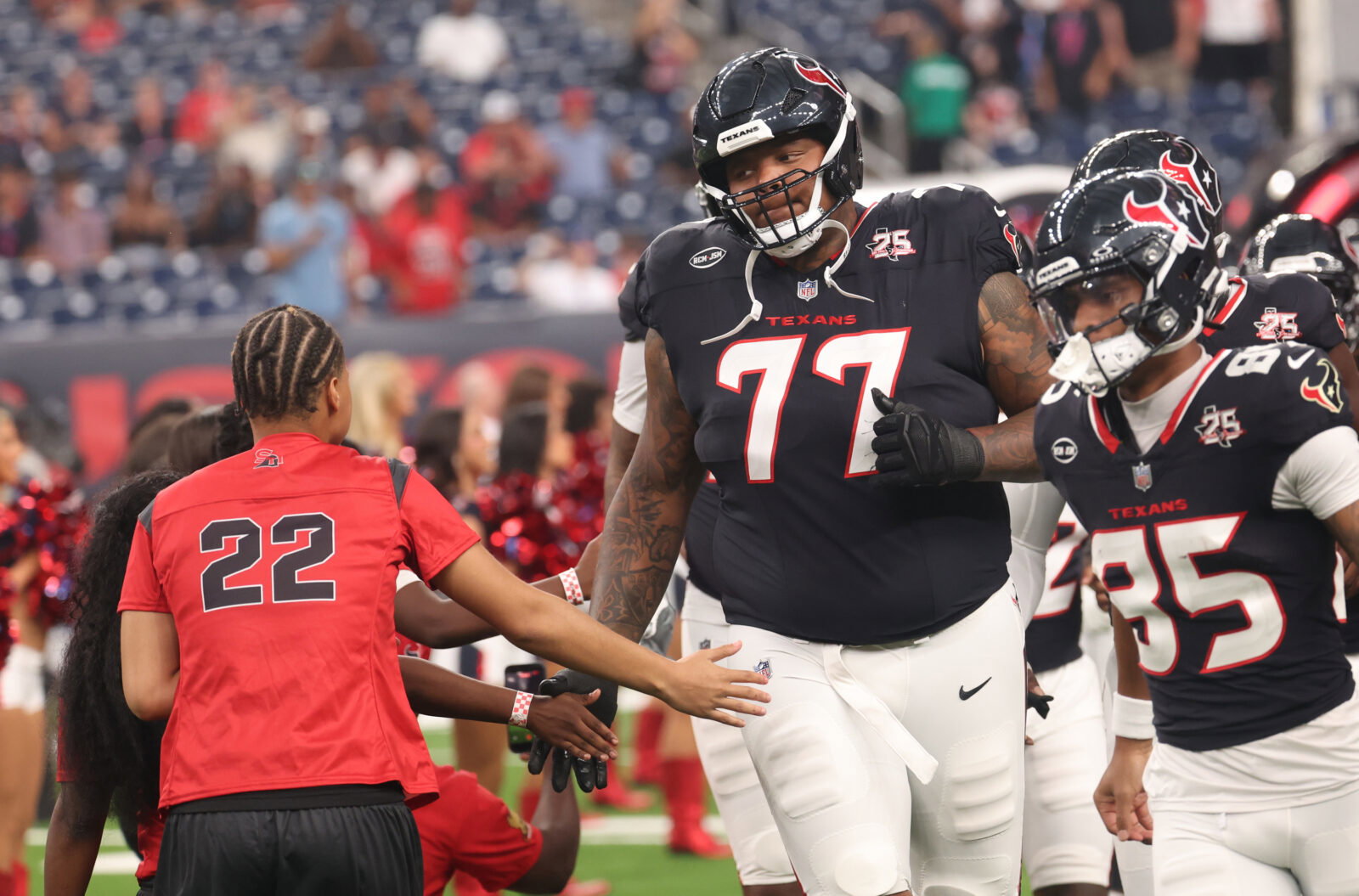
American football is absolutely brutal on the body. It’s basically controlled chaos where two teams ram into each other for three hours straight, and the hits are genuinely violent.
And nowhere is that more obvious than in the trenches. That’s where the offensive and defensive lines go to actual war every single play, fighting for inches.
Over the decades, NFL players have gotten noticeably bigger. Sports science got better. Strength training became proper science instead of just ‘‘lift heavy things.’’ Scouting improved. Teams figured out that more weight often equals better results on the line. The average lineman from the 1970s was maybe 250 pounds. Now? That’s basically undersized.
Today, even NFL fans pay attention to how heavy the linemen are when placing bets. It sounds weird, but a 20-pound difference on the line can genuinely change whether a team gets a touchdown on fourth down. As a UK fan, if you follow these matches and those in other sports, and you’ve been thinking of making money from your favorite teams, you can do so by betting on their outcomes at the best betting sites in the UK. Ensure to read reviews to discover the best sportsbooks before you start.
How NFL Player Weight Actually Works
These days, 300 to 350 pounds is pretty standard for interior linemen, but a small group of absolute units has pushed way beyond that, smashing records and making people question what the human body is actually capable of. More mass means more leverage. More leverage means you’re controlling the line of scrimmage.
Official weights get recorded at team weigh-ins, the NFL Scouting Combine, and training camps. Teams publish these numbers on their rosters, but here’s the thing: those numbers change constantly. A guy might weigh 380 in September and 375 by December. The listed weight is basically just a snapshot.
Offensive and defensive linemen absolutely dominate the heavyweight list. These are the guys doing the actual blocking and colliding on every snap. They need the mass to push back against opposing players who are trying to destroy them. Without serious weight, you get pushed around like a rag doll.
The tricky part is that the official weight almost never tells the whole story. Players drop weight in summer training camps. They gain mass in winter. Real playing weight changes week to week depending on injuries, schemes, and what the coaches want. It’s way more complicated than the roster number suggests.
Being massive has obvious advantages. You’re basically immovable. But it also means your knees hate you. Your cardiovascular system has to work harder. You get slower. If you’re carrying extra weight around your middle instead of muscle, quick defensive ends will burn you on the edge.
Who’s Actually the Heaviest?
The records speak for themselves, but one name stands alone at the top.
Aaron Gibson: The 410-Pound Record Holder
No one comes close, honestly. Gibson got picked by Detroit in Round 1 of the 1999 draft, and he showed up weighing a ridiculous 410 pounds. Six-foot-six. First guy ever officially on the books over 400. It’s wild.
Other Massive Linemen Still Playing or Recently Played
But Gibson isn’t alone in the heavyweight conversation. Plenty of other linemen have come remarkably close to those extremes.
Beyond Aaron Gibson, things get interesting. Trent Brown? 380 pounds, won a Super Bowl with New England, and he’s actually brilliant at the position. Not just big: he knows what he’s doing out there. Daniel Faalele’s right there at 380 pounds with the Ravens. The guy played rugby before football, which honestly makes sense when you’re built like that.
Nate Newton played for Dallas back in the day at 380 pounds and made six Pro Bowls. That’s not an accident. Dawand Jones with Cleveland at 374 pounds has an 89-inch wingspan that’s absolutely insane. Like, he could probably reach across the whole field.
Desmond Watson and College Extremes
College is where things get truly extreme. One player pushed the boundaries further than anyone else before transitioning to professional football.
Defensive tackle Desmond Watson pushed it even further during his college days at Florida, reportedly hitting 464 pounds. That’s absolutely bonkers for an actual player. In the NFL, he competed at around 435 to 449 pounds. It really shows how extreme college athletes can get before trimming down for professional play.
Why Linemen Need to Be Stupidly Heavy
So why do all these massive athletes exist in the first place? There’s actual physics behind the need for all this weight.
Offensive tackles face 260-pound edge rushers flying at them like track stars. It’s chaos. You need mass to build leverage, and you need leverage to not get pushed into your quarterback’s lap. Basic physics: force equals mass times acceleration. When a 370-pound guard hits someone, the transfer of energy is absolutely mental. Weight gives you tools to stand your ground and not get overpowered on every single snap.
It’s also about occupying space. In running plays, you’re not necessarily moving the other guy. You’re taking up so much real estate that linebackers physically can’t flow through. A 360-pound lineman basically becomes a human obstacle.
Defensive tackles need mass for completely different reasons. They’re holding ground against double teams from the center and guard. That’s two 300-plus-pound guys hitting you simultaneously from different angles. You need to be low, thick, and basically immovable. DJ Reader’s 335 pounds, and he absolutely wrecks run plays. Compact frame, moves crazy fast, and that’s what makes him so good.
The Evolution of Getting Absolutely Enormous
But it used to be way different. Back in the seventies, 250 pounds was actually massive for a lineman, and the shift happened gradually over decades.
In the 1970s, a 250-pound lineman was considered genuinely substantial. Standards shifted dramatically. By the 1990s, linemen were averaging 290 to 310 pounds. A significant jump in just two decades. Now? 315 to 350 pounds is basically standard for anyone playing in the trenches.
What changed? Weight rooms got exponentially better. Nutrition became an actual science instead of ‘‘eat more meat.’’ College recruiting pipelines started identifying massive athletic prospects and developing them specifically for football. Year-round training replaced the old ‘‘show up and see what happens’’ approach that dominated earlier eras.
But here’s the important bit: size alone absolutely doesn’t cut it anymore. Defenses became quicker and more explosive. Passing offenses got sophisticated and harder to defend. You can’t just field slow, massive linemen and expect success. The best linemen today combine their mass with genuine athleticism. They move efficiently, have solid footwork, and actually understand leverage and positioning.
Famous Heavy Players and What Made Them Special
Trent Brown’s a notable tackle in the league. Six-foot-eight, 380 pounds, but his footwork is weirdly clean for someone that big. He’s not just standing there looking large: he actually moves. Bryant McKinnie did it for Minnesota and Baltimore too, showing you don’t have to choose between size and skill.
On the defensive side, Ted Washington held it down for 17 years at 375 pounds. Then you’ve got Vince Wilfork with the Patriots. In Belichick’s words, ‘‘Few players reached or will ever reach the special level of Vince Wilfork.” That statement captures what separates elite heavy players from just big ones. Damon Harrison was arguably the best run-stopping interior tackle of his era at 350 pounds.
Heaviest NFL players compared
The table below outlines historical data regarding the heaviest players in professional football history:
| Player Name | Primary Position | Listed Weight (lbs) | Key Historical Achievements |
| Aaron Gibson | Offensive Tackle | 410 lbs | Heaviest player in official NFL history |
| Trent Brown | Offensive Tackle | 380 lbs | Super Bowl LIII champion, Pro Bowl selection |
| Daniel Faalele | Offensive Tackle | 380 lbs | Selected by Baltimore Ravens, former rugby player |
| Nate Newton | Offensive Guard | 380 lbs | 6x Pro Bowl selection, 3x Super Bowl champion |
| Ted Washington | Defensive Tackle | 375 lbs | 4x Pro Bowl selection, Super Bowl XXXVIII champion |
| Dawand Jones | Offensive Tackle | 374 lbs | Selected by Cleveland Browns, 87.8-inch wingspan |
| Bryant McKinnie | Offensive Tackle | 360 lbs | Pro Bowl selection, Super Bowl XLVII champion |
| Damon Harrison | Defensive Tackle | 350 lbs | First-team All-Pro selection |
| Vince Wilfork | Defensive Tackle | 325–350 lbs | 2x Super Bowl champion, 5x Pro Bowl selection |
Does Getting Heavier Actually Make You Stronger?
The obvious answer seems to be yes, but it’s actually more complicated than that.
Partially, yes. More mass gives you more momentum when you hit someone. You can anchor better against bull rushes from defensive linemen. You control the trenches better overall. But there’s definitely a line where it gets silly. Too much weight slows your acceleration off the snap. Your knees start talking to you. You can’t condition properly. By the time you finish the fourth quarter, you might be completely gassed.
The Advantages and Drawbacks of Extreme Weight
Advantages
- More momentum during initial contact
- Better anchoring against bull rushes
- Superior trench control and gap coverage
- Resistance to double teams from offensive linemen
Drawbacks
- Reduced acceleration off the snap
- Higher joint stress on knees, ankles, and feet
- Demands superior conditioning to finish games
- Increased injury risk if not managed properly
Ideal Weight by Position
| Position | Ideal Weight Range | Key Reason |
| Offensive Tackles | 330-360 lbs | Typically 6’6’’+ height allows weight distribution |
| Guards & Centres | 310-330 lbs | Lower center of gravity works in tight spaces |
| Defensive Tackles | 315-340 lbs | Compact power needed for gap control |
| Quarterbacks & Receivers | 200-220 lbs | Speed and agility essential for these roles |
| Cornerbacks & Safeties | 190-210 lbs | Coverage speed matters more than mass |
The ideal weight’s completely different depending on where you play. Quarterbacks, receivers, running backs: they all need to be light or they fall apart out there. Extra weight just slows them down way too much.
The Biggest NFL Players Who Became Fan Favorites
Fans are naturally fascinated by extreme human dimensions. Seeing a 350-pound athlete move with speed creates captivating television moments and highlight clips.
Nicknames and Media Coverage
Unforgettable nicknames have amplified the media presence of massive athletes throughout history:
- William Perry: The Refrigerator
- Nate Newton: The Kitchen
- Damon Harrison: Snacks
Combine Measurements and Public Perception
When massive prospects perform at the official NFL Combine, their bench press counts, wingspans, and 40-yard dash times generate major media interest.
How NFL Teams Evaluate Oversized Prospects
Wondering how the league evaluates these guys? Well, here’s the NFL front office scouting protocol for heavy prospects:
- Physical Measurements: Height, weight, hand size, wingspan.
- Agility & Movement Testing: 3-Cone drill, 20-yard shuttle, 10-yard split.
- Game Tape Analysis: Hand placement, balance on contact, leverage control.
- Medical Evaluations: Joint imaging, heart health, weight management history.
Film Versus Measurements
A prospect might look impressive at 360 pounds, but scouting tape reveals whether they play with good leverage or get exposed by faster edge rushers.
Medical and Durability Evaluations
Team physicians scrutinize joint health, back stability, and cardiac conditioning. If a player struggles to keep their weight manageable, franchises may flag them as a health risk.
Could We See Even Heavier Players?
There’s a natural limit to how massive a human can actually get and still perform at an elite level, so probably not. The NFL’s basically hit its ceiling around 380 to 400 pounds. Beyond that, joints break down, and lateral movement becomes nearly impossible.
The Trend Nobody’s Talking About
Here’s what’s actually changing in how teams think about lineman weight: massive linemen aren’t actually getting heavier anymore. The future’s about getting smarter. Teams will keep prioritizing 330-to-350-pound linemen who move athletically. That’s what wins. Teams are getting smarter about composition. A 340-pound guy with low body fat is way more useful than a 360-pound guy carrying flab. Scouts now look at body composition, not just scale numbers.
The bottom line? Aaron Gibson holds the heaviest NFL player record at 410 pounds, but Trent Brown, Daniel Faalele, Dawand Jones, and DJ Reader proved that combining weight with athleticism makes great linemen. Size matters. Movement, footwork, leverage. That’s what separates Pro Bowlers from just big linemen.









Leave a comment