

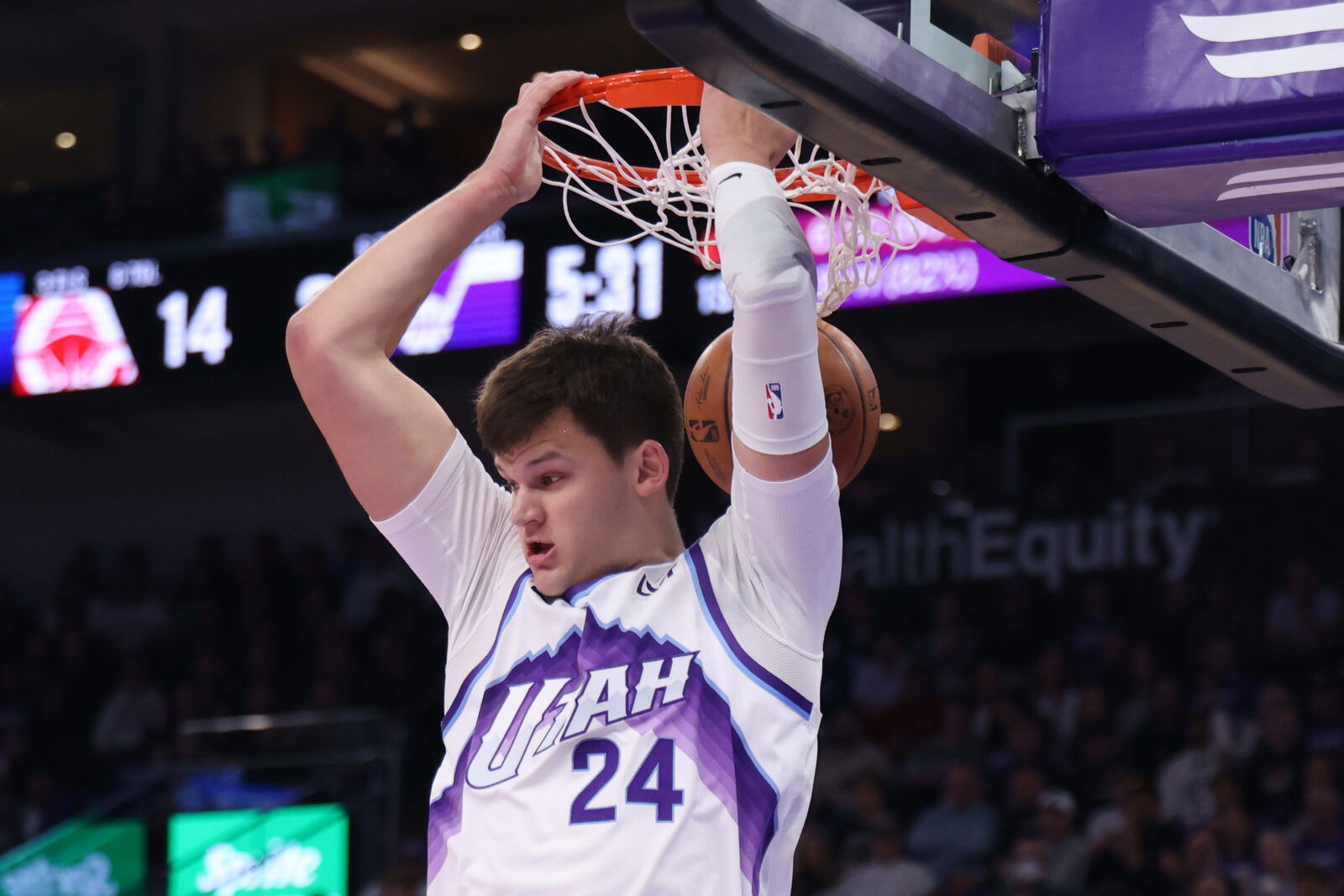
Ever since his trade to the Utah Jazz, Walker Kessler has continued to prove he belongs in the NBA.
Kessler became the first rookie in 25 years to record seven-plus blocks in four games, only trailing Tim Duncan‘s five games in 1998. He wowed audiences when he helped the Jazz to a one-point win over the Minnesota Timberwolves on Jan. 16, 2023, scoring 20 points and bringing down 21 rebounds.
A player with Kessler’s talents deserves an extension. However, the new NBA salary cap rules hinder a team’s ability to give out long and expensive contracts, meaning the Jazz were unwilling to sign him earlier. Reports showed Kessler and his group want a longer contract worth up to $30 million per year. The Jazz would not budge on that price, so their contract stalemate continues.
To fully understand this stalemate, The Lead conducted an exclusive interview with Jazz insider and KSL Sports host Ben Anderson to break down the situation to see if the price is truly right for Kessler.
No Extension Signed for Walker Kessler
Last season, there were numerous rumors suggesting that Kessler was potentially being shipped off at the deadline. With teams like the Los Angeles Lakers eyeing the young center, the Jazz had an ultimatum. The team could either sign Kessler to a longer, more expensive deal, wait till his restricted free agency and use their Bird rights to re-sign him, or trade him for more assets.
According to Anderson, the Jazz chose the smarter decision.
“I think they just wanted to preserve as much financial flexibility this coming summer as they could,” said Anderson. “By not signing him last season, they didn’t already have a number for his contract on the books when the new (NBA) calendar year starts on July 1.”
Because the Jazz didn’t sign Kessler to an extension, the front office can now focus on signing free agents or new trade acquisitions since Kessler only has a $14.9 million cap hit this season. If they had signed him earlier to his preferred payment, Kessler’s contract would have had a $30 million cap hit, hindering the Jazz from making any trades or signings.
This also gives the Jazz a chance to use the Bird rights rule to re-sign Kessler while maintaining financial flexibility.
Flexibility is Key
In today’s NBA, roster flexibility could be the difference between the playoffs or the depths of mediocrity. That is due to the fact that there are higher penalties for teams spending over the salary cap now.
The minimum salary for this new cap is $139.182 million per team. Once a team spends over $195.945 million, certain penalties such as paying a luxury tax worth millions of dollars are imposed on the team’s ownership.
Teams that spend past the second apron of the salary cap (spending over $207.824 million), incur harsher penalties, such as freezing first-round picks placed seven years into the future, making them unable to trade.
Besides penalties, Anderson made another great point on why the Jazz made the right decision not to sign Kessler and stay within the cap.
“Because the new aprons with the salary tax are so difficult to get around,” said Anderson, “if you go over the tax aprons, you’re just basically stuck with your roster, or the only direction you can move is to get worse.”
The Jazz already trudged through a rebuild that shook the fanbase’s core; they don’t need another one coming quickly after signing too many players to early, expensive contracts.
Is the Price Right for Walker Kessler?
Anderson seemed quite confident that the Jazz will re-sign Kessler at any necessary price.
“I think what the Jazz won’t do is let him walk for nothing,” said Anderson. “I think it’s probably in the mid 20s to 30, [but] I would be surprised if he got over $30 million. Now the salary cap continues to go up, so it’s not quite as much as it seems, but it’s still a lot of money to go over $30 million.”
This year’s trade deadline proved Anderson’s point. The Jazz were allegedly offered trade packages that included two first-round picks for the big man, and they turned that down. To the Jazz, the price is worth it just by Kessler’s on-court output alone.
Loading Up to Face the West
“The future best player in the NBA is going to be Victor Wembanyama,” stated Anderson. “Teams are going to want to load up on size to be able to combat that, especially in the Western Conference.”
The Jazz already have size, even if Kessler doesn’t resign. With players like Lauri Markkanen, Jaren Jackson Jr., and Ace Bailey, the Jazz already have three players in the 7-foot to upper-6-foot range.
To make him more valuable to the Jazz, Kessler dominates the boards. The Jazz’s new acquisition, Jackson Jr., struggles to pull down rebounds (averages 5.6 each season) for his size..
Pairing Jackson Jr. with a center that ranked fifth in rebounds per game in the entire league last year would immensely help the Jazz. Jackson Jr. would only have to worry about his on-ball defense and the scoring punch he can provide.
Through his first three years in the league, Kessler has always ranked within the top five in blocks per game. Furthermore, Kessler leads the team in FG% since the 2023-2024 season; those two center-focused stats carry on the flame of Rudy Gobert quite well.
Valuable Trade Asset
Besides incredible play, resigning Kessler would make him a valuable player for potential trades.
“Maybe Walker doesn’t end up being the $32 million piece they want, but he still becomes a trade asset after you sign him,” said Anderson. “If you do have him, you could always move that contract.”
Anderson adds on to his point, saying, “I think that’s where, you know, there’s extra value, maybe hidden value, for the Jazz. If Walker comes in and can perform up to that level, that would be great. But if not, he can be a big salary filler in another blockbuster trade.”
In the off-chance Kessler doesn’t perform up to his contract standards, the Jazz could use Kessler rather than Markkanen or Keyonte George in a trade for top-tier NBA talent.
Worth the Cost
The Jazz made the right decision to wait for this coming offseason to sign Kessler once again. Though the decision caused contention between the player and the front office, they maintained their financial flexibility. Without that flexibility, the Jazz wouldn’t have had the ability to pay for Jackson Jr. or sign any free agents this coming offseason.
Despite the price, Walker Kessler is worth every penny he might ask for this coming offseason. Whether he becomes a trade piece or continues to contribute to the team for four or five more years, so long as he signs a contract, Kessler will leave a legacy for the Jazz and its fans to remember.









Leave a comment