

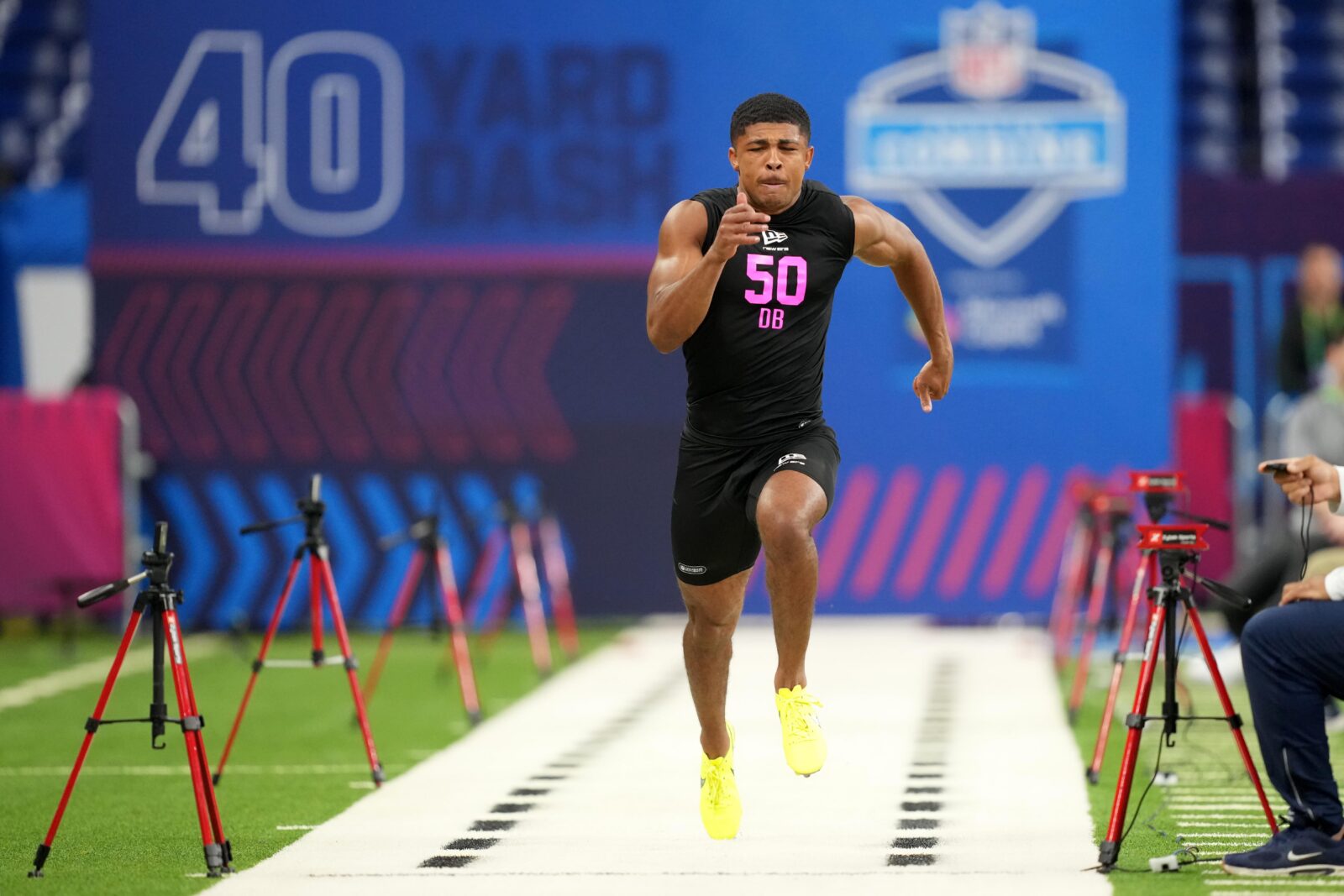
Skill challenges and pro-showings have seemingly lost their appeal.
What once thrilled GMs now lulls them to sleep. NFL teams pay more attention to impressive jumps than jumping into the playbook. Sadly, peak athleticism is slowly ruining the NFL draft.
Athleticism Doesn’t Equal Talent
What may seem obvious has become a fine line between a first-round pick and an undrafted free agent. Perhaps a cornerback can outpace any wide receiver on the field. Yet, as soon as that receiver makes one cut, that speedy defender is lost in left field.
Some things, like game sense, can’t be taught or coached. However passionate a coach may be, players either have it or they don’t. No amount of speed, strength, or dexterity can ever generate it. Yet fans are still left wondering why players’ development has fallen from its lofty heights of old.
In a new era of football, what separates the very best? Being faster and stronger is not as impressive as it once was. Training is better across colleges; growth in strength is more attainable for even the smallest developed athletes.
And yet, the NFL is trending in a treacherous direction.
History Repeats Itself
Most people remember the shocking choice of the Indianapolis Colts to draft Anthony Richardson. A painfully mediocre quarterback who failed to change Florida’s extended slump, Richardson had a whopping 6-6 record in college. His largest accomplishment was an 81-yard touchdown run that set a Florida quarterback record.
So, what did the Colts see in Richardson? It’s hard not to look at a 4.43 40-yard dash, a 40.5” vertical jump, or being 6-foot-4 and 244 lbs. Easily placing him with an athleticism score of 95, scouts were raving over his physical ability.
Yet, his weaknesses were just as evident, if not glaring.
Analyst Lance Zierlein described Richardson as having inconsistency and inaccuracy when throwing the ball. Additionally, Richardson exhibited below-average touch and ball placement, faced accuracy issues, and struggled to read coverage. Equally important aspects of a starting quarterback that a team should value more than his similarity to Cam Newton.
Despite this, Anthony Richardson and the Colts were not the first team to look through rose-colored glasses at freak athletes.
JaMarcus Russell, the Bazooka Joe before Joe Milton, was drafted first overall by the Oakland Raiders in 2007. Notably entering the draft at a towering 6-foot-5 and a half and 265 pounds, Russell was touted as a top quarterback prospect. Before the NFL was overrun with incredible athletes, a quarterback like JaMarcus Russell had owners and managers salivating at the mouth.
Nevertheless, Russell was no diamond in the rough. Clearly, he relied more on natural talent and cheeseburgers than dedication and time in the film room. Arguably, he had the lowest football IQ of any quarterback seen at that point. Despite his incredible hype, his short career ended with the Raiders, as no other team gave him a workout following his departure.
Priorities Continue to Degrade
Athleticism is crucial in every position on the football field. No debate. However, college athletes are progressively prioritizing being the greatest athlete while forgetting what makes them great football players. Look at Sonny Styles, for example.
A solid recruit out of Ohio State, Styles was projected to be a mid-to-late first-round pick for the right team. Surprisingly, Styles was once a safety turned linebacker who fit in comfortably on an elite defense. After a mind-boggling NFL Combine where he broke the linebacker record for vertical jump at 43.5″, Styles’ draft stock surged significantly. Now Styles is a projected top-5 pick after showing freak athleticism.
On the other hand, take Dillon Thieneman. An average safety out of Oregon, Thieneman had solid draft stock, easily a round three or four pick. However, after an impressive combine where he placed first among safeties with an 85 athleticism score, Thieneman is now a projected first-round pick.
Now, it’s not to say that these players won’t be incredible NFL players. Rather, they follow a trend of displaying incredible athletic performances that suddenly skyrocket their future potential. What about their game reads, their coverage breakdowns and their ability to memorize playbooks? Who steps up to read that veteran quarterback when he plays you with his eyes?
The greatest and most legendary players weren’t just athletic; they changed the way the game was played through their adaptability and game sense. Laying the foundation for new players, they showed what it took to be great. Sadly, this generation of players is slowly fading as the NFL continues to want the best bench pressers, who later turn into bench warmers.









Leave a comment