

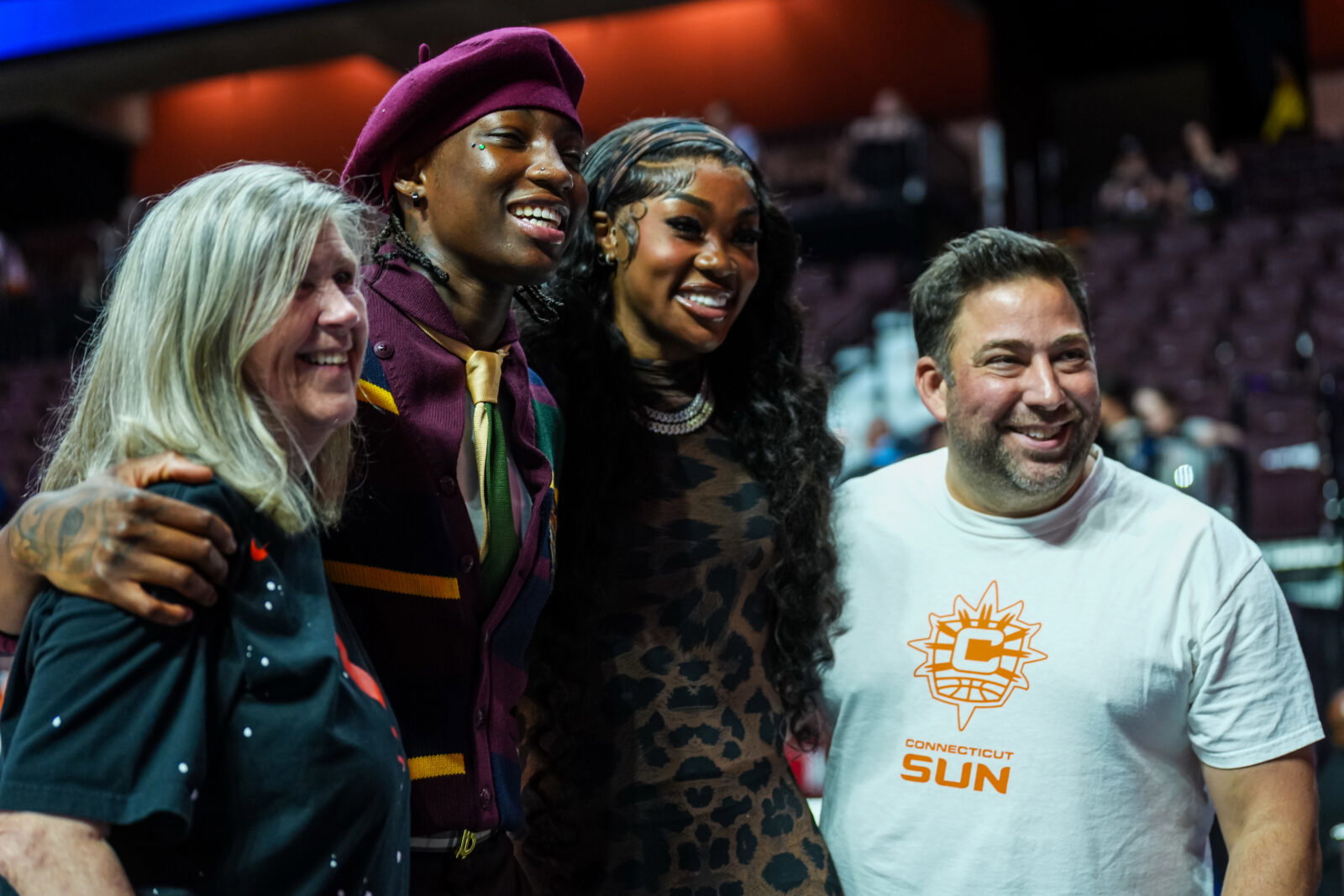
As the WNBA continues growing, more people are recognizing women’s basketball as a culture. Despite that growth, the WNBA faces one of its biggest issues: the hateful narratives surrounding it.
Social media is a huge aspect of what makes sports, especially women’s sports, a culture. Viewership for several women’s leagues, including the WNBA, continues to increase. Social media is only escalating that increase. It is the underlying evidence for the narrative that deserves to be pushed: athletes are not just athletes.
Saniya Rivers Is Going Beyond the Basketball Court
In an interview, Connecticut Sun guard Saniya Rivers gave her insights on how social media helps grow the WNBA. Rivers is incredibly active on platforms like Instagram, Threads, and TikTok. The guard discussed how social media can be one of the most useful tools when shining light on different sides of players.
“I think a lot of us aren’t just basketball players, but we’re women with personalities, and we have stories to tell,” Rivers said.
Across the league, players use social media to express interests that aren’t aligned with basketball. Seattle Storm guard Flau’jae Johnson embodies this duality, as she’s thriving in both her basketball and music career.
Back in April, Johnson dropped her single, “WOAH”, after being selected in the 2026 WNBA Draft. Social media was the tool she, like many other athletes, used to push forward her art.
“I’m sure [Flau’jae] inspires a lot of the youth because she’s showing that she can do both, and she’s doing them both well,” Rivers said.
The WNBA Is a League of Individuality
While the WNBA has a wide range of different talents, it also has a wide range of styles. Fashion plays a huge role in recognizing athletes’ individuality. Combining style with social media promotion lets fans see how women’s fashion doesn’t have a strict line between masculine and feminine. It’s a spectrum, and a testimony to the uniqueness of each player.
“I think we can display our femininity through basketball and through social media,” Rivers said. She is one of the many athletes across the league who use social media to express her style.
“Me, personally, before I leave the house, I look in the mirror, I tell myself ‘I’m fly, I look good,’ and I expect everybody else to think the same thing,” Rivers said. Following her rookie season in 2025, Rivers was selected to League Fits’ All-Rookie Team on Instagram.
If there were one word to describe social media, it’d be multifunctional. Not only does it allow athletes to express themselves. It also helps them better connect with fans.
Learning to Be Vulnerable
After losing her mom just before her rookie season began in 2025, Rivers learned what it meant to share that side of her life with the public. She discussed navigating vulnerability on social media when some topics hit incredibly close to home.
“I think me being so open and vocal about that, about my grieving process, my healing process, I think that’s powerful, and I think that’s a testament to how strong I am,” Rivers said.
Her courage in opening up on such a personal issue reflects the human beings that athletes truly are.
Social media is sentimental; it allows players to tap into their vulnerability. Fans use social media to gain insight on athletes they may look up to, allowing for a stronger, more personal connection to their icons. This connection further emphasizes that players don’t just live their lives on the court.
“I think I more so use [social media] to let other people know that it’s okay to grieve, it’s okay to cry,” Rivers said. “We’re human, we’re not robots. We have a heart, and it bleeds red.”
Understanding There’s a Balance
Unfortunately for Rivers and other players, tapping into vulnerability has led to some downsides. An overall effect of a growing league is that some fans believe they are entitled to knowing more about a player’s personal life. Fans will feel entitled to information athletes are not comfortable sharing.
“I definitely think it’s a little hard to find a balance between what you want to share and what you want to keep sacred,” Rivers said. Finding that balance is not just an issue that Rivers alone has faced.
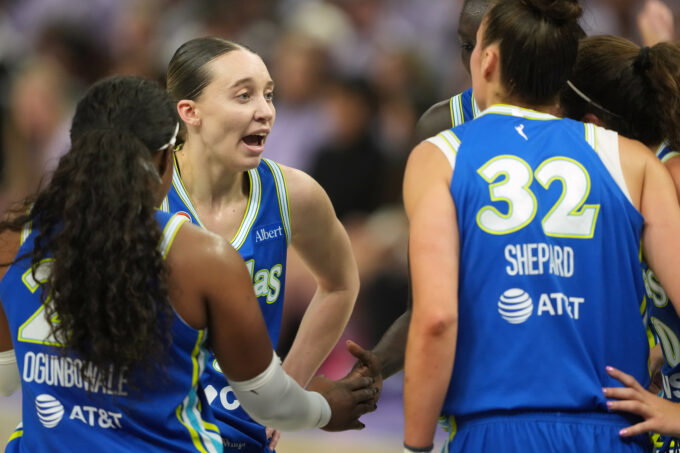
At the beginning of the season, Dallas Wings guard Azzi Fudd reunited with her former teammate, Paige Bueckers. Much of the conversation surrounding this moment dove into their personal relationship.
“I believe me and Azzi’s personal relationship is nobody’s business but our own, and what we choose to share is completely up to us,” Bueckers said in a press conference before the season began.
A Double Standard On and Off the Court
At times, ignorant behavior in the media treats women’s sports as nothing more than a joke. They expect women athletes, and women in general, to be lenient and ladylike with their responses to such disrespect. If a woman wants to keep certain business to herself, there’s going to be backlash — much more than a man would ever face. It’s a double standard.
Female athletes setting boundaries is slowly but increasingly becoming the standard. These assertions, the same ones men set for years, can lead to the public viewing women as too sensitive or emotional. In reality, that “sensitivity” was and will forever be athletes simply being humans.
The WNBA is a league of growth. Players like Bueckers and Rivers who put their foot down about what they do and do not want to share with the media help establish that athletes have standards. They don’t owe fans more than what they are comfortable sharing. Social media is about voice. These athletes are using theirs in the best way possible.
By standing up for themselves, they eliminate the parasocial relationships that fans are trying to create. The entitlement fans believe they have to know about players’ personal lives has the same effect as the entitlement people online believe they can use to disrespect players. This idea certainly isn’t new in the world of women’s sports.
An Emphasis on the Personal Narrative
“I don’t take any form of disrespect,” Rivers said. “[Fans] don’t know the real me. I’m a human being that has a heart, that has feelings, so sometimes I just get them off my back.”
With more stories surrounding the WNBA as a whole comes audiences that like to push false narratives. Some fans take one viral moment from a game and will run with it to come up with a story in their head about someone they don’t know at all.
Former Connecticut Sun forward Alyssa Thomas has spoken on this issue several times, most notably in a press conference following the Sun’s 87-81 win over the Indiana Fever during the WNBA Playoffs in 2024.
“Basketball is headed in a great direction, but we don’t want fans that are going to degrade us and call us racial things,” Thomas said. Much more recently, while playing for the Phoenix Mercury, Thomas faced online backlash after her flagrant two foul against Fever guard Caitlin Clark back in June.
“Now we’re being painted as thugs,” Thomas said following the incident. “There’s death threats out on us. It’s really unacceptable. It’s something that needs to change in this league, and I’m just really sick and tired of it.”
Unfortunately for athletes, especially Black athletes, more viewership equates to more hate. We’ve been able to see how certain players take it and respond through social media. As female athletes, these players already have targets on their backs. Having the courage to stand up for themselves using an online voice helps push the most important narrative of all: their own.
“My dad always told me that with bullies, you can’t just let them keep going,” Rivers said. “You got to let them know that they can’t treat you any type of way.”
Elevating the League for the Future
Social media’s ability to give players a voice they didn’t always have is the stepping stone. This small step is thus contributing to the greater push to move the league forward. This league is now over halfway through its 30th season. So much has changed in 30 years, but one of the biggest changes is how the league is talked about.
Social media is the tool that brings audiences back to what makes the WNBA the WNBA, which is the players. No outside noise, just their voices and their narratives.
“I’m hoping that the W[NBA] players and everybody else will keep using social media as a positive outlet,” Rivers said. “The world is cruel, but you can hope for the best.”










Leave a comment