

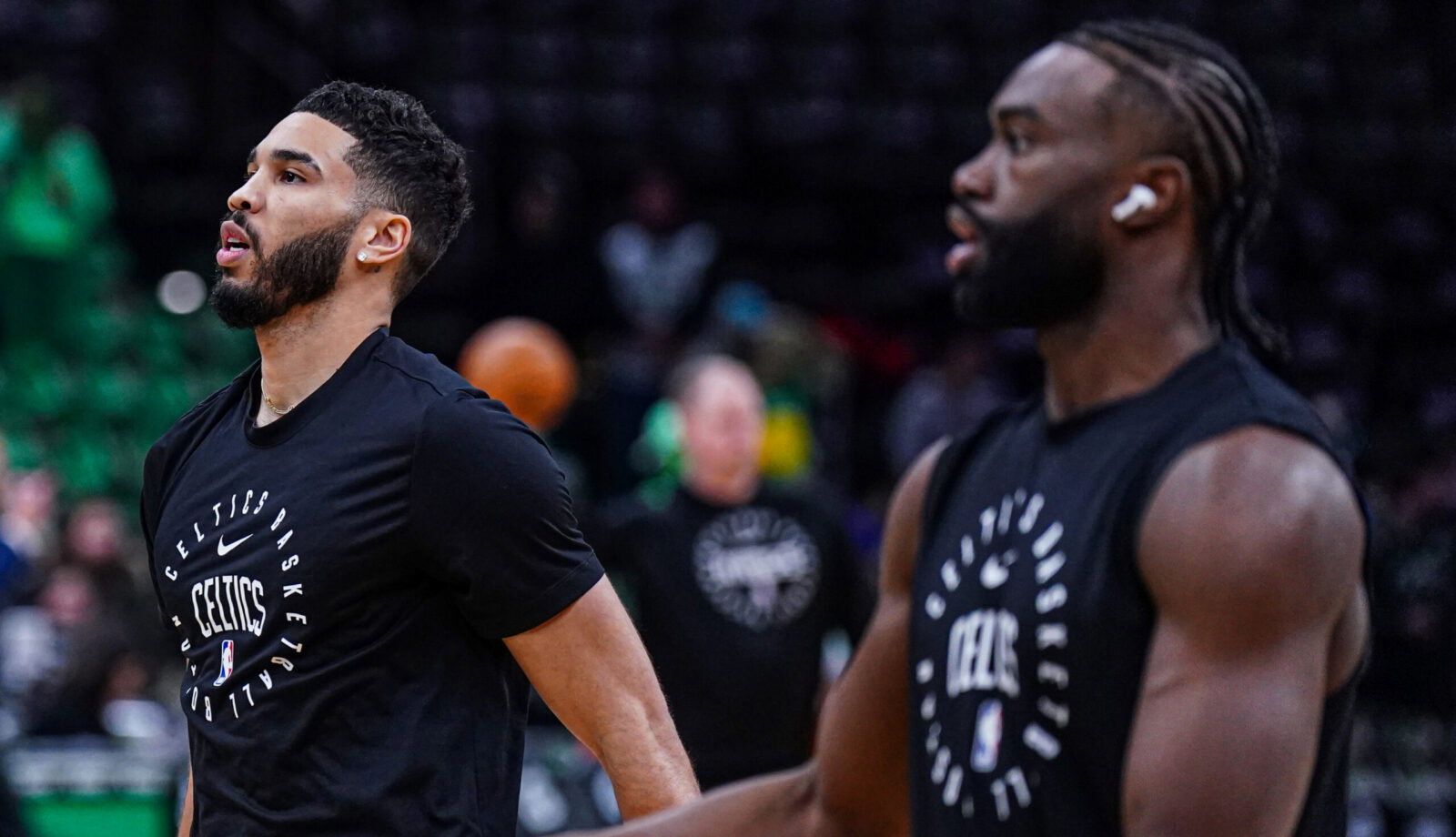
The Boston Celtics’ front office approached the 2026 offseason aggressively — but not as buyers.
Instead of making a push to acquire talent, Celtics president of basketball operations Brad Stevens did the opposite. He had an asset he was actively trying to sell.
Boston reportedly pursued Giannis Antetokounmpo, but only at a specific price: Jaylen Brown and, at most, a few other lower-leverage assets.
Brown’s inclusion in the Antetokounmpo package was an early hint at the decision Stevens had made: not only was Brown expendable, but the Celtics wanted to move him.
On July 1, Boston traded Brown to the Philadelphia 76ers for Paul George, two first-round picks, and two second-round picks. This return for a 10-year franchise cornerstone, who just finished sixth in MVP voting, is massively disappointing.
With that underwhelming return, Stevens made his intentions clear.
The Celtics are now officially, unquestionably, Jayson Tatum’s franchise.
Why Did the Celtics Trade Jaylen Brown?
The relationship between Brown and the organization appeared to be nearing its breaking point with another offseason of trade rumors. However, Boston’s front office being the party that has had enough comes as a surprise.
“Whether it was personal situations between the two players or whether it was just the on-court basketball fit, the Celtics had just made the determination that, moving forward, they can no longer win a championship with Jaylen Brown and Jayson Tatum,” ESPN’s Shams Charania said the following morning.
Charania has repeatedly stated that Brown never requested a trade.
In one of Brown’s final public comments on the Celtics before the deal, he said during a May 7 Twitch stream, “If it was up to me, I could play in Boston for the next 10 years.”
With three years remaining on his current contract, Brown had little leverage to force his way out even if he wanted to. The decision to move on was Boston’s.
The Celtics initially sought four or five first-round picks in exchange for Brown, per Charania. George and two first-round picks is obviously well below that asking price. It’s a stark contrast to their negotiations with the Milwaukee Bucks for Antetokounmpo, where they were entirely unwilling to move off their price.
Boston’s front office decided moving on from Brown was more important than maximizing the return.
Exactly what caused the relationship to reach this point may not become public for months — or even years. Whether it was an interpersonal issue, a basketball fit, or something else entirely, only those inside the organization know for certain.
After nearly a decade of building around the Jays, Stevens decided the team’s future belongs to Tatum.
Celtics Look to Tatum for New Identity
Not only did the Celtics suffer a historic collapse in the 2026 playoffs, but they looked truly lost as the ship went down.
Head coach Joe Mazzulla, after a tremendous regular season that earned him Coach of the Year honors, struggled to empower all of Tatum, Brown, and the supporting cast simultaneously. It was a tough task doing so while trying to bring Tatum back into the lineup in March, but the taking-turns elements of the Jays’ combination still reared their heads at times.
Truly maximizing each roster spot means getting a group of players who all enhance one another. The Celtics have about a decade’s worth of data to evaluate which player most elevates their teammates. Brown’s career season included significant growth in his playmaking for teammates. He still led the league in total turnovers (fifth in turnovers per game). His volume initiating, while improved, is not as great as Tatum’s.
It’s not that Brown wasn’t talented or that he doesn’t make players around him better — but the Celtics determined that he wasn’t at a high enough level in either capacity to justify an imperfect fit next to the player they evaluated as their best possible offensive engine: Tatum.
Building Around Jayson Tatum
The Celtics could have waited until next year, or even the deadline, to get a similar, if not better, package. Repairing the relationship would not have been easy, but it would have been doable. Even after learning the market was not in their favor, the Celtics were still intent on dealing Brown.
Stevens appears to have seen this as a necessary step to establish a new identity under Tatum.
In some ways, Brown’s leading the Celtics to 56 wins and the No. 2 seed may have reinforced Stevens’ belief that Boston’s infrastructure was strong enough to hold with one true superstar at the top of the hierarchy.
The Celtics’ +12.9 net rating (via DataBallr) with Brown off the court last season, in his career year, may be one of many indicators of why the organization could have reached this conclusion.
George will not replace Brown as an offensive engine. Instead, Boston is asking him to complement Tatum. Alongside Derrick White and Payton Pritchard, George gives the Celtics another smart secondary creator who is an excellent shooter, has strong defensive instincts, and can be efficient without high usage.
White and Pritchard’s expanded responsibilities last season have gone from a Gap Year experiment to a preview. Both excelled as decision-makers, generating shots for teammates and minimizing turnovers. Their growth last year elevated the players around them, a theme across the backcourt, George, and Tatum.
Mitchell Robinson’s arrival also reflects Stevens’ vision of surrounding Tatum with role players who can excel in clearly defined positions. His lob-catching radius will be a great tool alongside Tatum, who has thrived with rim-running bigs in the past.
The End of the Jays Era
As Tatum and Brown grew up in the NBA together, having two players capable of handling such hefty responsibilities made for a stellar winning formula that yielded incredible team success.
The Jays were a valuable collective in their formative years. Brown’s contributions to the Celtics, especially in helping close out their 2024 championship run (as if the other decade of excellence didn’t exist), speak for themselves.
The Celtics were spoiled having two All-NBA offensive engines, especially with so much high-end talent around them on the 2024 Finals team. But as several teams passed Boston by during its Banner 18 roster deconstruction, Stevens now needs roster flexibility to make up ground.
Brown was a pivotal part of the Celtics’ last decade. His legacy in Boston is stamped.
As Boston attempts to work its way back into the championship mix, Stevens felt dissatisfied with the team’s identity. It seems as though roster hierarchy was a concern of his.
After determining that the Celtics need to run through Tatum, he may have felt that Brown’s stature, coming off a career season, was a threat to that.
Brad Stevens Betting on Jayson Tatum
Jayson Tatum has lived in the NBA spotlight since leading a Celtics Eastern Conference Finals run in his rookie season. Pushing prime LeBron James to Game 7 for a chance at the Finals was the first indication of Tatum’s readiness for stardom.
Tatum has always welcomed those challenges as one of the self-proclaimed best players in the world.
As long as he is who he and Brad Stevens believe him to be, the Celtics should be in playoff contention once again next season, with improved roster flexibility for the future.
Trading Jaylen Brown did not make the Celtics better for next season, and it does not feel like a trade that can ever go down as a win for Boston. However, it made the Celtics’ intentions crystal clear: the franchise’s next title push will be with Tatum as the defined superstar.










Leave a comment