


On Oct. 13, the NBA announced a new multi-streaming platform alongside a revamped version of NBA TV. Four new shows from various parts of the basketball community were added: The Athletic Daily Show, The Front Office Show, Thinking Basketball, and No Ceilings NBA.
No Ceilings co-founder Tyler Metcalf has created something truly special, and his passion for basketball runs deeper than most people know.
Starry Wisconsin Nights
Tyler Metcalf was born in Wisconsin during the spring of 1992 to two loving parents. Unfortunately, they would later separate, but Metcalf was blessed with a younger half-brother after his father remarried.
“Me and my younger brother, we’re six years apart,” said Metcalf. “So, growing up we were a little rocky, you know, just because of the age gap, but obviously [we’ve] gotten closer as we got older.”
“And then my older stepbrother and I, we were pretty close, but you know, divorced parents, and you’re splitting time between houses, so you hang out when you can, and whatnot, but as you get older, schedules get busy.”

Growing up between two households, he was fortunate to have many friends from two different neighborhoods. His friends were always outside playing kickball or shooting hoops, just like most kids in the early 2000s.
“ [We would play] pick up hoops, or get five people together and go play a makeshift baseball game or something at the park, or football on the street. Other times, we found an open field, we would turn it into tackle, but otherwise, just a little two-hand touch,” Metcalf said.
“Neighborhood-wide games to play capture the flag, and that kind of stuff. Split the cul-de-sac down the middle, divide everyone up, and hope for the best.”

Three-Point Specialist
As he grew older, basketball became Metcalf’s favorite sport, and when the Milwaukee Bucks acquired Ray Allen via trade in the 1996 NBA Draft, it changed his perspective on basketball forever.
The Hall of Fame shooting guard revived the Bucks franchise after the conclusion of the Sidney Moncrief era in 1989. Allen’s influence touched everyone in Wisconsin, including the young Tyler Metcalf.
“From the jump, [my favorite player] was always Ray Allen,” said Metcalf. “Just the shooting, the athleticism, the confidence, I loved how that dude played. After the Bucks traded him away for Gary Payton ( and Desmond Mason), it broke my heart.”
The Power of Spectacle
In 2003, the 11-year-old Tyler Metcalf was devastated by the loss of his three-point marksman, but little did he know, he was on the verge of witnessing history.
“I pivoted and became a Pistons fan, and those early 2000s Pistons teams with Ben Wallace, Rip Hamilton, Chauncey [Billups], Rasheed [Wallace], Tayshaun Prince, I was head over heels watching those guys, their toughness, their team concept,” Metcalf said.
“You know, when I think back on it, it’s like, oh man, who’s my favorite? Like, I can’t pick between Chauncey, Ben, and Rip. Was that team my all-time favorite, or just a single player? It’d be tough to beat Ray.”
Detroit was an absolute powerhouse in the early 2000s, boasting a Hall of Fame duo with Billups and Wallace. Rasheed could easily be inducted today, making it one of the most stacked teams in NBA history.
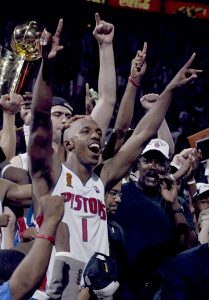
Metcalf’s parents admired his love for the sport and bought him tickets to a first-round playoff game so he could witness the spectacle of his favorite NBA team.
Happiness in the Palace
“[I remember] Just… just being in awe of being lucky enough to get that close, and appreciative of, especially at that time, my parents selling out like that,” said Metcalf. “It’s like this is [my] Christmas and birthday, and maybe the next Christmas present as well, and it was just really surreal, just to see the physicality and the speed that those guys played with. It’s just so much different than watching on TV, and it always popped for me.”
Playoff tickets are very expensive, no matter the team, and Tyler knew that even as a kid. Going to the game didn’t just shift his view of his favorite sport, but also taught him a life lesson he still remembers today.
“My entire family sacrificed a lot for all of us, my parents sacrificing their time, and shifting their work schedules to be pretty brutal hours, so they could spend as much time with us and try and go to as many sporting events or just school events — to be there as much as possible” Metcalf said. “It really instilled the importance of family, and the importance of being there for those who count on you, and following through on your commitments.”
From Wisconsin Cold to Minnesota Snow
Tyler Metcalf’s passion for the game was at an all-time high after attending the Pistons game. He played on his school basketball teams during middle school and high school. Unfortunately, he wasn’t blessed with a growth spurt, and he struggled on offense as a defense-first guard, leading to the end of his hoops career.
After high school, he attended the University of Minnesota as a finance major with a minor in sports management. His love for basketball had to take a backseat as he prepared for the ‘real world’.

“My parents were big on pursuing what you love, but also have a plan A, and have a safety net, because, unfortunately, sometimes not everything goes the way that you want it to go,” said Metcalf. “So make sure that you’re okay, and still have a career path and opportunities to make a living and support yourself and your loved ones.”
At 18 years old, he was enjoying the best time of his life, but his grades began to decline as he immersed himself in extracurricular activities on campus. The harsh reality of responsibility compelled Tyler Metcalf to look within himself.
“I was lazy and didn’t have my priorities straight. I was more focused on the social aspects and having fun, and not the importance of just get your work done. [Instead it was] just constant procrastination, ” Metcalf said. “You can get by in high school a little easier with that. In college, it’s a different story.”
Academic challenges were new for Tyler. Managing it was straightforward, but balancing social events with a college workload proved to be difficult.
“Early on, you get a little too into enjoying the weekends a little more than the classroom, but you do enough to get by, and then kind of reorient your priorities later on.”
“So I don’t think it was anything outlandish,” Metcalf said. “But I was able to find a community, a group of really close friends, who I’m so close to this day, luckily enough. And we just kind of went through the challenges of college together. We’re kind of always there for each other.”
The Education Of Experience
The humbling experiences of college motivated Metcalf to improve his behavior in the classroom. While becoming proficient with numbers during his courses, he interned for the University of Minnesota athletics department, allowing him to continue his passion for sports while honoring his parents’ wishes.
Working in sports at a Big Ten school reaffirmed his future goals, and after graduating from the Minnesota in 2014, Metcalf secured an interview with Minnesota United FC. At the young age of 22, he was hired as a Marketing Assistant for the 2014-15 season.

“I just applied and interviewed, and I initially joined before they got promoted up to the MLS, so they were still in that like Tier 2,” Metcalf said. “So, you know, they were just looking for help, really, and I applied at the right time. I was able to get in, and then stayed with them for a couple years after that.”
Exploring the franchise gave him a new view of professional sports. By 2017, Minnesota United had moved up to the actual MLS.
Sadly, as time went on, Metcalf discovered that the behind-the-scenes world of sports didn’t match the dream he had as a kid.
“It is far less glamorous than you would initially think. There’s just a lot of stuff that goes on behind the scenes in terms of game day ops and marketing.”
“The front office stuff is the sexy stuff. There’s a lot that goes on on the business side, fans and people in the industry don’t have a clue of, and there’s just so much that goes on to put on those singular events,” said Metcalf.
Metcalf Makes It Back to Basketball
It wasn’t all bad though. Working with the franchise and witnessing the production of a world-class sports team ignited a passion in creating content for Metcalf.
But even though he was enveloped in soccer, he couldn’t shake his first love of hoops.
That same year, he started writing basketball content for Hashtag Basketball, using it as a way to express his ideas.
His love for the game by this point in his life had been redefined by his maturity, informed by lessons from college and his brief taste of the ‘real world’.
“With Hashtag, it was something where I was like, I’m watching all these games, I have these thoughts, I’m doing personal draft rankings on my own, I’m not putting it out anywhere, screw it, let’s see if someone will take my stuff,” Metcalf said.
“And they did. Joey over at Hashtag was awesome. Really awesome editor, and can’t thank him enough for just being like, ‘yeah, sure’.”
The Trials and Tribulations Of Creativity
As writing became part of Tyler Metcalf’s daily routine, so did the struggle to find his voice. Like other writers, the proverbial wall of creativity was a constant obstacle for Metcalf, and having his ideas on display for the world to see was an adjustment.
“The biggest change was just kind of getting used to having my thoughts and my words public, and trying to find my voice when writing, because as you know, that can be really difficult,” Metcalf said.
“Your first thought is like, ‘Oh well, I know how I talk,’ and then you start writing, and I’m like, ‘this doesn’t make any sense.’ Like, ‘who would want to read this?’ So kind of getting over that initial hesitation of ‘what’s the point of it’ and just doing it.”
Metcalf continued to master his craft over the next few years.
“And then continuing to do it, getting those reps in, trying to find my voice, and figure out what I want to say, asking ‘is this something that’s worth writing an actual article about, or can it be a tweet?”
“And it’s like, if it can be a tweet, it’s gonna be a crappy article,” Metcalf said. “So just kind of figuring out what matters, what’s worth saying, and if I’m the right voice or have the right mindset to say it.”
Tyler Metcalf — NBA Scout
Eventually, he developed a niche in player scouting. Metcalf created Hashtag’s first-ever draft guide and compiled a list of 60 players based on his own research. His cerebral approach increased his notoriety, prompting other content creators to invite Tyler onto their podcasts, giving him even more exposure.
“ I’ve always loved the whole concept of team building and player development and individual growth, and all of that kind of stuff, and trying to just watch the game and enjoy the X’s and O’s,” Metcalf said.
“I’ve never tried to pretend to be an X & O’s master or anything like that, there are far smarter people, and I’m not gonna bother trying to call out plays or diagram stuff .”
His humility kept him grounded and his work sharp. Metcalf’s kind personality, combined with his ability to create unique visual content and analyze players, led to a life-changing opportunity for the then 29-year-old.
The Creation Of No Ceilings
While the world was still recovering from the Coronavirus pandemic in 2021, Tyler Metcalf was honing his craft more than ever. His reputation was at an all-time high, and one day received a message about a potential opportunity.
“Around that time, I was kind of thinking of leaving Hashtag anyways, and I’m just like, ‘do I start my own website, or my own Substack?'” said Metcalf.
“And then Corey Tulaba, who I’d gotten to know a little bit over the years, came to me and said, ‘Hey, me and Tyler Rucker are thinking of combining a couple of people, and starting a company, and kind of pooling all of our draft knowledge and followings and stuff into one site.”
That trio, now including Metcalf, along with their Director of Communications, Albert Ghim, collaborated on what their brand name should be as their launch date approached, and Ghim began generating ideas.
“I’m just so bad at naming things,” said Metcalf. “As our launch date approached, and we’re trying to lock down websites, and file paperwork for our business, we were like ‘guys, we need a name’, and I think, just one day, Albert Ghim just started throwing out a whole bunch of names, and, then one day he has a list of like 20 or something, because he’s creative and clever like that and we we’re like ‘[how about] No Ceilings?’ and it rung.” 
After settling on a name, they began growing their platform during the 2021-22 NBA season. The first year offered its own share of battles for the newly minted media company, but their experiences brought them closer together.
“[We learned] it’s hard. It’s really hard, and sometimes you just get lucky, because we’re spread all over the country, and Corey and Rucker didn’t have to present the opportunity to me, they didn’t have to share their idea with me at all, but they had appreciated some of the work that I did, and thought I would be a good fit with them, and be a good partner to build this thing with,” Metcalf said.
“But throughout building [No Ceilings] we’ve had a lot of struggles both good and bad, and all that kind of stuff. It’s like every year, we need to communicate, and not that we don’t communicate, we talk all the time, but you know sometimes, especially early on, it’s like, oh, ‘I don’t want to bother these guys with that stuff’, but then it’s always like, well, no, just speak up if you need something.”
The Fruits Of Lifelong Labor
Their scouting show, No Ceilings: Film School, showcased Tyler Metcalf’s basketball expertise and game knowledge. Metcalf performed well, creating a weekly online column and helping the platform gain subscribers at a rapid rate. 
As the platform grew, so did its staff. They recruited a supporting cast of world-class talent from across the basketball community, including Nathan Grubel, Stephen Gillaspie, Ignacio Rissotto, and many other rising stars.
By 2025, the platform had become a household name in basketball scouting. Their quick ascent caught the NBA’s attention after just four years together, and all their lifelong dreams finally came to fruition after announcing their partnership with the league on Oct. 13.
“It was really surreal and really humbling,” said Metcalf. “It was a cool moment for the team once we were able to announce that, because it was just a sign that whether you love our stuff or you don’t, or you hate our rankings, or whatever, we’re trying to do it in the right way.”
“We’re trying to present these guys’ abilities and their potential in an informative way, where you’re learning something, but you’re also enjoying it, and having fun, and trying to be entertaining.”
Reaching the global stage has secured their position in basketball media, which is highly challenging in today’s digital age. Operating on the same level as the New York Times truly reflects their potential, and when asked about working alongside The Athletic, Metcalf responded:
“To be included with not just the NBA, but [also The Athletic], it helped take care of a little bit of the imposter syndrome that inevitably creeps into everything, where it’s like, ‘are we doing the right thing? Is this real? Should we be here? Do we matter? Do people value our opinions?’…I guess we’re doing something right.”
No Ceilings a Full-Time Gig?
The entire staff has carved out a future in basketball, but what sets No Ceilings apart from other media companies is its camaraderie. In a world filled with millions upon millions of dreamers, they formed the right team based on authenticity and originality.
It’s a special dynamic that ensures they remain together for the distant future, and Metcalf is excited about what’s to come. With two months remaining in the year, he shared his hopes for next year and beyond.
“Probably to make [No Ceilings] a full-time thing, and make this our number one priority,” said Metcalf on his team’s plans for the company. “[We want to] be able to support our families with it by continuing to build out our video presence and our audio presence.”
“I think we’ve really cemented ourselves as one of the go-to places in terms of written stuff, but there’s always room to grow, both in that and especially on stuff like YouTube and what those opportunities in the video sphere could continue to grow out into.”











Leave a comment