

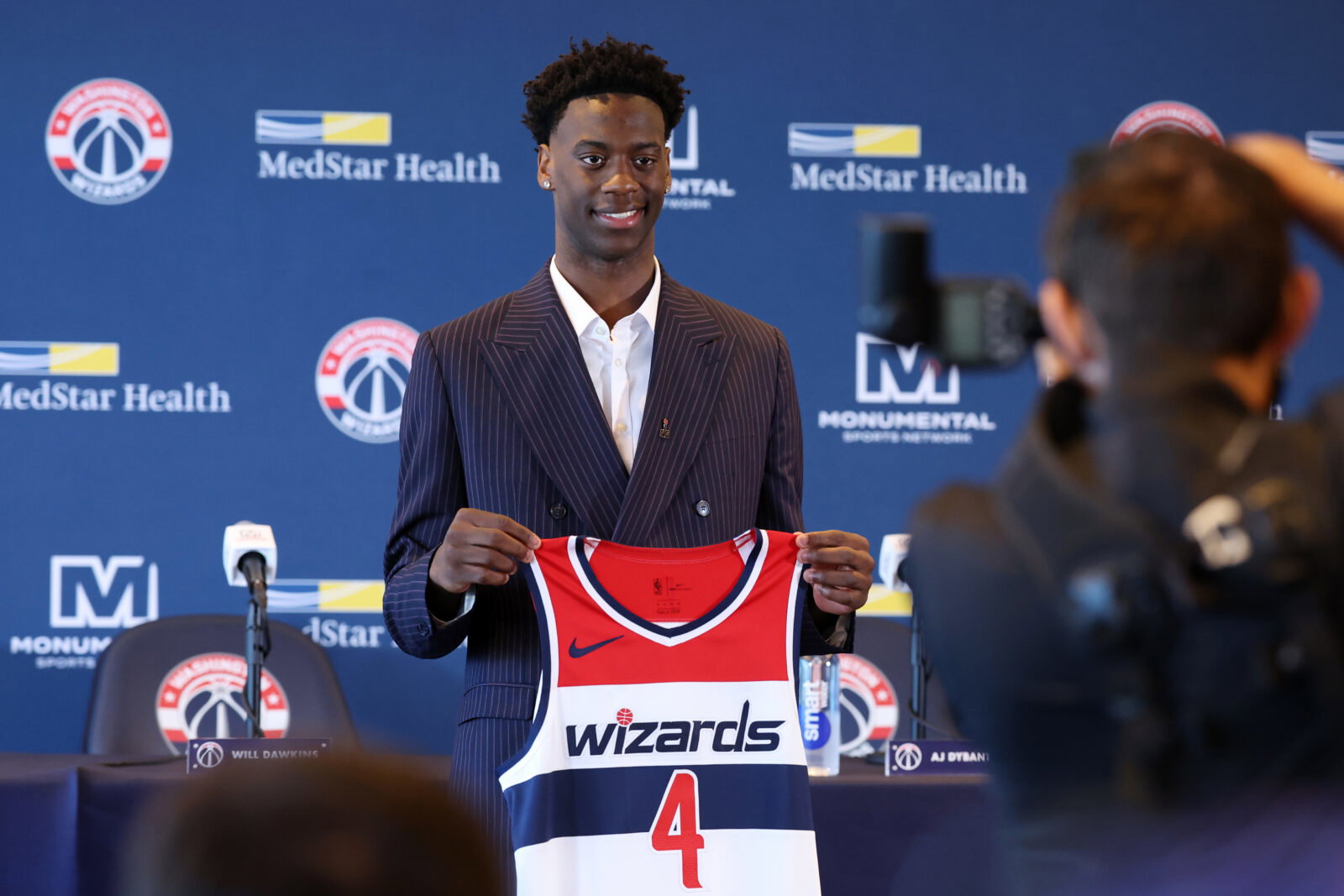
The Washington Wizards concluded their most anticipated Summer League season in years with a 3-2 record. The excitement centered around No. 1 overall pick AJ Dybantsa making his debut, but he wasn’t the only story.
Will Riley embraced the starting point guard role, Tre Johnson looked like he’d outgrown Summer League competition, and hungry reserves proved their worth.
This year’s summer squad offered a list of what to expect for next season.
AJ Dybantsa’s Game Will Translate
The top pick will always be the talk of July hoops due to sky-high expectations. Dybantsa verified that those expectations weren’t wild dreams.
In his debut game, he immediately etched his name in the record books. He scored 27 points, tying the most points in a Summer League debut by the first overall pick. The scoring explosion mirrored his college play, which is both a good and bad thing.
The enticing aspect of his game was the head-down approach to the rim. Dybantsa’s first points came from breaking a double team, then scoring over the taller Orlando Robinson at the rim. He quickly topped that tough reverse layup with a two-handed poster after a leap in which he seemed to be floating forever.
The defense was also encouraging. Entering the league, there were questions surrounding that part of his game. Everyone knew he had the tools to be a pest on defense — he’s a 6-foot-9 athletic freak. The next step was combining his physical gifts with effort. He did exactly that with two steals and a block. He kept his hands moving, made opponents uncomfortable, and even surprised Blake Hinson with a block from his blind spot.
A.J. Dybantsa’s Shooting is Worth Monitoring
The other thing that hasn’t changed since college is his struggles with shooting. Dybantsa has always generated offense at the rim, while also being a confident shooter from inside the three-point line. mid-range shooter. However, in Vegas, he only drained four of his 13 mid-range attempts.
Dybantsa’s numbers outside the arc weren’t pretty either. He went 1-11 in two games. Jump shots are a substantial part of his shot diet, so these stats are a little alarming. As defenses begin to load up on his drives, developing a distance jumper will become increasingly important.
But there’s no need to push the panic button three months before the season — Summer League efficiency usually isn’t great for top picks anyway. On the upside, his aggression led to 14 trips to the free-throw line (minimized by the Summer League’s single free-throw experiment).
So, Dybantsa’s short Summer League stint confirmed what fans already knew: he’s an elite interior scorer with clear room to grow on the outside. He has what it takes to bring Washington out of the gutter and be the best rookie in a stacked class. Two games were all he needed.
Will Riley Is Arriving
Riley was a quieter member of the Wizards’ young core for much of his rookie year. That all changed when he broke out in the second half of the season and put up the big scoring numbers Washington envisioned when they acquired him. So coming into Sin City, Riley was on many fans’ radars, and he proved his worth.
Against Utah, he recorded 18 points. Riley also made the game-clinching layup after a slick half-spin to lose Cody Williams. It was an impressive return to the court for the sophomore. But two days later, he stole the show.
Against Sacramento, Riley exploded for the game-high 32 points on 6-8 shooting from deep. He played comfortably, driving fluidly through the lane and relocating for open jumpers. That confidence is a surefire indicator that he is ready for more minutes next season and can elevate his game further.
There are signs off the court pointing to his ascension as well. The Wizards are keen on improving as a collective during the summer, referring to the offseason as the “Jump Season“. Riley himself said he’s aiming to bulk up, too, which would allow him to become more physical and grow from his 186-pound Draft Combine weight.
Riley’s stats last year were the indicator. His performance this summer is the proof. Following this pattern, next season means yet another advancement.
Beekman, Livingston, and Trimble Can’t Be Overlooked
A known fact that’s worth rementioning: Summer League isn’t just about lottery picks. Often forgotten are G-League players and undrafted rookies alike fighting for a chance. Reece Beekman, Chris Livingston, and Seth Trimble all fought hard this summer. There won’t be space on the roster for all of them, but they may be carving out cases for two-way contracts.
Beekman is a scrappy, smart point guard who is never in a rush. He looked to be in complete control any time he operated the pick and roll, racking up six assists per game. Four of his 14 assists against Atlanta came from putting dunks on a platter for Felix Okpara. Add to that his blazing 41.7 percent clip from distance and two steals per game, and Beekman exhibited all-around talent.
Livingston can be described similarly. He played all five games and averaged 14.4 points on striking 52.9 percent and 41.7 percent shooting splits. The beyond-the-arc shooting is promising, but his physicality is what really stood out. Livingston took on the opposing team’s best wing with conviction and had something to prove when he guarded them. In doing so, he accumulated 1.2 steals per game, a figure that is hard to be mad at.
That’s a perfect segue to Trimble, who, though a premier scorer for North Carolina last year, earned playing time by ball-stopping. He defends with a sense of vigor on the perimeter, creating eight steals for himself in Vegas. And don’t count out blocks just because of his 6-foot-3 frame — Trimble’s rejection of former teammate Henri Veesaar‘s dunk defied logic. This isn’t to discount his offense either, though. His burst for 24 points against the Clippers electrified the starting unit, but Trimble’s shaky average of 26.7 percent from distance is worrisome.
Tre Johnson Showed All the Right Signs
From October to January of last season, Johnson was averaging 12.9 points per game on 39.3 percent shooting from three. From February to April? 10.9 points per game on 29 percent shooting from three.
The big scoring nights before the All-Star break came to a screeching stop, and Johnson ended the season with questions surrounding his consistency. Everyone knew the offensive ability was still there, but could it stick? His lone appearance in this year’s Summer League gives the idea that it will.
Johnson made fools out of the Jazz with 26 points in 28 minutes. It looked utterly too easy. He took on drives to the rim with noticeably more aggression than last year and flowed into mid-range jumpers. What hurts his efficiency are the grandiose pulls from the logo, but he was all about the inside that night.
Tre Johnson Will Take the Leap
Johnson’s 60 games last year mean something, but not everything. It was a bit of a mixed bag performance-wise, but it’s important to remember how incredibly early he is in his career. That 28-point outing could be a signal of what a healthy restart will look like for him in year two.
Johnson was actually creating a lot of on-ball offense against the Jazz, but with Trae Young and other strong pieces surrounding him, he will be able to relax a bit off the ball.
If there’s one takeaway to temper the excitement, it’s that his defense is still on the weak side. There’s no way to be sure that it’ll change by October. But it’s still heavily outweighed by his offense. That night suggests a jump is coming. Maybe not to a first-option role like those preceding him in his draft class, but an elite complementary scorer every serious team needs.
All in all, it has been a productive July for the Wizards, which means that much more for the page-turning 2026-27 season.









Leave a comment