

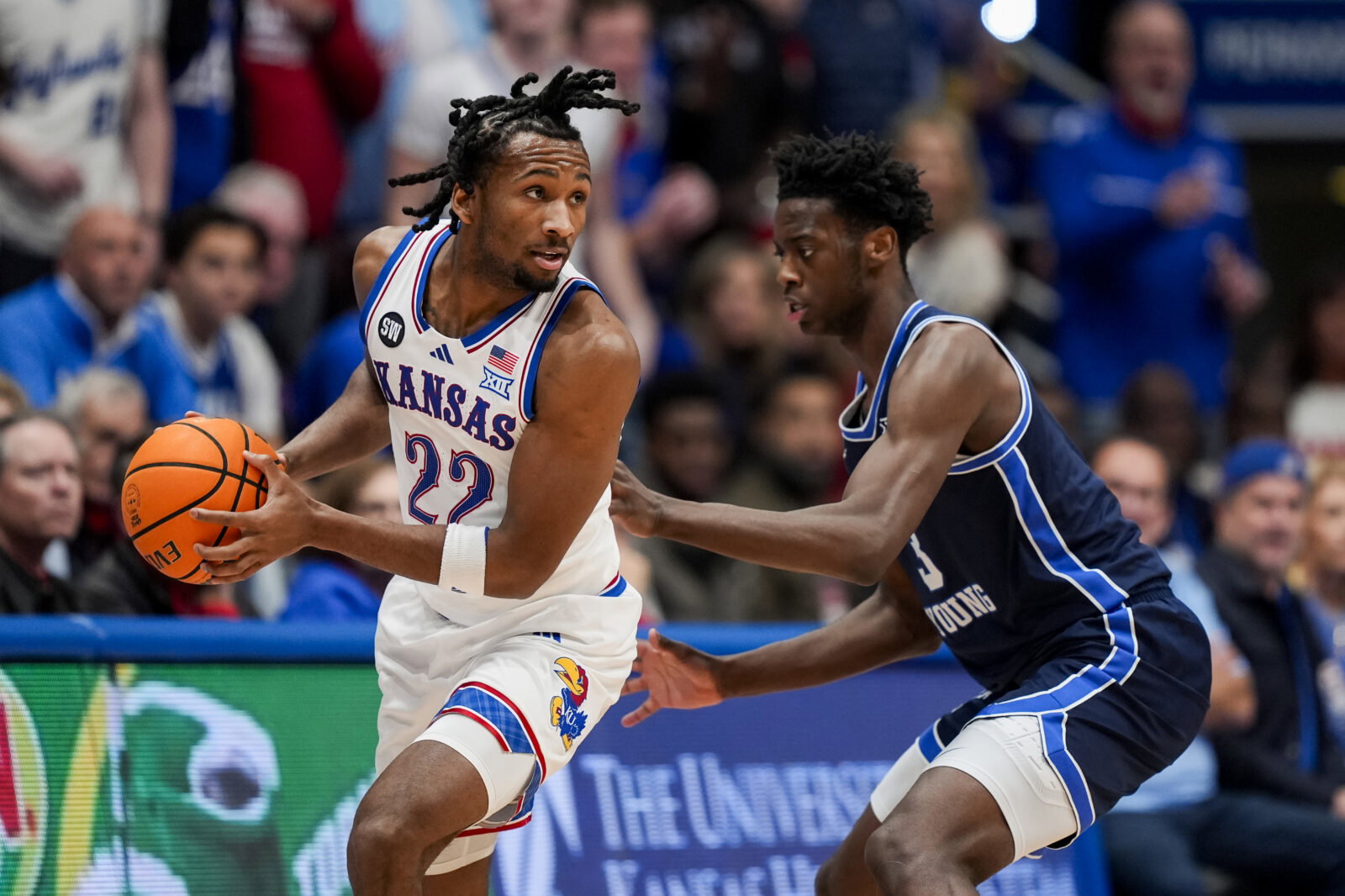
Few events in sports capture the attention of fans quite like the NCAA Tournament.
March Madness delivers everything: Buzzer-beaters, Cinderella stories, and the kind of unpredictability that keeps viewers glued to their screens for weeks. As a result, it turns casual viewers into die-hard fans every spring.
For many fans in Dallas, that excitement has come at the perfect time. With postseason hopes gone, fans are now studying prospects. They are also imagining which college stars could soon be wearing a Mavericks uniform.
With this in mind, here are the five best fits for the Mavs in this upcoming draft
No. 5: Cameron Boozer, F, Duke
This is not a dig at Boozer’s skillset. Averaging 22.4 points per game and 10.3 rebounds per game, Boozer is just one of 14 players in all of college basketball to average a double-double this season. He’s also the only player in the nation to average a double-double with 20 points a game.
This is merely about Boozer’s fit on the Mavs, as they already have another ball-dominant forward from Duke in Cooper Flagg. In addition, Boozer’s slow foot speed would hurt a Mavericks team that plays best in transition.
Boozer didn’t disappoint in the tournament, as he averaged 22.5 points per game in four games. However, Duke largely underperformed in the tournament and struggled in their first three games against Siena, TCU, and St. John’s. In addition, in their Elite Eight matchup against UConn, Boozer’s Blue Devils blew a 19-point lead, losing on a game-winner.
The team that drafts Boozer will be getting an amazing talent. There is no denying that. But Boozer would not be a great fit on the Mavericks.
No. 4: Caleb Wilson, F, North Carolina
If drafted by the Mavericks, Caleb Wilson would be the player Nico Harrison thought he was trading for in Anthony Davis. A true two-way forward, Wilson averaged 20 points per game, 9 rebounds per game, and 1.5 blocks per game for the Tar Heels this season.
While Wilson plays the same position as Boozer, they are very different players. As such, Wilson’s style of play complements the Mavericks better than Boozer’s.
Wilson’s athleticism makes him a natural fit in transition. He runs the floor comfortably and can finish above the rim. Boozer, by contrast, does most of his damage in the half-court. Wilson also doesn’t need the offense to run through him. Additionally, he can rebound, hustle, defend, and finish.
Unlike some prospects in this class, Wilson could contribute immediately without forcing Dallas to adjust its style of play.
Unfortunately, Wilson was out of the tournament with a thumb injury. Thus, Mavs fans were robbed of getting to watch him in March. However, those who saw him throughout the season in Chapel Hill know what he’s capable of and how high his ceiling is.
No. 3 Darryn Peterson, G, Kansas
Possibly the most polarizing prospect in this year’s class, Peterson averaged 20.2 points per game in his lone season in Lawrence.
On Peterson’s best day, he’s arguably the best prospect in the class. He was one of the best shot-making guards this season, and a 1-2 punch of Kyrie Irving and Darryn Peterson in the back court would be lethal.
However, there is a reason Peterson is polarizing. Peterson missed 11 games this season with what he and the Jayhawks called “traumatic full-body cramping.” Furthermore, Peterson took himself out of games against BYU, Iowa State, and Oklahoma State. Some scouts question if these are lingering issues that will hinder his NBA career. Others questioned Peterson’s effort and called into question whether Peterson was load managing his injuries.
Peterson played two games in this year’s tournament, scoring 28 and 21 respectively. His season, like Boozer’s, also ended on a game-winner, this one at the hands of St. John’s.
If Peterson reaches his full potential, he could become the most talented player on this list. But availability will ultimately determine his value.
No. 2: Darius Acuff Jr., G, Arkansas
Darius Acuff Jr. put the basketball world on notice after his game against Alabama on Feb. 18. Playing in all 50 minutes of a double overtime game, he shot 60% from three and scored 49 points. That game showed what Acuff can do. He can be the driver of the offense and register double-digit assists. But when he needs to, he can take the ball and take over the game.
Acuff finished the season with 23.5 points per game and 6.4 assists per game, both ranked top 15 in the nation.
If drafted by Dallas, Acuff would be able to share the floor and learn under one of the NBA’s best point guards in Kyrie Irving. That situation would allow him to develop at a comfortable pace. Meanwhile, he could still contribute immediately as a second or third playmaker along with Cooper Flagg.
Acuff continued his amazing play in the tournament, averaging almost 30 PPG in three games for the Razorbacks, including 36 against a sneakily dangerous High Point Panthers squad.
Though he may not have the highest ceiling in this class, Acuff’s fit, reliability, and playmaking make him one of the safest selections on the board.
No. 1: AJ Dybantsa, G/F, BYU
AJ Dybantsa is the perfect complement to Cooper Flagg and Kyrie Irving.
Dybantsa was the nation’s leading scorer at 25.5 points per game. He also averaged eight rebounds and 3.5 assists per game, showcasing his ability to impact the game in multiple ways.
At 6-foot-9 with elite athleticism, Dybantsa has the tools to become a true two-way star at the next level. He can score in transition, create his own shot in the half-court, and defend multiple positions. His versatility allows him to impact the game whether he has the ball or not. This trait separates great players from simply productive ones.
He complements Flagg by being another frontcourt presence that defenses must account for, which would allow both players to attack offensively. He also creates opportunities for Irving by giving him another scoring forward to play off of.
In his lone March Madness game, BYU was upset in the first round by Texas despite his 35-point effort.
Simply put, with his size, athleticism, and scoring ability, Dybantsa has a chance to be a generational player in the NBA.
Draft Day Decision
Ultimately, the Mavericks’ decision may come down to which of the stars is available at their pick. However, with Cooper Flagg at the helm, Dallas is starting to establish a new core and a new identity. This draft gives them the opportunity to build upon their new culture.
Whether they choose to prioritize fit, upside, or reliability, this draft could shape their future for years to come.











Leave a comment