

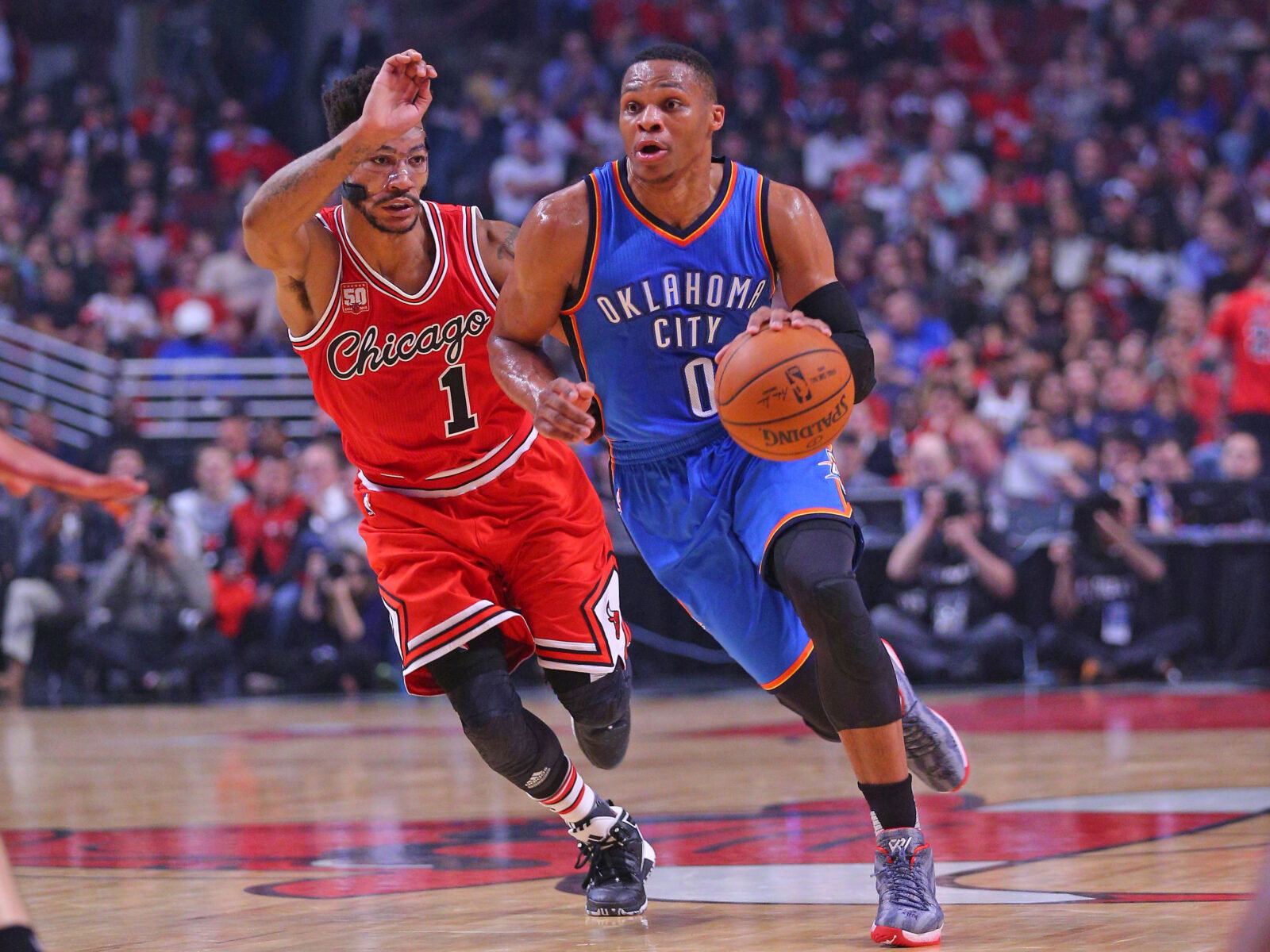
As a hardcore Derrick Rose fan, I feel nothing but gratitude for having the chance to watch Russell Westbrook play. Both guards played with the same relentless, full-throttle intensity that made possessions feel personal.
Rose bottled that fury in a purer, more explosive form. But Westbrook stretched it across more seasons than most bodies could handle and operated like a freight train with no guardrails.
Watching Westbrook felt like seeing an alternate version of the same engine. One that refused to quit even after his prime years faded.
Westbrook and Rose Shared the Chaos of Relentless Play
Rose and Westbrook attacked the game in similar fashion: head down, shoulders square, and no regard for the consequences.
Rose’s 2011 MVP season is still the gold standard for that style. He was quicker off the dribble, more explosive in the paint, and played with more grace that could explode on a dime.
At his peak, Rose bested Westbrook. The numbers and the eye test both say so. Rose averaged 25.0 points, 7.7 assists, and made All-NBA First Team while leading a young Bulls squad to a Conference Finals. Westbrook was already a star by then but hadn’t yet become the force he would later be.
What Westbrook lacked in the early part of his career, he made up for with pure stubborn volume. He just never stopped. Night after night he hunted triple-doubles like they owed him money. That same unrelenting motor that Rose fans recognized in his game was on full display in Westbrook for more than a decade longer.
Longevity as Its Own Kind of Victory
Rose’s body betrayed him. The ACL tears, frequent injuries, and years spent fighting just to stay on the floor sting to this day. Westbrook’s body also took a beating, but he was able to keep elevating his game.
He posted seasons of historic usage and rebounding as a point guard well into his thirties. Where Rose’s peak was brighter and more beautiful, Westbrook’s career volume and durability represent a different kind of accomplishment.
One man reached a higher ceiling. The other refused to leave the building.
The purest example of that refusal came in 2015. Late in a game against Portland, Westbrook took an accidental knee to the face from teammate Andre Roberson while scrambling for a rebound.
It left a physical dent in his head from a fractured zygomatic arch.
Most players would have been done for weeks. Westbrook had the surgery and returned days later wearing a protective mask. Within four days, he dropped a then-career-high 49 points with 15 rebounds and 10 assists. That’s the version of no quit that turns stubbornness into a legend.
There is something deeply satisfying as a Rose fan about seeing that type of shared play style survive longer than anyone expected. Westbrook’s game was never as pretty as Rose’s was at his height. It was louder, more chaotic, and occasionally self-defeating.
But the effort never wavered, and that matters.
Stubbornness and NBA Love Don’t Always Mesh
Westbrook’s stubbornness is both his greatest asset and his easiest target for criticism.
He clung to habits like high-usage midrange pull-ups, defensive gambles, and the occasional refusal to adjust long after the league’s style evolved past him.
That same refusal to yield is what kept him relevant when other competitors faded. It’s what got him back on the floor with a repaired face before the swelling fully settled.
Some would call it pigheaded. Fair enough because it’s true. It’s also the reason he piled up triple-double records and All-Star awards while still playing with the same fury that once defined Rose.
Rose, by contrast, earned something rarer…genuine affection from around the league. Players, coaches, and even opposing fans softened when speaking his name. The injuries humanized him.
The quiet professionalism and visible pain just to stay upright created a protective fondness Westbrook never quite received.
The difference is real, and it’s ok to acknowledge without pretending it erases Westbrook’s accomplishment.
Westbrook Is the Familiar Flame That Never Went Out
I didn’t root for Westbrook the same way as I did for Rose. But watching Westbrook was a reminder that the style Rose made famous didn’t die with his injuries. It just found a different, longer-lasting host.
Both versions of that relentless guard play deserve appreciation. As a Rose fan, I’m grateful I got to see the second one keep going.









Leave a comment