

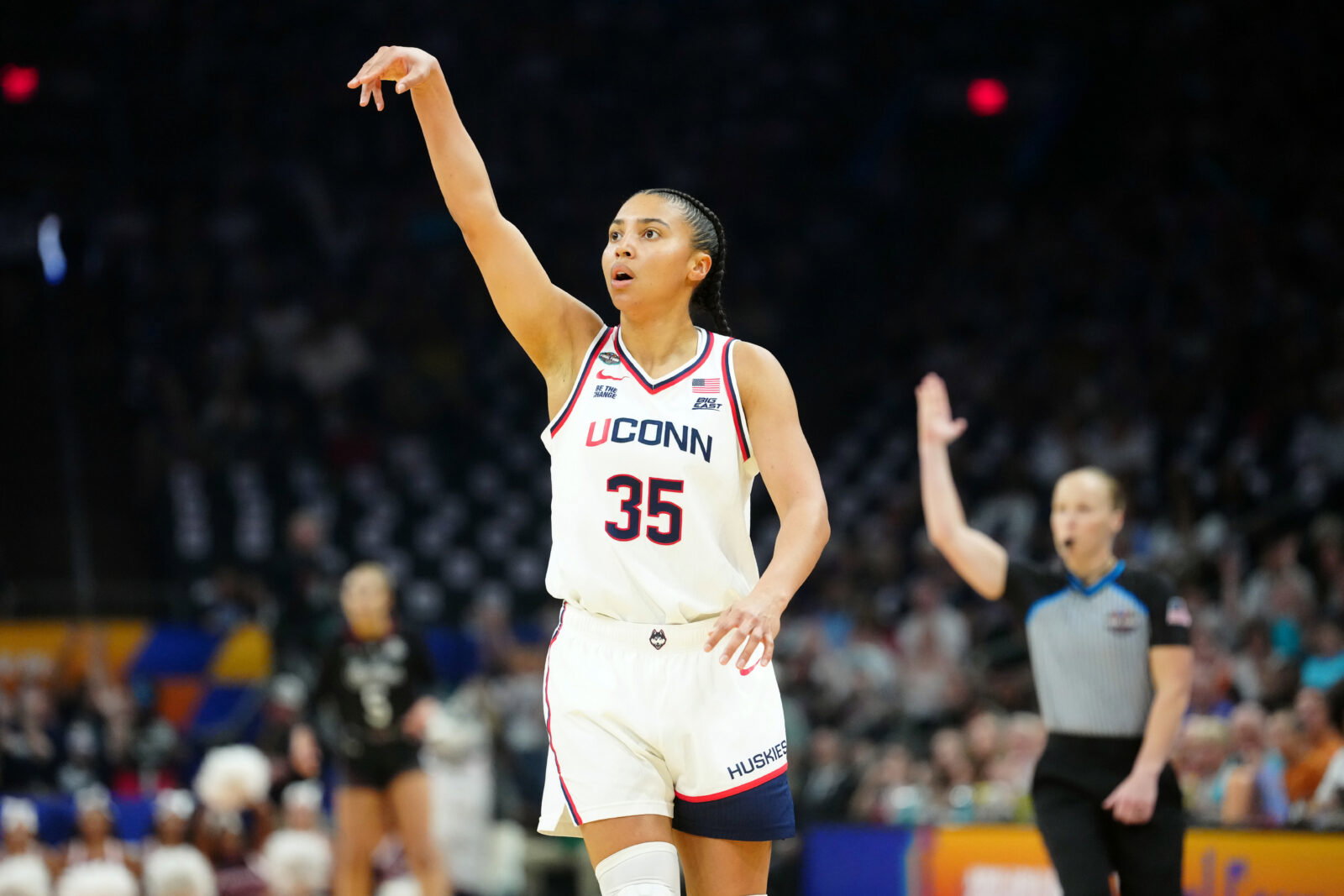
As the clock winds down toward the 2026 WNBA Draft, the conversation surrounding Azzi Fudd as the No. 1 pick continues to gain momentum.
This reflects a league that is redefining the landscape of women’s professional sports. Yet, unlike the relative certainty surrounding recent No. 1 selections such as Caitlin Clark in 2024 and Paige Bueckers in 2025, this year’s class enters with far less consensus at the top. Even amid that uncertainty, however, one narrative has undergone a dramatic shift. What was once framed as a “what if” surrounding Azzi Fudd — largely due to injuries — has evolved into a far more compelling “why not?”
In a draft class loaded with talent, Fudd increasingly stands out as both the safest selection and the prospect with the highest ceiling. This reality is reflected in growing momentum across the sport. It includes projections from ESPN that place her atop draft boards.
With Fudd anchoring an undefeated, dominant UConn Huskies women’s basketball program that continues to separate itself from the competition, her selection at No. 1 appears less like a question and more like the most logical conclusion.
Injury, Resilience and the Comeback Arc
For Fudd, her résumé speaks for itself.
It is highlighted by honors such as the 2025 Most Outstanding Player, National Champion, and 2026 AP First-Team All-America. These accolades reinforce her standing at the top of this draft class. While these represent some of the highest honors in the NCAA, Fudd’s achievements are all the more remarkable given her journey. The redshirt senior was sidelined just a few years earlier by significant injuries, including a torn ACL and MCL.
While her return took time, Fudd played a central role in UConn’s 2025 championship run. She and 2025 No. 1 pick Paige Bueckers led the charge to cutting down the net in Tampa. This stretch marked the true turning point of her career. It also solidified her emergence as a premier, pro-ready talent despite the obstacles.
Head coach Geno Auriemma described Fudd’s resilience during her injury period. He noted that she worked hard to return and remained committed through setbacks. He emphasized her love for the game and tireless work ethic and expressed confidence that she would continue to rehab and return stronger.
Translation to the WNBA and On-Court Profile
Azzi Fudd’s game presents one of the clearest translations to the professional level among this year’s top prospects. While the 2026 class features elite talent — including UCLA’s Lauren Betts, TCU’s Olivia Miles, and international standout Awa Fam — Fudd’s offensive efficiency and adaptability separate her from the field.
Fudd’s production reflects a player who does not need high volume to impact winning. She averages 17.5 points per game while shooting nearly 49 percent from the field. Fudd blends efficiency with shot creation in a way that is increasingly valuable in the modern WNBA. Her ability to score at all three levels, especially from the perimeter, forces defenses to extend. This spacing creates driving lanes for both herself and her teammates.
Fudd has credited her smooth, repeatable jumper to early development under her mother, Katie Fudd, who played collegiately at NC State and Georgetown. That foundation has shaped her game and drawn attention across the basketball world. Stephen Curry has praised her mechanics and consistency, highlighting her elite shooting profile.
That shooting base, combined with improved playmaking (3.1 assists per game) and stronger decision-making, positions Fudd as more than just a scorer. She projects as a versatile guard who can function both on and off the ball. This is an essential trait for WNBA backcourts that require spacing, adaptability, and efficiency.
A Complete, Scalable Offensive Profile in Comparison
Building on her comeback and heightened efficiency, Fudd distinguishes herself structurally from many guard prospects. Her offensive game is reliable and scalable. Her scoring efficiency reflects more than volume. It is rooted in disciplined shot selection, consistent mechanics, and the ability to generate high-quality looks within team concepts.
Fudd’s shot versatility and proven performance in high-pressure environments further separate her from developmental prospects. She can score as a catch-and-shoot threat. She can create off movement and attack off the dribble. This gives her value both on and off the ball. Combined with her composure in big moments, she projects as a low-risk, high-ceiling guard. She offers a strong floor of efficiency while still providing significant upside compared to more positional or unrefined prospects.
Other No. 1 draft candidates each bring distinct strengths. Betts profiles as an interior anchor with rim protection and traditional post dominance. Miles stands out as an elite facilitator who controls the pace, with a high basketball IQ and playmaking ability. Fam offers international upside, size, and long-term developmental projection. While Betts anchors the paint, Miles orchestrates offense, and Fam provides frontcourt versatility. Fudd delivers the most complete blend of readiness, reliability, and offensive versatility.
This makes her uniquely equipped to contribute at a high level from day one.
Proven on the Biggest Stage
Fudd has already demonstrated her ability to deliver in the most high-stakes collegiate environment. Her role in the 2025 National Championship run culminated in Final Four Most Outstanding Player recognition.
This performance highlighted her ability to elevate when the stakes are highest. Across the tournament, she showed consistent shot-making. She remained effective in late-game situations where composure and execution are critical. Rather than fluctuating under pressure, she maintained confidence and efficiency. This reinforced her reliability in win-or-go-home settings.
That performance aligns directly with her broader offensive skill set. Her game is defined by shooting and spacing across the floor. Her ability to stretch defenses forces opponents to extend coverage. This opens driving lanes and creates offensive balance. She thrives off the ball by using movement to stay engaged without requiring high usage.
She also offers secondary playmaking, enhancing lineup flexibility. Combined with a near 50% field goal efficiency, her shot selection and decision-making reinforce consistency. This blend of high-pressure production and translatable skills fits the WNBA, where spacing, pace, and efficiency define success.
Fudd’s Fit With Dallas & Expansion Strategy
The Dallas Wings have a clear need for consistent perimeter scoring and reliable half-court creation. This creates an opportunity to stabilize and define their offensive identity.
Azzi Fudd fits this context as a high-level shot creator. She can generate offense in late-clock situations while also providing off-ball gravity that complements primary creators. Her ability to contribute immediately makes her an ideal candidate to step into a meaningful role from day one. Rather than requiring adjustment around her, she enhances existing structures by adding efficiency and spacing.
In the broader context of expansion draft pressures, teams must prioritize protecting core talent. They must also balance immediate competitiveness with long-term stability. Fudd’s profile aligns with these demands. She is young enough to build around and polished enough to contribute right away. She is also versatile enough to fit multiple roster constructions. This combination makes her both a short-term offensive solution and a long-term cornerstone.
Prospects at the top of the draft offer different archetypes, but each comes with dependencies. Bigs like Betts rely on scheme, spacing, and guard play to maximize impact. Primary playmakers like Miles depend on surrounding scoring to unlock their full value. In contrast, Fudd brings immediate scoring gravity, simplifying the game for teammates. She creates space, reduces the burden of creation, and elevates complementary pieces. Her skill set eases roster construction while raising both a team’s offensive floor and long-term ceiling.
The Safest No. 1 Pick in an Uncertain Class
In a draft class without a clear generational consensus, the priority shifts toward certainty, efficiency, and proven production. Fudd’s championship pedigree, elite shooting efficiency, resilience through injuries, and ability to perform on the biggest stages all point to a player who can impact winning immediately. Her game translates cleanly to the WNBA’s demands for spacing, pace, and decision-making. This minimizes projection risk while maximizing readiness.
Returning to the central question, “Why not No. 1?” Fudd represents the most complete blend of readiness and upside. With prior concerns addressed by current performance, she stands as a logical and defensible choice to lead the 2026 WNBA Draft.











Leave a comment