

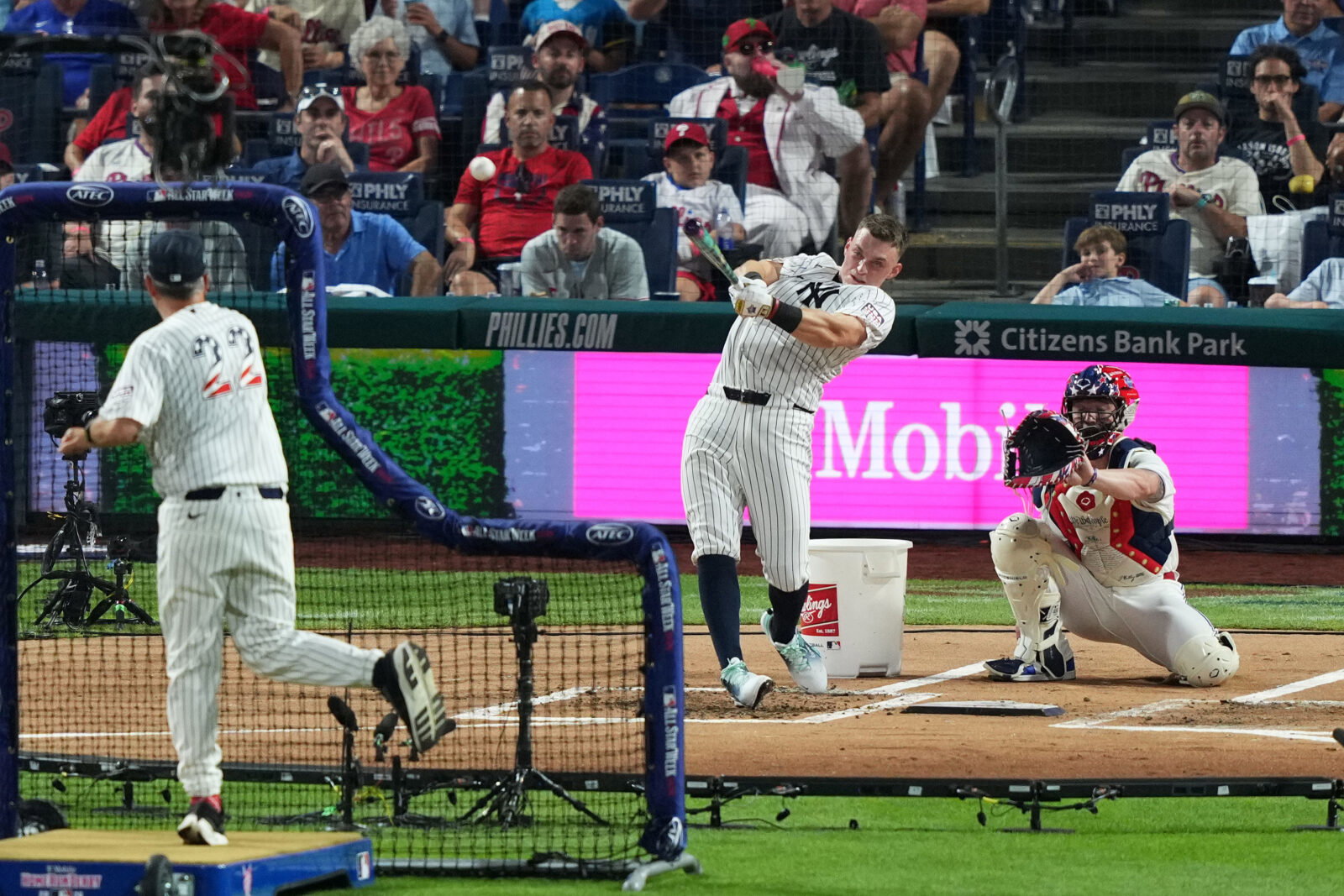
To kick off MLB All-Star weekend, New York Yankees first baseman Ben Rice participated in the Home Run Derby. However, he did not have a great showing, hitting only seven home runs and failing to advance past the first round. With the theory of a Home Run Derby “curse” being talked about for years, fans of Ben Rice are worried that participating will mess up his swing in the second half of the season.
While some data suggest that players do struggle after the Home Run Derby, other data suggest that the “curse” is actually a myth.
Players Who Struggled After The Home Run Derby
1. Aaron Judge
Rice’s teammate, Aaron Judge, won the Home Run Derby in 2017 as a rookie. In the first half of that season, Judge set the league on fire, hitting .329 with 30 home runs and an OPS of 1.139. However, his numbers in the second half fell off drastically. After the All-Star Break, he hit just .228, and his OPS dropped to .939. After winning the derby, Judge said he aggravated a shoulder injury he suffered earlier in the season and had to get surgery on it in the offseason.
In 2025, Judge declined the opportunity to participate in the Derby and said he would only do it if the All-Star Game was at Yankee Stadium. It’s unknown when the All-Star Game will be at Yankee Stadium next, so Judge may never do the event again.
2. Bobby Abreu
In 2005, Philadelphia Phillies outfielder Bobby Abreu won the Home Run Derby, hitting 41 home runs in the entire event. During the first half of that season, Abreu hit .307 with 18 home runs and an OPS of .955. In the second half, his average and OPS plummeted to .260 and .787, respectively, and he hit just six home runs.
3. Todd Frazier
Another former Yankee, Todd Frazier, won the 2015 Home Run Derby with the Cincinnati Reds at their home ballpark. His first half was one of the best of his career. In 85 games, he hit .284 with 25 home runs and a .922 OPS. In the second half after the Derby, his OPS dropped to .622, the worst second-half OPS of any Derby champion this century.
Most Data Suggests That The “Curse” Isn’t Real
Despite these examples of players struggling after the Home Run Derby, most of the data implies that the Home Run Derby “curse” doesn’t actually exist, and there are other legitimate reasons for players’ stats getting worse in the second half of the season.
The first reason is that the “first half” of the season isn’t really a half. Teams play more than 81 games before the All-Star break, so players can more naturally regress in the second half due to there being fewer games.
The second reason is that players who are chosen for the derby are often having a great first half. It is hard to maintain that same level of production over the course of a full season. According to a study of 50 Home Run Derby participants from 2018-2025, 24 of them improved in the second half of the season.
The study cited the 2021 Home Run Derby, in which Shohei Ohtani and Juan Soto faced off in the first round. Ohtani lost, and his OPS dropped from 1.062 in the first half of the year to .839 in the second half. On the other hand, Soto’s OPS in the second half increased by 312 points. Simply put, you can’t predict in advance which players will improve or decline after the Home Run Derby.
Rice Is Not Concerned About the Curse
After the derby, Rice said he practiced for the event twice over the week prior, did two full rounds, and didn’t think anything was wrong with his swing. His goal was just to have fun, and he certainly enjoyed the experience of being there in front of the fans and having his dad pitch to him.
With Aaron Judge not having a definitive timeline for his return, the Yankees need Ben Rice to produce in the second half as he did in the first half of the season.









Leave a comment