

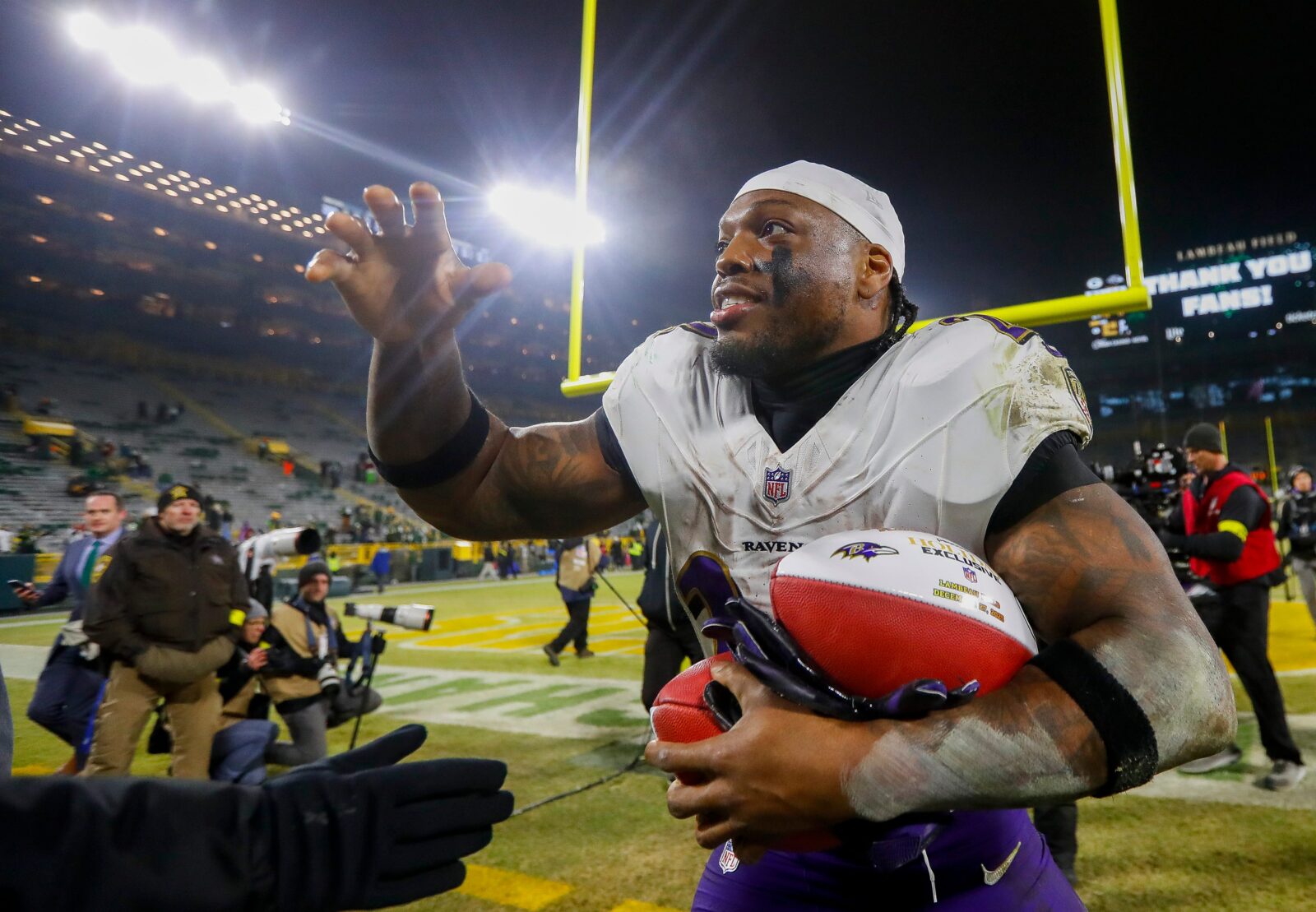
Derrick Henry is nicknamed King Henry because of how dominant he has been on the ground. Fans also know him as the GOAT of high school football.
In high school, he ran for 12,124 career rushing yards on 1,397 carries with 153 touchdowns. Henry was so dominant that, back in middle school, he had to be taken out of games once his team reached a 21-point lead.
That dominance hasn’t stopped after middle school and high school, allowing him to keep defying expectations even as he ages in the NFL.
When you think of the average lifespan of a running back, their prime usually ends when they hit their late 20s, followed by a steep drop-off in production.
But Henry’s been the exception — he’s getting better with age.
His commitment to his long-term health and career heading into his age-32 season is why he has a decent chance of breaking Emmitt Smith’s all-time rushing record of 18,355.
The Commitment That Keeps Henry Elite
As Henry has gone deeper into his career, he’s shown that his commitment to health and a strict diet is a major reason he’s lasted so long in the NFL.
Henry’s financial advisor stated he spends over $240,000 on his body, showing not only a time commitment he puts in to keep his body operating at a high level, but a lucrative one.
We’ve seen players get into the top ten of the NFL’s rushing record; Vikings legend Adrian Peterson finished fifth all time; Frank Gore, the model of consistency, finished third with 16,000 yards.
Henry is coming off his age-31 season, where he put up 1,595 yards on 307 carries for 5.2 YPC. Henry finished his age-30 season with the most rushing yards by a running back who was 30 years old. He followed that performance in his age-31 season with the third most rushing yards by a back who’s 31.
What separates Henry isn’t just the numbers, but the consistency he’s doing it with. He just tied with Barry Sanders for the most t 1,500-yard rushing seasons, with five — something modern legends like Peterson and Gore were never able to match. Peterson has only two such seasons, and Gore has done it only once.
Henry’s Playing Style Ages Better Than Any RB
Derrick Henry’s longevity isn’t just because of his investment in his body. It’s also because of his playing style, which tends to age more gracefully than most running backs’ in the NFL.
The modern running back has evolved into more of a WR-RB hybrid, where players have to excel at both the run and pass game. Just look at Lions running back Jahmyr Gibbs and Falcons running back Bijan Robinson as examples.
Last year, Gibbs had 1,223 rushing yards and 13 rushing touchdowns, along with 616 receiving yards and five receiving touchdowns. Meanwhile, Robinson had 1,478 rushing yards and seven rushing touchdowns to go alongside 820 receiving yards and four receiving touchdowns.
Modern running backs now carry a larger share of the offensive workload. The era of running backs serving as bell cows is almost extinct; Henry is one of the last of his kind.
Henry’s play style is the complete opposite of the modern NFL running back. He offers almost no receiving help and does all his damage from the ground. His play involves repeatedly punching a team in the mouth and wearing them down over four quarters.
With running backs expected to do more on offense, their bodies tend to disintegrate a lot more quickly, and their career tend to be a lot more short-lived. With Henry’s style of play, he’s not doing as much.
Derrick Henry Is Built to Last
At 6-foot-3, weighing 252 pounds, Henry is built like a modern giant compared to the average running back, whose height is 5-foot-10. His size doesn’t just allow him to absorb hits much better, but it also lets him plow through opposing defenders with his lethal stiff arm. Even as Father Time slowly approaches, Henry has shown no signs of slowing down.
How Baltimore Extends Henry’s Prime
After spending most of his career with the Tennessee Titans, Henry did all the dirty work as their lone bell‑cow back. Now that Henry is in Baltimore, he’s not the focal point of the offense and has a lot more opportunity to eat up defenses as they have to figure out a way to not only game plan for Henry but also the two-time MVP quarterback Lamar Jackson.
With Jackson under center, defenses can’t just stack the box to prevent Henry from taking over games. They must play with a QB spy every play to prevent Jackson from taking the game over with his legs. That not only gives Henry more opportunity to break away on plays, but it also puts less wear and tear on his body.
Henry will continue to have open lanes to take advantage of because defenses have to choose between the lesser of two evils: Derrick Henry’s power or Lamar Jackson’s speed.
The Path to Emmitt’s Record
With everything Henry has accomplished — the awards, the production, the unmatched consistency — he now faces one last challenge: win a Super Bowl and chase Emmitt Smith’s rushing record to cement himself as the greatest running back ever.
Henry is entering his age-32 season, turning 33 in January. At 13,018 career rushing yards, he’s only 5,338 yards from passing Smith for the most rushing yards in NFL history. Those numbers look massive for a player who’s supposed to be approaching the end of his career. But for a player like Henry, he already showed the league he is a walking anomaly.
Here’s what Henry would have to do to break the record:
Derrick Henry is currently averaging 1,300 yards per season; expecting Henry to keep up stats like that for the next four years is unrealistic. But if Henry can maintain just over 1,000 yards for the next four seasons, he would only need two seasons of 650 yards rushing to break the record.
With Derrick Henry as the RB1 in Baltimore, there’s a good chance he could break the record in less than six seasons. By having Lamar Jackson as his QB, that could be the exact reason he beats the record, not because his body held up, but because teams had to pick their poison between Henry and Lamar.
If anyone is going to break the rushing record, it’ll be a walking anomaly — and Derrick Henry fits that mold perfectly.












Leave a comment