

The New Orleans Saints fell to the Arizona Cardinals 20-13 in their Week 1 home opener. Although the loss was perhaps expected, it felt self-inflicted. A loss via one thousand cuts, rather than outright domination by the Cardinals.
The Saints had 13 accepted penalties against them for a total of 89 yards, showing no disciplinary improvements from last season.
Even with these drive-killing and drive-extending penalties (for the Cardinals), the Saints found themselves with a chance to tie it up at the end of the game via a late drive led by QB Spencer Rattler.
With nine seconds to go in the fourth quarter, Rattler threw arguably the best ball of his young NFL career to TE Juwan Johnson in the endzone. Johnson leaped into the air and hauled the ball in, but it was forced out of his arms by Cardinals safety, Jalen Thompson, on his way down to the ground.
https://twitter.com/JeffDuncan_/status/1964788259499692298
After the game, Johnson talked to the media about the drop.
Johnson felt, rightfully so, that the drop shouldn’t have been looked at as the game-losing play.
Despite Johnson trying to take accountability, the Saints had their chances throughout the entire game. The team wasn’t getting blown out. They stayed competitive and within scoring range. They just had too many penalties and kept shooting themselves in the foot every chance they got.
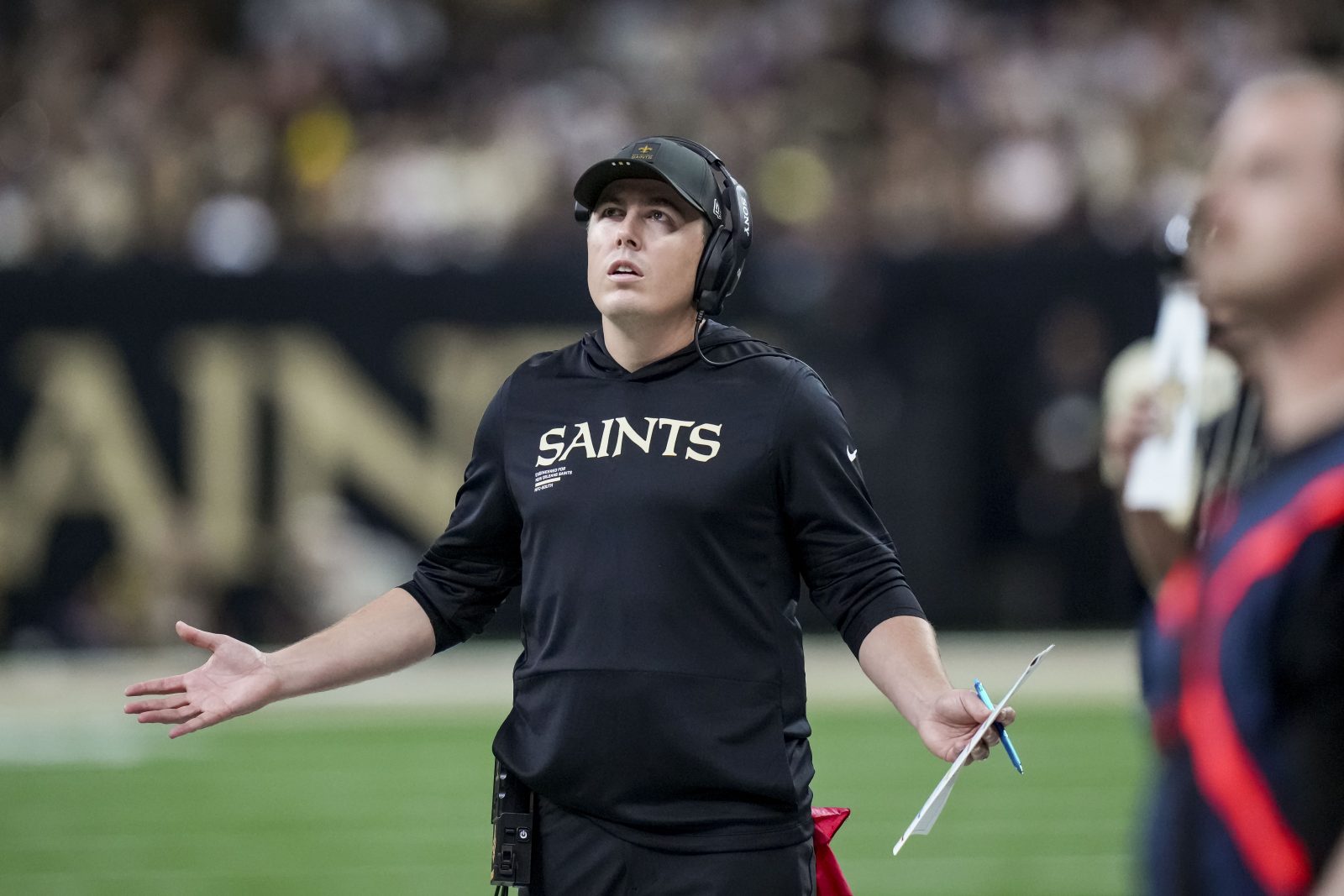
This begs an interesting question: How did the Saints lose the game? Did Kellen Moore cost them a win?
Conservative Play Calling
Moore dialed up a safe game plan. Early on, he balanced the run and pass, but most throws were short to intermediate. The only true deep ball came on a pass intercepted by rookie CB Will Johnson. An interception that was called back due to illegal touching away from the play.
It’s hard to determine why Moore had this conservative approach to the passing attack. Was it due to a lack of trust in the offense? We may never know the true answer to this question.
It is safe to say, however, that this game plan probably cost the Saints some explosiveness that was needed. In the future, the team can’t rely on short passes to win games. There has to be an element of trust in Spencer Rattler to air it out and complete big plays.
Conservatism makes it harder to complete big plays when teams choose to call them, like the one to Juwan Johnson that could have been game-tying.
But even with this conservative calling by Moore, the Saints were in the game the whole way. So while the play calling restricted the offense, it’s what Moore chose not to do at the end of the first half that likely cost the Saints a win.
What Even Are Timeouts?
With under two minutes to go in the first half, the Cardinals had the ball deep in Saints territory. During this particular drive, Kellen Moore had all three timeouts in his pocket, but chose not to use any. This move prevented the Saints from having a chance to put together a functional drive after the Cardinals scored with just 28 seconds left.
When asked why on TV, Moore said he didn’t call timeouts because he did not expect Arizona to bleed the clock like they did.
An NFL head coach didn’t expect the opposing team to bleed the clock out.
He further explained after the game that he did not want to leave time for the Cardinals to score had the Saints gone three-and-out.
An NFL coach was more worried about a hypothetical than making the obvious right choice.
The logic didn’t hold up. The move unfortunately looked like that of someone unprepared for the day.
With his NFL experience, Moore should’ve known the importance of stopping the clock during an opposing red-zone drive with under two minutes left. The decision cost the Saints a precious scoring chance. It was a display of incompetence by Moore, and had he shown better game management, we could be talking about an undefeated Saints team right now.










Leave a comment