

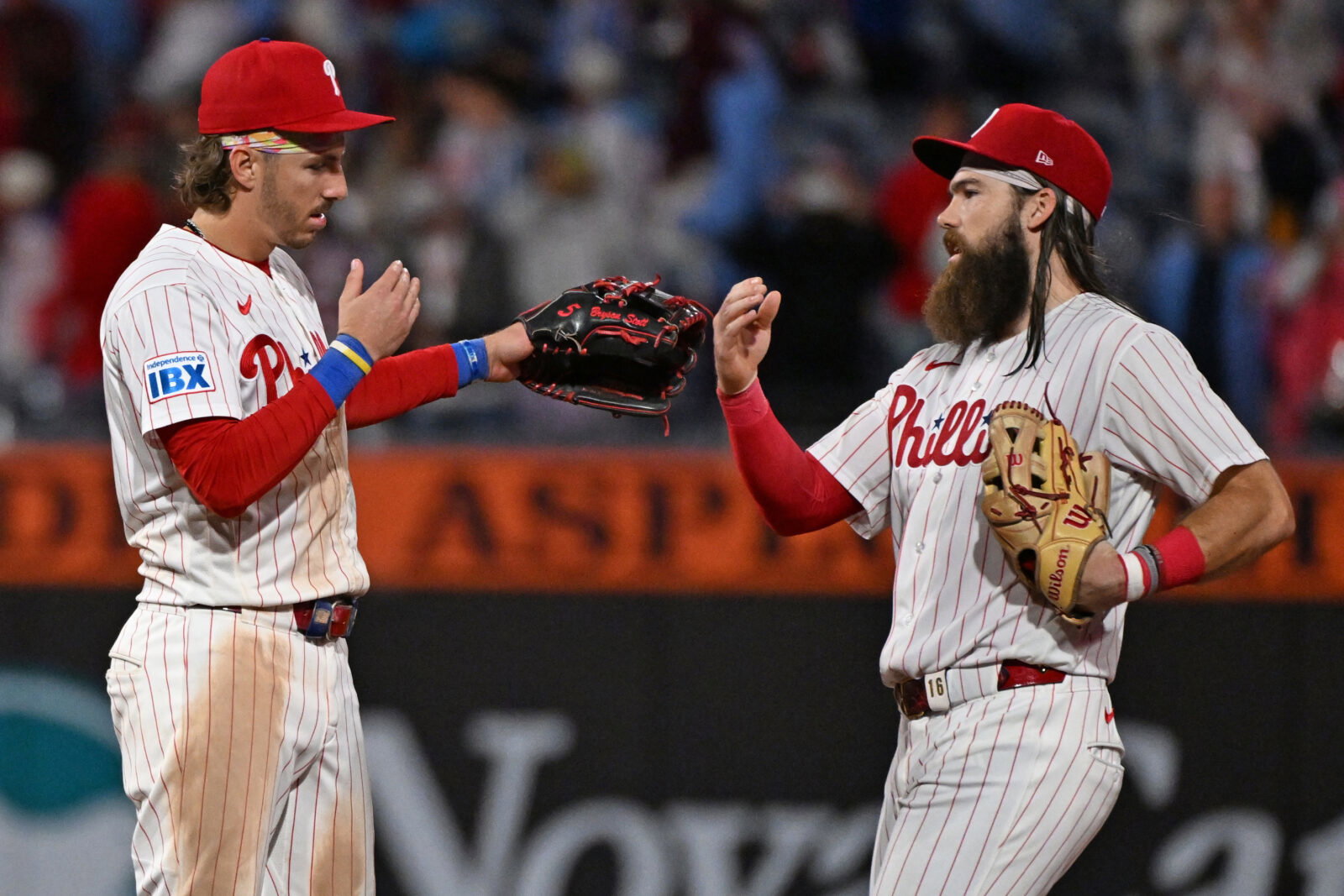
Time and again, the Phillies’ offense has carried the team a long way. The lineup is anchored by sluggers Bryce Harper and Kyle Schwarber but can run even deeper. Former Silver Slugger winner Trea Turner brings a good contact-speed blend with solid gap power. Alec Bohm has been a solid run producer in the middle of the lineup. Bryson Stott has shown a tendency to work long at-bats and find ways to get on base.
Sure enough, the team exemplified this in 2025. Schwarber had a career year, Bryce Harper had another strong season, and Trea Turner posted an NL-leading .304 average. Alec Bohm had a strong second half, and midseason trade pickup Harrison Bader sparked the offense down the stretch. The team finished top ten in the league that season in runs (778), slugging percentage (.431), on-base percentage (.328), and OPS (.759).
But the lineup cratered in 2026. Kyle Schwarber (MLB-leading 45 home runs) and Bryce Harper (.865 OPS, NL-leading 107 walks) again led the way. However, they would be the only two Phillies in the starting lineup to finish with an OPS above .800. As a unit, they were just outside baseball’s bottom-10 in runs scored. Their .395 slugging percentage was sixth-worst in baseball, and their .707 OPS ranked eighth-worst.
A handful of the bats in the lineup will hit free agency (notably Alec Bohm and trade deadline acquisition Luis Arraez). However, many of them will return to the team next year. How can they improve on offense to make their lineup a strength again?
Trea Turner Needs To Be Better
As mentioned earlier, Trea Turner’s production in 2025 was vital to the team’s strong offensive performance. Turner led the National League with a .304 batting average, but provided more than just high-contact numbers. He also hit 31 doubles, 7 triples, stole 36 bases, and posted the second-best strikeout rate of his career at 16.7%.
The stark drop-off in results was hard for fans to accept and for the team to understand. Though his K% rose to 21.0%, little changed in his overall profile. Never the strongest hitter, his batted-ball numbers remained relatively similar this year to his strong 2025 campaign:
- Barrel% (2025)- 5.8%
- Barrel% (2026)- 6.0%
- HardHit% (2025)- 42.1%
- HardHit% (2026)- 39.3%
- Average Exit Velocity (2025)- 89.3 MPH
- Average Exit Velocity (2026)- 88.5 MPH
Turner’s batted ball profile didn’t change much either, with his groundball rate actually dropping (48.3% to 45.3%). The biggest culprit for his struggles was how he handled pitches in the heart of the zone. Defined as the main part of the zone pitchers try to avoid, the heart of the zone is where batters can do the most damage.
Turner became much more passive on heart zone pitches this year. As a result, his run value on pitches in the heart of the zone was a career worst: -16. His H-Swing% and H-Contact% (percentage of swings and amount of contact made in the heart zone) noticeably dropped:
- H-Swing% and H-Contact% (2025)- 79.5%, 91.9%
- H-Swing% and H-Contact% (2026)- 75.7%, 89.8%
His first-pitch swing rate also fell almost 6% from last year, down to 32.6%. While there is certainly such a thing as being too aggressive, a more aggressive approach may serve to benefit Turner.
Deepen the Overall Lineup
The Phillies’ lineup once again leaned more top-heavy. Kyle Schwarber and Bryce Harper shouldered the load all year, but the lineup lacked depth behind them. Other players got hot in stretches but couldn’t sustain production all season.
Brandon Marsh was the closest of the group to do so. In the first half, Marsh posted an .829 OPS with 15 home runs and 15 doubles. He played a little above his pay grade, aided by a .377 BABIP, but his regression was sharper than anyone anticipated. Marsh vanished after the All-Star Break, ranking as one of the least valuable players in all of baseball:
- OBP- .243 (tied-fourth worst)
- SLG- .259 (tied-second worst
- OPS- .502 (second worst)
- wRC+- 31 (worst in MLB)
Outside of Marsh, Alec Bohm enjoyed a strong second half, posting a .794 OPS. But a heightened 48.2 GB% kept him from tapping into more of his power potential. J.T. Realmuto enjoyed a strong July (.848 OPS) but struggled the rest of the year. It culminated in an ugly 0-34 stretch as the Phillies were clawing their way to a playoff spot. Arraez maintained his low-strikeout approach when joining the Phillies, but saw his overall production drop after the trade (.678 OPS, 82 wRC+).
Bohm and Arraez will leave the team in free agency. Veteran players like Realmuto, Turner, Schwarber and Harper are only getting older. That group likely won’t move much, but could others in the lineup? The Phillies could shake up some of the surrounding names to add more overall length to this aging core.
Reinforcement With a Youth Movement
The Phillies’ farm system is a little top-heavy, with little depth beyond their four top 100 prospects. But that doesn’t mean they lack youthful players who could contribute.
A graduate of the team’s top 30 prospect list, the Phillies saw a sample of work from Gabriel Rincones Jr. At his best, he’s a power bat who can draw walks and even flash some solid speed. At his worst, however, he’s a strikeout-prone platoon bat with limited defensive ability. The Phillies unfortunately saw more of the latter this year, though Rincones battled a knee injury early in the year.
Keaton Anthony is another player who has shown potential to make an impact at the major-league level. He missed a little time with injury but hit well at Triple-A in 78 games. He showed a solid approach at the plate, striking out just 15.5% of the time and walking 11.0% of the time. His quality-of-contact numbers were roughly average, but his swing-and-miss rates were well above average (20.3% whiff rate, 9.1% swinging-strike rate).
The big-ticket prospects who could help next year’s lineup are two of their top 100 guys. Both infielders, the Phillies will need to find ways to make space for both Aidan Miller and Bryan Rincon. But both players have enough upside that there should be plenty of incentive to do so.
Rincon hit 26 home runs and stole 30 bases in a career year while maintaining elite defense. Miller likely would’ve helped the big-league team this year if an injury hadn’t kept him out of action. He returned to play just eight games (four in Reading’s postseason run) and is now working in the Arizona Fall League.










Leave a comment