

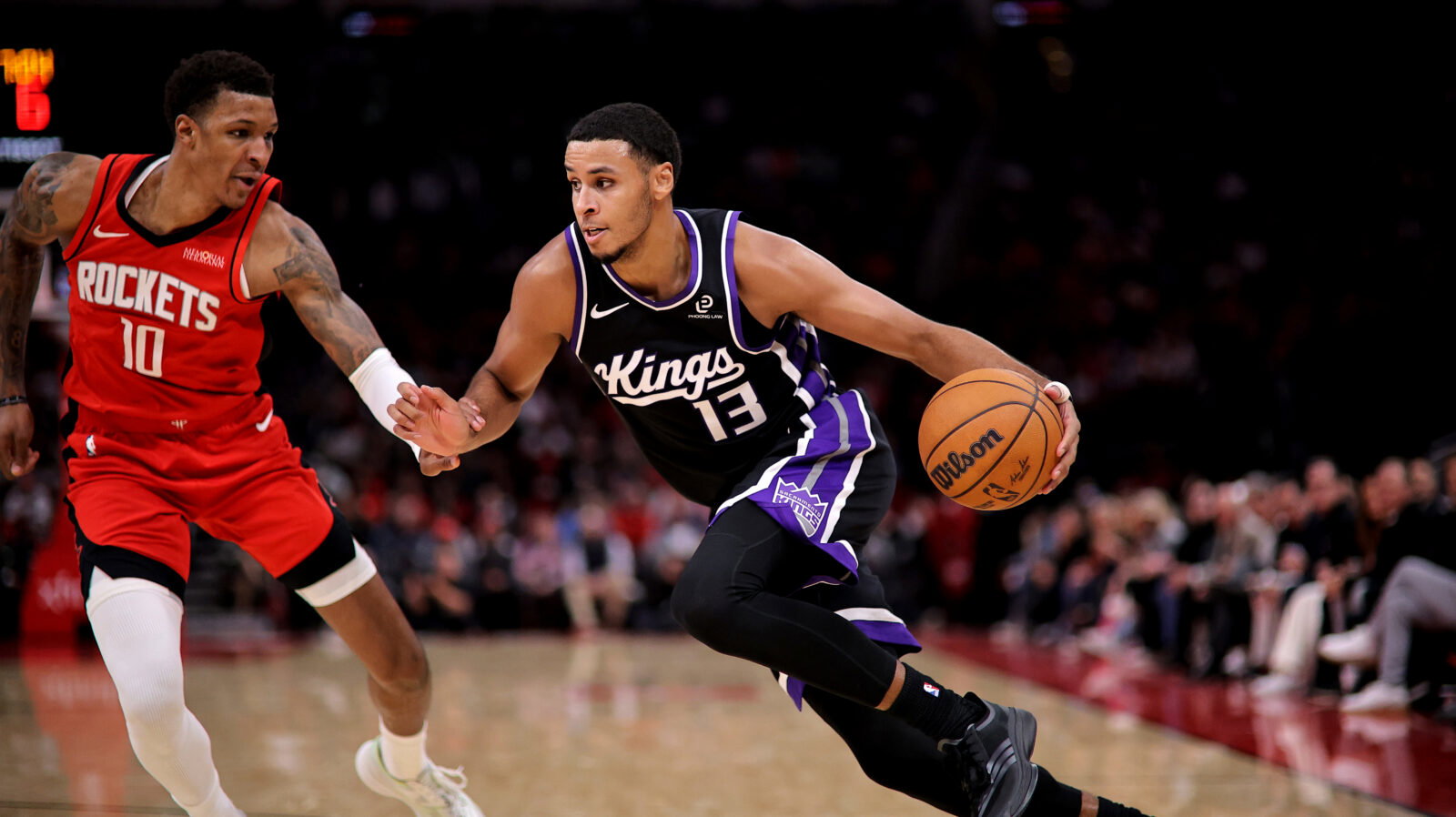
Keegan Murray’s development has not followed a typical path.
After a rookie season defined by elite shooting, his efficiency from beyond the arc has steadily declined. What once looked like a foundational strength has become one of the more surprising questions surrounding his game.
But the numbers alone do not tell the full story.
The Shooting Decline
Murray entered the league as one of the best shooting rookies in recent memory, and the environment around him played a major role in that success.
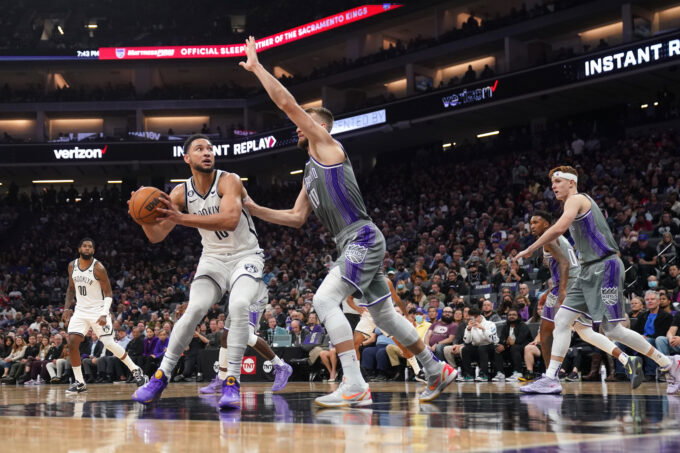
During his rookie season, the Sacramento Kings built one of the most efficient offenses in NBA history, scoring 118.9 points per 100 possessions. At the center of that system was Domantas Sabonis, whose role as a dribble handoff hub created consistent opportunities for shooters.
Sabonis recorded over 1,000 dribble handoffs that season, the highest total tracked in the Second Spectrum era and well above any other player in the league. That volume allowed Sacramento to generate clean, repeatable looks, particularly from the perimeter.
Murray benefited directly from that structure.
He ranked among the league leaders in dribble handoffs received, finishing with 141 from Sabonis, which consistently put him in position to take open three-point attempts. Within that system, he thrived, shooting 41.1% from three on 6.3 attempts per game and setting the NBA rookie record with 206 made three pointers, a mark later surpassed by Kon Knueppel.
That stretch captured how effective Murray was within that system.
That version of Murray operated in a clearly defined role in a highly optimized offense, a situation that has since changed.
His three-point percentage has dropped each season, from 35.8% to 34.3% and now to 27.7%. Without the same volume of clean looks or consistent offensive rhythm, the efficiency has not held.
The shot quality has also shifted, and the numbers reflect that change.
During his rookie season, nearly 40% of Murray’s attempts came with defenders six or more feet away, and he converted those looks at an elite 46.9% from three. Those were clean, in-rhythm opportunities created within Sacramento’s offensive structure.
This season, that number has dropped to 20%, cutting his share of clean looks nearly in half. At the same time, his efficiency on those wide-open looks has fallen to 27.5%.
That combination tells a clearer story of what has changed. Murray is not only getting fewer clean looks, but he has also struggled to convert the ones he does get. The decline is not tied to a single factor, but rather a mix of changing shot quality and inconsistent shooting.
A Changing Role
The context around Murray’s role has shifted significantly. Following his rookie season, Sacramento began asking more of him defensively. Rather than operating primarily as a floor spacer, he often takes on the responsibility of guarding the opposing team’s top scoring option.
The defensive side of Murray’s game has taken a real step forward. His versatility, effort, and ability to handle tougher matchups have improved and, in many ways, exceeded expectations.
Even in a limited sample of just 24 games due to injury, he has been productive on that end of the floor. He averaged one steal and 1.6 blocks per game, totaling 2.6 stocks per game. This number would have ranked 11th in the league over a full season.
That production reflects better timing, stronger instincts, and more confidence in his defensive role, especially while taking on tougher matchups. That tradeoff has shown up on the offensive end.
Offensive Environment
Murray’s role within the offense has also become less defined.
As a rookie, over 60% of his attempts came off catch-and-shoot opportunities, where he shot 41.1% from three. This season, that share has dropped to 36%, and his efficiency on those shots has fallen to 30.8%. At the same time, his pull-up attempts have increased from 10.7% of his shots to 35%, while his three-point percentage on those looks sits at just 14.3%.
Lineup dynamics also play a role. With high usage scorers controlling the ball for extended stretches, opportunities to operate within the flow of the offense become limited.
For a player whose game relies on timing and rhythm, that shift can have a noticeable effect.
Injuries and Rhythm
Murray has also played through injuries, including a torn thumb ligament this season that required him to wear a wrap.
While it does not fully explain the drop in shooting efficiency, it adds another layer to the inconsistency. Shooting is often the skill most affected by even minor physical limitations, particularly for players who rely on repetition and touch.
The Bigger Picture
The drop in three-point shooting is real, and it remains the most concerning part of Murray’s development.
At the same time, his overall game has expanded in other areas.
He is rebounding more, defending at a higher level, and taking on responsibilities that were not part of his role early in his career. Those improvements carry weight, even if they are less visible than shooting percentages.
Murray’s development has not been linear, but it has not stalled either.
What Comes Next
The key for Murray moving forward will be finding balance.
If his shooting returns closer to his rookie level while maintaining his defensive growth, his overall impact could take a significant step forward. The foundation is still there, even if the results have been uneven.
For now, his trajectory remains difficult to define. The numbers suggest regression. The context points to something more complex.










Leave a comment