

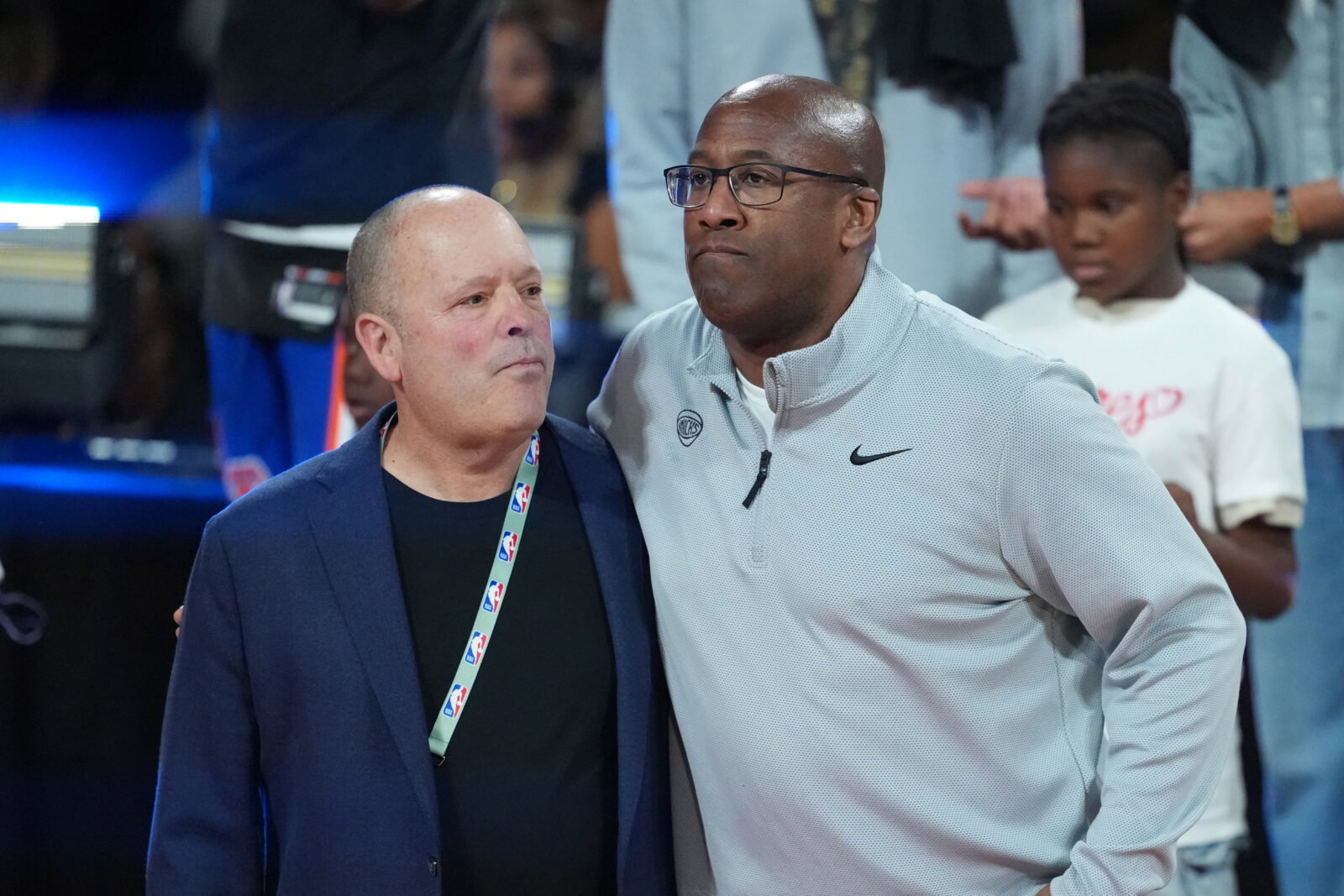
While the rest of the NBA plays the chaotic offseason game of musical chairs, scrambling to create the next super team, the New York Knicks front office is forced to settle its books and crunch the numbers.
With the league firmly settled into the “apron era,” teams that spend big money are restricted from continuously upgrading their rosters. Each apron threshold comes with an assortment of penalties and restrictions.
The higher a team goes, the more limitations it incurs. These range from trade constraints and buyout restrictions to no contract aggregation, no cash considerations, no mid-level exception, and even draft-pick freezes. The first apron begins at approximately $209 million, while the second apron kicks in at $221.6 million.
With all this in mind, owner James Dolan made it clear that the Knicks would not go over the dreaded second apron and would do everything to remain below that threshold.
As the team currently stands, New York sits just several million dollars away from the second apron. After most recently resigning Jordan Clarkson to a one-year deal on Thursday, the team now finds itself closer to that mark. And, for a team looking to defend a championship, every dollar matters just as much as every roster spot.
The New York Knicks Are Losing Depth at Center
To stay below this apron, the New York Knicks had to let veteran big man Mitchell Robinson walk in free agency. Bringing him back would have pushed the team over the line.
Robinson signed a three-year, $47.4 million contract with the Boston Celtics.
To add insult to injury, backup center Ariel Hukporti signed a one-year deal with the Philadelphia 76ers. Meaning, the Knicks are even more gutted at what was already their thinnest position.
As the Knicks’ offseason continues, fans are watching every move closely. Ultimately, these moves will set the tone for the team’s competitiveness next year.
With a glaring hole at the five, President of Basketball Operations Leon Rose had to navigate the rough waters of the remaining free agents.
By this point, most of the premier targets had already changed hands. Deandre Ayton moved to Washington, Walker Kessler joined Luka Dončić in Los Angeles, but somehow, someway, the Knicks avoided committing to an all-small-ball lineup by adding former Philadelphia center Andre Drummond.
At first glance, Drummond’s numbers don’t jump off the page. He averaged 6.4 points, 8.4 rebounds, and 1.3 assists per game last season. However, those numbers compare favorably to Robinson’s production of roughly five points, nine rebounds, and under one assist per contest.
By acquiring Drummond on a one-year veteran minimum contract, the Knicks remain safely under the second apron while giving themselves another body at the five.
What’s Next for Leon Rose and the Knicks?
Now, the Knicks’ offseason isn’t over. Rose still has moves to make.
Even with Drummond, the Knicks still lack depth at center. Before acquiring the veteran, New York had reportedly been involved in trade discussions for Hornets’ young center Moussa Diabaté.
Diabaté carries a modest $2.5 million salary, one that the Knicks could realistically match by moving bench pieces like Tyler Kolek. Hopefully for Knicks fans, the team remains in the hunt for Diabaté and works toward a deal with the Charlotte Hornets, who now need a point guard after trading away LaMelo Ball.
The Biggest Moves May Still Be Ahead
Overall, the second apron is certainly limiting what the New York Knicks can do. Besides Drummond, the Knicks have only re-signed the rest of their 2025-26 depth, outside of Robinson.
With very little that’s realistically left in free agency, it appears the Knicks’ biggest opportunity to improve won’t come from who they can sign. It will come from who they can trade for.
If the Knicks are going to repeat as champions, Leon Rose’s biggest move this summer may not be the flashiest one. It may simply be the move that keeps this roster competitive while staying under the second apron.











Leave a comment