

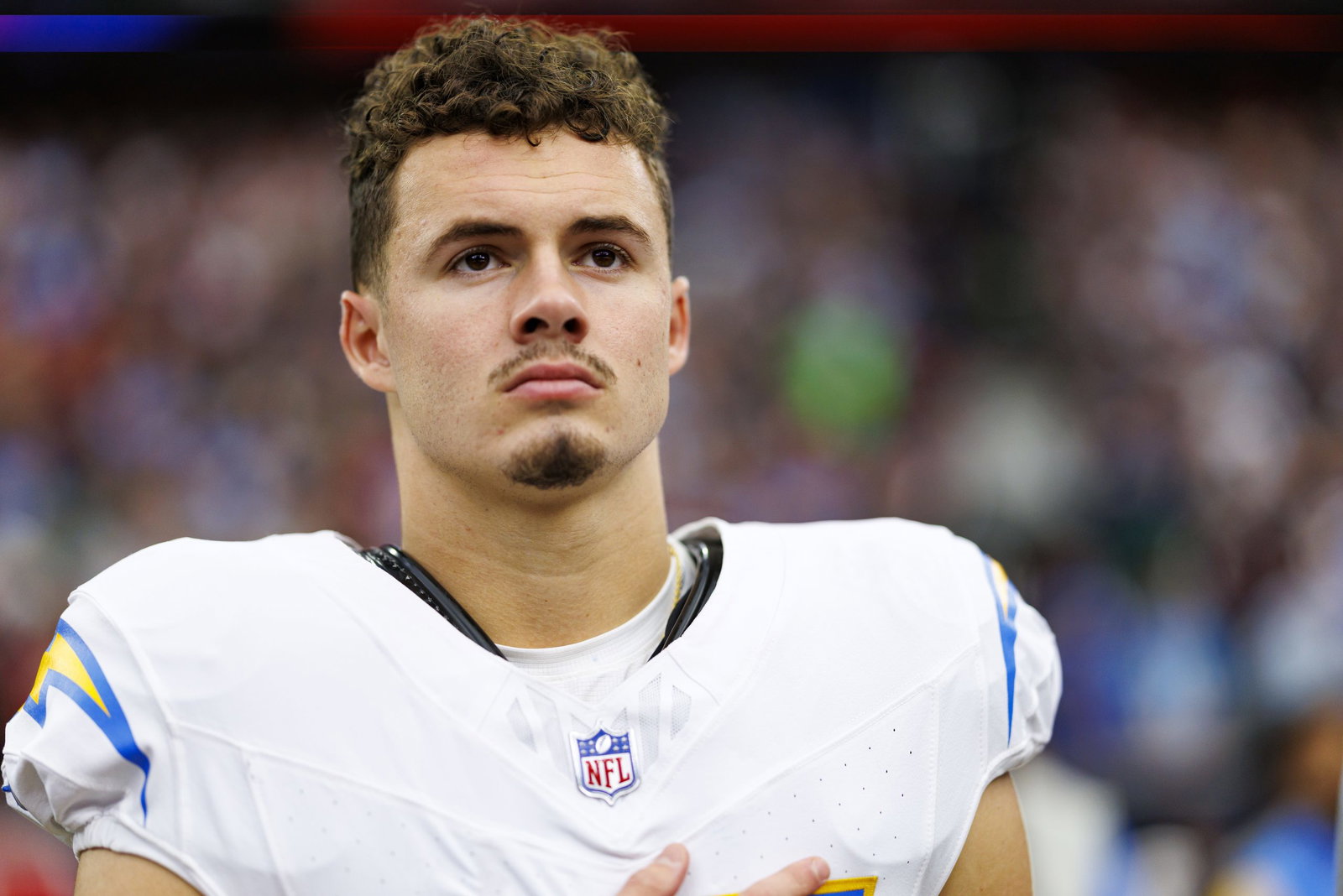
McConkey’s Path to L.A.
Throughout the 2024 offseason, Chargers fans were left wondering who would emerge as Justin Herbert’s main target. With Keenan Allen traded, Mike Williams cut, and Quentin Johnston producing a disappointing rookie season, the concerns made sense.
After hiring a new general manager, Joe Horitz, and head coach, Jim Harbaugh, the Chargers’ new leadership faced the challenge of navigating a tight salary cap.
Fortunately, their debut draft gave the Chargers a promising new top receiver in Ladd McConkey.
At Georgia, McConkey had built a résumé on his reliability and explosiveness, despite playing in a crowded offense. Across three seasons, he totaled 1,687 yards and had an incredible two-touchdown performance in the 2023 national championship. His sharp route running, separation skills, and great hands were signs of the success he could have in the NFL.
For a Chargers offense in dire need of timing, rhythm, and trust, McConkey’s precision made him a seemingly perfect fit.
McConkey’s specialty is his ability to find soft spots in coverage. He didn’t just thrive on screens—he won at all levels, even against SEC secondaries. His tape showed a player who knows how to make himself available, a skill that translates immediately to the NFL.
In a post-Keenan Allen era, L.A. found its future centerpiece.
The Route to WR1
McConkey wasted no time making his mark in Los Angeles. He led the team in receptions and receiving yards, maintaining the same route-running precision that made him a star in Athens.
His ability to create separation on short routes helped stabilize an offense in transition. His chemistry with Herbert gave the Chargers a reliable go-to option on critical downs. By the end of the season, McConkey earned a reputation as one of the league’s most polished rookie receivers, drawing comparisons to Allen for his consistency.
Still, despite McConkey’s breakout, it was clear the Chargers needed more firepower on the outside. Johnston remained inconsistent, and the offense lacked a vertical threat who could stretch defenses and win in contested catch situations. With defenses keying in on McConkey underneath, adding a physical, downfield presence became a clear priority.
Enter Tre Harris.
Solving the Vertical Void with Tre Harris
Leading up to the 2025 draft, Harris wasn’t a consensus first-round name.
However, he steadily climbed boards thanks to a strong final season at Ole Miss and an impressive pre-draft process. Most analysts projected him as a Day 2 pick, praising his size (6-foot-2, 205 pounds), physicality, and contested-catch ability. In 2023, he had 47 receptions for 851 yards and 8 touchdowns, averaging over 18 yards per catch. His tape showcased strong hands and body control that made him a nightmare in one-on-one matchups—and a top name in the SEC.
For the Chargers, Harris filled a glaring need: a vertical, outside receiver. With Johnston still unproven and the rest of the depth chart in flux, Harris offers a toughness that aligns perfectly with Harbaugh’s vision for a physical, aggressive offense. He wasn’t drafted to be an immediate No. 1 receiver, but to stretch the field and give Herbert the kind of big-bodied target the team has been missing.
Building a Blueprint: Harbaugh’s WR Formula
Jim Harbaugh has a clear vision for how he wants to build an NFL offense: tough, physical, balanced, and efficient.
Part of that formula? Targeting wide receivers in the second round. It’s a trend reminiscent of his days at Michigan, where players like Roman Wilson and Cornelius Johnson flourished, and now it’s shaping the foundation in Los Angeles. McConkey and Harris fit this mold perfectly—each drafted with a purpose.
McConkey thrives underneath. Harris stretches the field and wins in the air. Together, they offer Herbert what he has lacked since the departure of Keenan Allen and Mike Williams: receivers who can beat man coverage and create separation. McConkey gets open early, Harris wins late. It’s the kind of pairing that forces defenses to choose their poison, similar to Detroit’s Amon-Ra St. Brown and Jameson Williams.
Now, the Chargers are quietly building a complete offense.
Mike Williams is back on a one-year deal. He doesn’t need to be the primary weapon anymore, but his presence can ease the transition for Harris. The addition of Tyler Conklin at right end provides a reliable, veteran target over the middle. The backfield of Omarion Hampton and Najee Harris will take pressure off the passing attack.
Still, the future clearly belongs to McConkey and Harris. They weren’t brought in just to complement the old core, they were brought in to become the new one.
With Herbert entering his sixth season and Harbaugh installing his system piece by piece, L.A.’s offense is starting to take shape. And it starts with two second-rounders who might end up defining a new era of Chargers football.
The Longevity of the Second-Round Strategy
Harbaugh’s approach to second-round receivers prioritizes fit, football IQ, and character. The Chargers target players who are sharp, coachable, and eager to develop. It’s a formula that builds a consistent, reliable group.
Though a funny pattern, these recent second-round picks are intentional building blocks to support the Bolts for years to come. With this formula, the Chargers are positioning themselves to compete year after year.











Leave a comment