

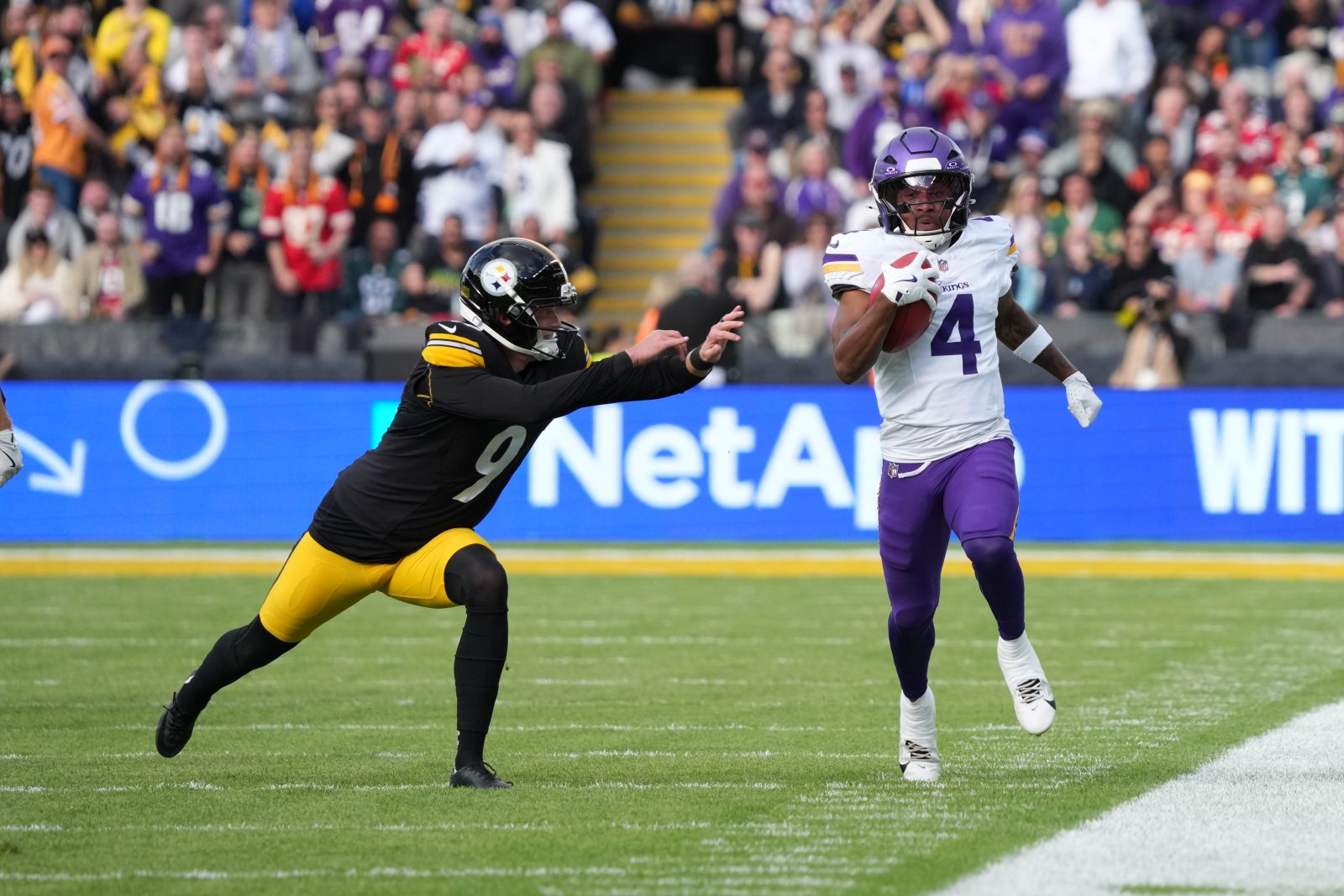
The NFL season this year has seen tremendous strides in the dynamic kickoff rules. They’ve made an impact on how teams manage games since the touchback is now the 35-yard line.
What once was a safe play for the kickoff team to kick the ball through the end zone and put offenses at their own 20-yard line has now become a huge no-no to give offenses the ball at their own 35-yard line.
A combination of aligning players closer on the kickoff has helped with the safety of kickoff plays, and the more advantageous positioning for touchbacks has skyrocketed the rate of kick returns.
Last year, 30 percent of kickoffs were returned. This year, over 80 percent of kickoffs have seen action.
The kickoff rules have impacted how teams manage the time and score.
The 35-yard Line’s Impact On the Score
Teams should think more about going for it on fourth down in the red zone as opposed to kicking short field goals.
This year, the average field position after a kickoff is the 29-yard-line. Following a short field goal, on the kickoff, a kicking team is giving their opponent the ball at the 35-yard-line if there’s a touchback.
Teams would be just two first downs away from being on the edge of field goal range and answering three points with a field goal of their own.
This means there’s a greater incentive than ever before to go for it on fourth downs in the red zone. If no points come out of the drive, opposing teams are at least pinned deep in their own territory.
If the offense can’t put touchdowns on the board in the red zone, they are at least helping their defenses with more yards to defend. Kicking field goals in the red zone and then being two first downs away from giving up a field goal in return is not as great of a tradeoff as it once was.
Strategy in a One Score, Crunch Time Battle
While nursing a one or two point lead in crunch time, offenses tend to play conservatively with the goal of running out the clock as opposed to adding another score to the board.
This type of offense is known as “the four-minute drill.”
If the four minute drill is unsuccessful, meaning the offense can’t stay on the field for the final snap, now they’re vulnerable to losing on their opponents final opportunity.
There’s an argument to made that it’s better to be in a tied game, as oppose to holding a lead, in crunch time. When offenses need a score to win, they tend to play more aggressively and produce better results.
Of course, this is known as the “two-minute drill.”
Bills-Ravens Week 1
Take the Buffalo-Baltimore Week 1 matchup that saw Buffalo win on a last-second field goal.
Down eight inside two minutes, Keon Coleman caught a touchdown pass, but Buffalo failed on the two-point try, ultimately keeping Baltimore’s lead to two.
Being up two can play a psychological factor. With very little time left in the game, Baltimore was vulnerable to losing on a field goal if they didn’t pick up a first down, which they did not, and had to kick the ball back to Josh Allen.
Conversely, if the game was tied, Baltimore would get the ball back with two minutes and would have likely played much more aggressively to win the game on a field goal of their own.
The argument could be had that for Baltimore, it would have been better to play the game out in a tie, taking matters into their own hands.
Being down one or two points in crunch time, Buffalo could sell out to defend a condensed field, since the Ravens were so focused on gaining just a few yards to end the game. In these scenarios, the defense knows that there’s fewer plays the offense wants to run when they are conservative.
Conversely in a tied game, the defense needs to defend the whole field and they know the offense has the entire playbook to work with.
Two-Point Lead Strategy in Basketball
Take basketball as another example. If your team has a two point lead with 24 seconds or less, you don’t want to give up a three-point basket.
Take it one step further, strategically, you don’t even want to see a three-point attempt.
Defenses can play up on the perimeter and if they give up two points (perhaps a straight line drive for two) early in the clock, they can go the other way with a chance to win it at the buzzer in a tied game.
Psychologically, defenses do not want to see Stephen Curry launch a three-point attempt while up two.
Final Thoughts
With all the different variables that come into play, sometimes teams play the math; others play high risk, high reward.
It’s a copycat league and once one team figures out a strategy that works, everyone will replicate it.











Leave a comment