

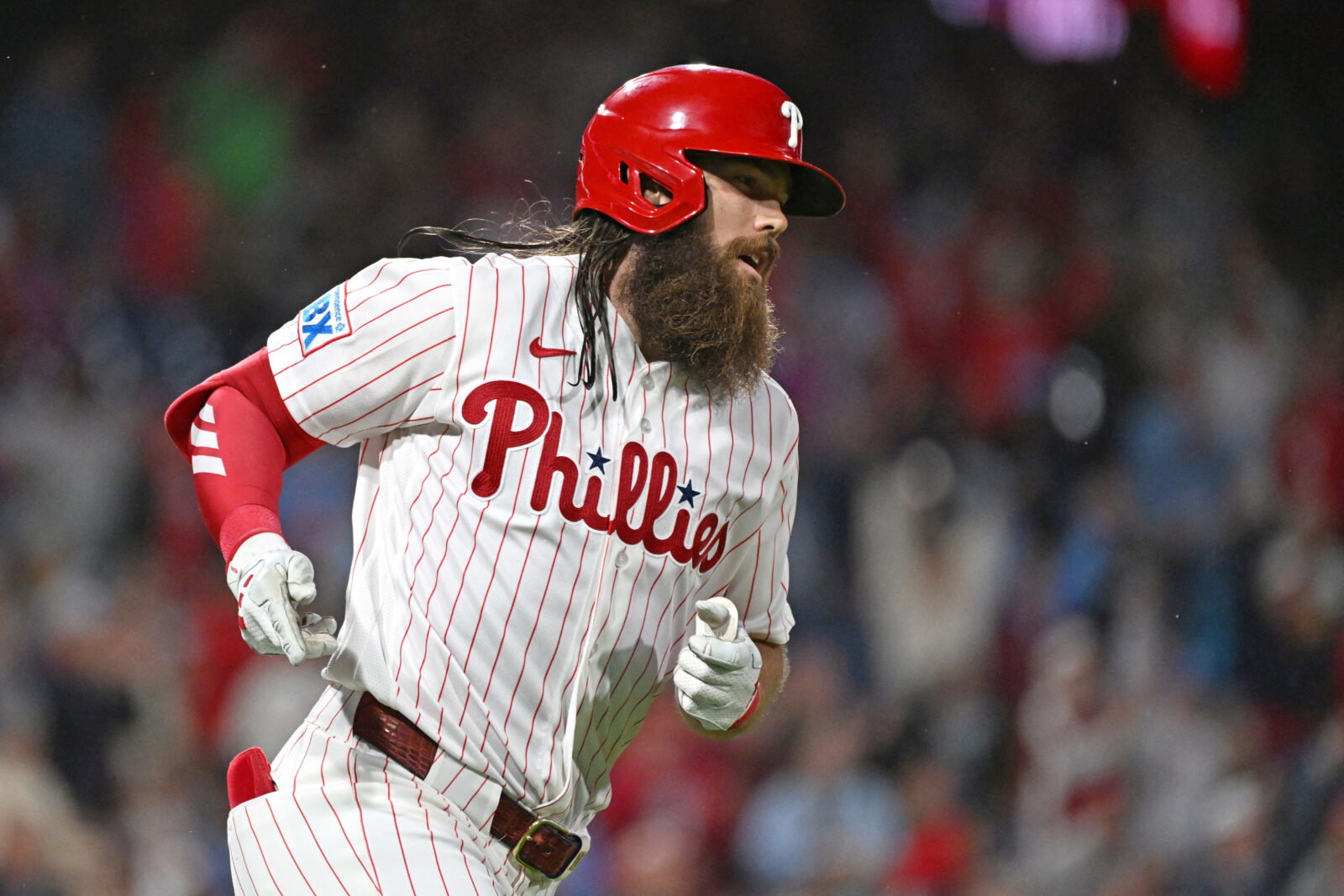
For the first half of the season, things were coming together perfectly for Brandon Marsh.
Acquired during the 2022 Trade Deadline, Marsh had been carving out a nice role for himself with the team. As a Phillie entering 2026, he hit .270 with a .786 OPS, mostly facing right-handed pitching. He wasn’t always platooned, but his production noticeably dipped against same-handed pitching (.604 OPS vs. LHP, .833 vs. RHP).
Everything started going right for him early in 2026, however. While key players like Alec Bohm and Trea Turner struggled, Marsh became one of the strongest bats in the lineup.
Kyle Schwarber and Bryce Harper provided the slug, while Marsh had a bit more of a rounded approach. He hit .301 in the first half but provided some power of his own, with 15 doubles and 15 home runs. It all culminated in his first All-Star Game bid, as he was named a starter for the Midsummer Classic in Philadelphia.
Everything went up in flames in the second half. Marsh’s bat didn’t just slip; he became a non-factor in the lineup, losing his guaranteed starting spot by year’s end. His average dropped to just .184, and his OPS cratered to .502 in the second half. How did things go so poorly for Marsh in 2026, and what should the Phillies do with him going forward?
Marsh Succeeded by Being Unpredictable, Not Dominant
It’s important to understand how Marsh was able to succeed early in the season. For starters, he didn’t necessarily tear the cover off the ball. Marsh’s first-half Statcast numbers were roughly in line with league averages for the season.
- MLB Averages: 89.3 average exit velocity, 7.7 Barrel%, 39.0 HardHit%
- Brandon Marsh (first half): 89.8 average exit velocity, 9.3 Barrel%, 45.9 HardHit%
While he was slightly above average, he wasn’t overwhelmingly better than the league in the way the game’s top players are. He had continued to lower his strikeout rate too, down to 26.4% after being at 30% in his first two years in Philly. Still, his rate was higher than the MLB average of 25.0%, and he wasn’t walking as much either (5.2 BB%).
Where Marsh found success was discussed in an article by Mike Petriello for MLB.com. Marsh’s lack of standout tendencies at the plate made it difficult for teams to adjust against him. He didn’t hit the ball hard, but he found gaps in defenses and placed hits where fielders weren’t.
Marsh’s contact profile was a little more spread out, which made it unpredictable for opposing defenses. His percentage of pulled and centered hits was very close (39.4% pulled and 35.8% centered). Even though his opposite-field presence was lower (24.8%), it still wasn’t low enough to fully close that section off for defenders.
The Pull-Heavy Shift Made Him Easy to Defend
The good times couldn’t keep rolling forever for Marsh, and warning signs began showing in July.
In 11 games that month before the All-Star Break, he hit just .179, with his slugging percentage dropping to .256. That all-fields approach began breaking down. 44.4% of his hits were to the pull side, and just 18.5% to the opposite field.
Overall, he became more pull-heavy, making him more predictable for defenders. Marsh’s second half pull rate was 41.7%. The difference between his pulled and centered hits dramatically increased, as just 30.6% of hits went up the middle. And though his opposite field approach jumped slightly (27.8%), it wasn’t enough to keep fielders guessing.
That also coincided with a significant drop in his quality of contact numbers. Marsh already hadn’t hit the cover off the ball, but was above average in important Statcast metrics. In the second half, however, he fell below league average, with an 88.3 average exit velocity, 5.6 Barrel%, and 36.8 HardHit%
Ironically, Marsh, who has the highest BABIP in baseball since his MLB debut, ran into some bad luck in his summer skid. His normally high BABIP of .377 in the first half fell to just .225 in the second, well below the league average.
Marsh even saw improvements in his strikeout and walk numbers in the second half. He dropped his strikeout rate further to 22.4%, while his walk rate came closer to average at 7.3%.
Philadelphia Doesn’t Need to Make a Rash Decision
The good news for the Phillies is that they don’t have to make any complicated decisions on Brandon Marsh this offseason. Marsh still has a year left of arbitration, and his projected salary by MLB Trade Rumors is $8.3 million.
The Phillies will shed some money with their departing free agents. Nick Castellanos and Taijuan Walker coming off the books frees up additional space. That’ll make Marsh’s salary a fairly insignificant mark on whatever the team spends this offseason.
There should be no rush to drop him from the team right now. His second-half struggles may raise questions about whether he can handle a starting job. But Marsh, since joining the Phillies, has remained a productive component of the team. And he’s bounced back from deep struggles before.
In 2025, Marsh began the year hitting just .095 with a .387 OPS. An injury shelved him early, and he would be sent on a rehab assignment to Triple-A in an attempt to right the ship. When he returned on May 3, he went 2-4 with a double and never turned back. He put up All-Star numbers the rest of the way, hitting .303 with an .836 OPS.
The Phillies may find a platoon partner for Marsh this offseason. If Trea Turner’s defensive struggles continue, Turner may move to the outfield, leaving Marsh to battle for a spot. There are several ways Marsh’s spot could get compromised on this team. But he’s shown great tenacity before in the face of adversity.
Since he’s been a Phillie, it’s been hard to count Brandon Marsh out. If he gets another chance in 2027, don’t expect that to change.










Leave a comment