

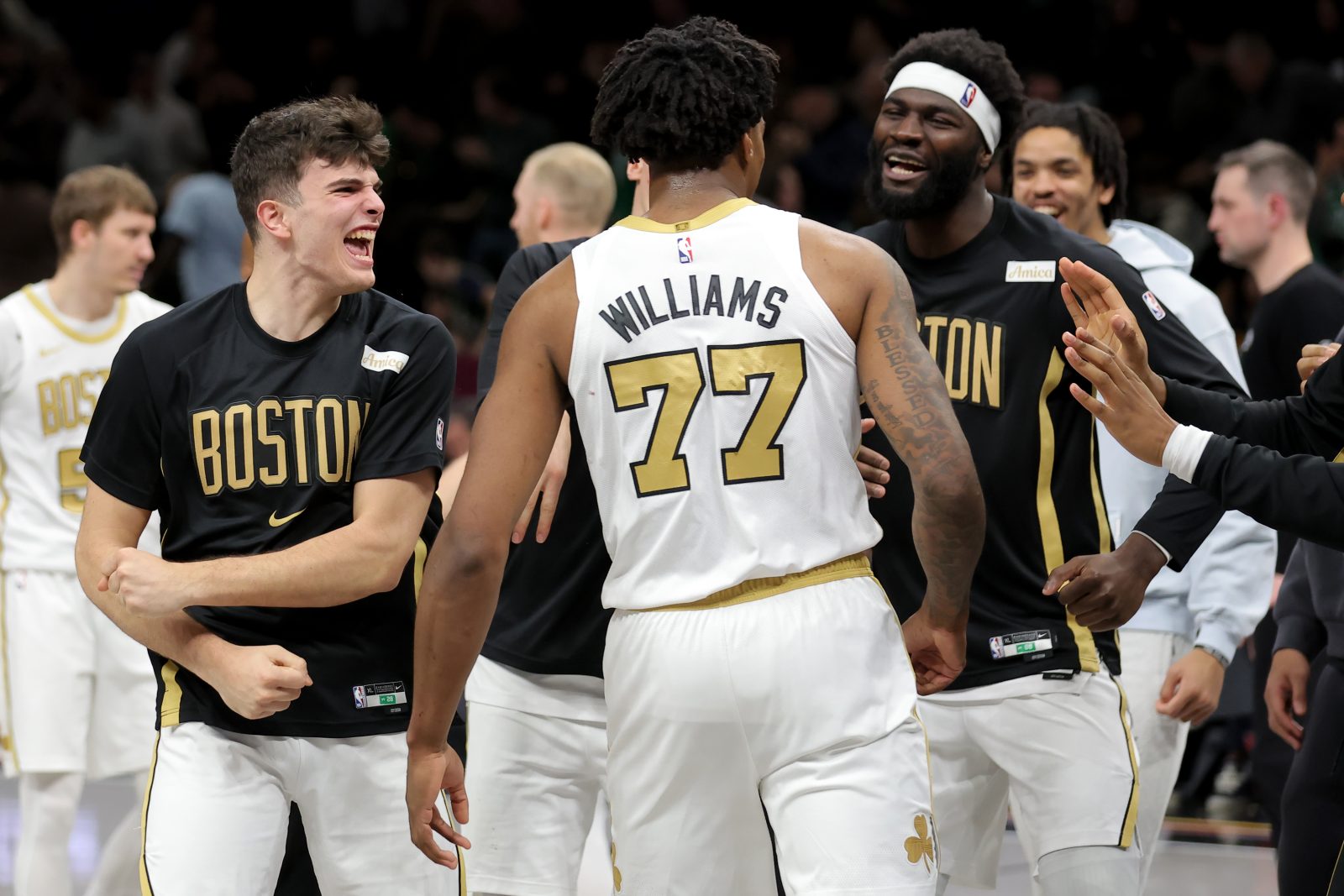
It doesn’t seem terribly long ago that NBA fans, analysts, and pundits were sharing their 2025 preseason predictions on how the Eastern Conference would shape out. Many assumed that the New York Knicks, fresh off their upset of Boston in the second round of last year’s playoffs, would summit the standings. Others believed that the Cleveland Cavaliers would build off their 2024-25 franchise-best regular season and maintain a top seed. Both assumptions have turned out to be incorrect thus far.
About 45 games into the 2025–26 NBA season, the Eastern Conference has taken the following shape:
- Detroit Pistons (33-11)
- Boston Celtics (29-17)
- Toronto Raptors (29-19)
- New York Knicks (27-18)
- Cleveland Cavaliers (28-20)
Despite being without All-NBA first teamer Jayson Tatum due to his Achilles injury last postseason, Boston has been one of the most impressive teams in the league this year. They have proven that this will not be a tank year, but one in which a deeper playoff run is actually feasible.
Yet, Head Coach Joe Mazzulla’s squad has been far from perfect at times. With the first half of the season already eclipsed, here are the Celtics’ biggest strengths and weaknesses:
Celtics’ Strength: Offensive Efficiency
Despite not being the highest scoring offense in the NBA (117 points per game), Boston still boasts the second-best offensive rating in the league (120.8). Additionally, they rank seventh in the association in effective field goal percentage (55.6).
In order for an offense to run efficiently, a team must take utmost care of the rock. Boston does just that, producing the second-lowest offensive turnover percentage this season (12.5), knocking on the door of the first place Oklahoma City Thunder. They lead the league in opponent points off turnovers (13.9).
With regard to how this efficiency has fared beyond the arc, it has not faltered. As has been reported many times before, one of the main aspects of the Joe Mazzulla era is the loyalty to the three-point shot. That has been the case this season, with Boston is shooting 36.9% on triples, good for eighth in the NBA.
Celtics’ Weakness: Points in the Paint
As commendable as the Celtics’ offensive production has been this year, there are a few glaring weaknesses that must be improved upon in order to have any postseason success. One of these weaknesses is their offensive presence in the paint.
With Al Horford and Kristaps Porzingis starting new chapters in their careers on different teams, Neemias Queta, along with role players such as Luka Garza, have had to man the middle. While the job they’ve done is nothing to scoff at, it’s become clear that down low is the weakest part of Boston’s offensive output.
Beantown currently ranks 27th in points in the paint (44.4). Change this to percent of points in the paint, and the Celtics are second to last, with 38%. Obviously, this lack of production close to the basket does not fall solely on bigs like Queta and Garza. In order for performance to improve, the entire team must make a conscious effort to be more aggressive.
Jaylen Brown recently informed the media that Boston does not go to the charity stripe often. Whether some believe that is in part due to officiating or not does not matter in this case, Mazzulla’s squad shoots the least amount of free throws in the NBA, at just 19 a game. Although free throws don’t count as points in the paint, the low number indicates Boston isn’t attacking the paint as much as they could be.
This is furthered by the Celtics’ number of shots attempted less than five feet from the hoop (21.2) being the lowest in the entire league.
Celtics’ Strength: Offensive Rebounding
As has been said by Celtics staff and players all season, they need to win the glass in order to win games.
On the offensive boards this season, Boston has been among the top teams, averaging 12.6 offensive rebounds per game, good for seventh-best in the NBA. In terms of offensive rebounding percentage, they also rank seventh (33.4).
Boston’s leading offensive rebounder, Queta, averages three offensive boards per game, placing him in the top 20 of the league.
https://twitter.com/B24Dunk/status/2009088569990893955?s=20
Back in early January during a win against the Chicago Bulls, the Celtics snatched a then-season-high 20 offensive rebounds and scored over 20 second-chance points, a stat they rank third in the NBA in (17.5). Chicago Head Coach Billy Donovan recognized his opponents dominance.
“…they (Celtics) get a lot of credit for their shooting, and how they are offensively, and they’re good, but a big big part of their offense is their ability to offensive rebound from all five spots,” said Donovan.
Celtics’ Weakness: Offensive Pace
Perhaps the least urgent soft-spot Boston has is that their offense is the slowest in the NBA, with a pace of 96.19. Because of this, the Celtics have struggled to generate fast break points, producing just 12.7 per game, the fourth-worst rate in the league. To go with this, their fast break point percentage is 10.9, the second-worst in the league. A quicker offense would not only improve these stats, but likely increase Boston’s scarce trips to the foul line.
Ultimately, the first half of the 2025-26 season has given Bostonians plenty to be excited about. They will look for their team to continue their overachieving play, while continuing to improve on the less-than-stellar.













Leave a comment