

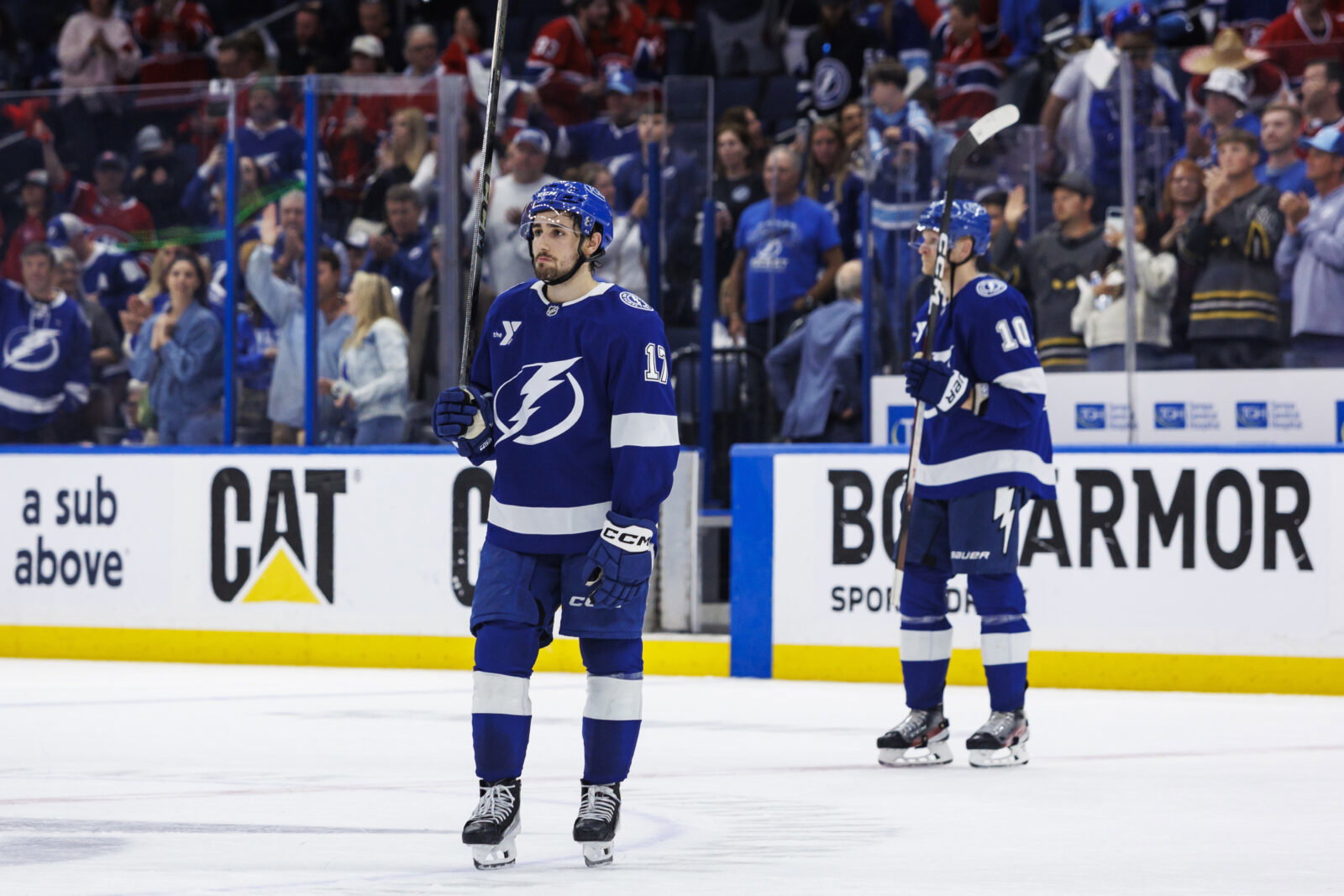
The first round of the Stanley Cup playoffs puts structure and calmness to the test. Teams can recover from mistakes over the course of a whole season. In a seven-game series, those same errors may change seasons and games.
To that note, the Lightning and the Stars let their mistakes compound the most and were the biggest upsets of the 2026 Stanley Cup Playoffs opening round.
Elimination of the Tampa Bay Lightning
After their in-state rival, the Florida Panthers, were eliminated from postseason contention in 2026, the Bolts entered the postseason with the goal of returning the Stanley Cup to the Sunshine State yet again.
A critical matchup against the young, feisty Canadiens proved to be difficult and boiled all the way down to a winner-take-all contest. Game 7 versus the Montreal Canadiens was never completely decided in Tampa Bay’s favor. It seemed controlled but not dangerous, even when they had possession.
Although the Lightning were able to move the puck through the neutral zone with ease, Montreal’s defensive system seized control once it was set up. Shooting lanes were immediately closed, and rebounds were collected before Tampa could set up second chances. Too many sequences ended with low-percentage shots from outside, allowing the Canadiens to regroup.
Nikita Kucherov had moments when he commanded the pace of the game by slowing it down, pulling defenders, and attempting to open up seams — but support was inconsistent.
Brayden Point, who is normally best at attacking inside the rink, was forced wide, restricting his ability to produce in tight spaces.
The larger concern emerged during the transition. Tampa Bay experienced several instances where a missed zone escape or a mistimed pinch resulted in an odd-man rush the other way. In playoff hockey, these are the plays that change the game in an instant. Andrei Vasilevskiy had to deal with clean looks more frequently than the Lightning would have liked in a Game 7.
Lightning Locked Out of Conference Semis
By the third period, it was evident that Tampa Bay was no longer dictating, but rather reacting. Pucks were pressed into traffic, entry became predictable, and the rush began to act against them rather than for them. The Canadiens walked out of Tampa Bay with a narrow, 2-1, Game 7 victory.
This was a shock not only to the Florida hockey community but the entire NHL. Tampa Bay has had a dominant first-round performance every time they have been in the playoffs since 2020 when they won the Cup. An early exit was a shocking result and an unplanned one for the Bolts.
Elimination of the Dallas Stars
The Dallas Stars had one of the league’s most balanced profiles going into the playoffs. Depth scoring, a structured defensive system, and dependable goaltending gave them the appearance of a long-term contender. However, under pressure during the first round, that balance never entirely translated.
The Stars gradually lost control rather than collapsing throughout their elimination game.
Dallas performs best when it can deploy four lines and gradually exhaust its opponents. That rhythm never settled in with this series. Shifts became more fractured, offensive zone time did not stack, and their attack lacked the layered support that defined their game at its peak.
Jason Robertson had times when he appeared to be ready to take over, creating opportunities with his release and positioning, but those sequences, like those of Tampa’s top players, did not build. They were isolated rather than supported.
Dallas did not have as many obvious defensive flaws as Tampa Bay, but the problem was more subtle and just as harmful. Gaps began to widen during transition, especially through the neutral zone. Opponents were able to attack quickly, forcing Dallas’ defense to pivot and defend rather than command.
That move is significant. When Dallas controls the tempo, their structure suffocates opponents. When they react, they create space, and that gap accumulates over time.
Jake Oettinger was solid in net, but he, like Vasilevskiy, was placed in situations when “solid” is insufficient. Playoff games at this level frequently rest on a single save in a high-risk situation, and Dallas allowed too many of those situations to unfold without intervention.
Stars Slashed from NHL Playoffs
The Stars appeared torn between identities toward the end of the game. They weren’t entirely committed to their methodical, grinding style, but they also weren’t launching a faster, more aggressive offensive. That uncertainty was evident in their puck management — missed connections, hasty decisions, and an inability to maintain pressure when it counted the most.
This would be a huge shock and disappointment for Dallas fans and NHL analysts because the Stars are not a first-round exit type of team. The Stars are also not known for cracking under the pressure as quickly as what they did.
Conclusion
The Tampa Bay Lightning and Dallas Stars did not leave the playoffs due to a lack of talent. They left because, under playoff strain, their structures failed to hold.
That is what makes the first round of the Stanley Cup Playoffs so punishing. It does more than just show faults; it multiplies them. Teams can overcome flaws over the course of 82 games. In a seven-game series, the same flaws determine the outcome.
Control, not just of the puck but also of identity, is what unites the two eliminations. The teams who advance are often not the most gifted. Even when the game becomes more competitive and there is less room for error, they are the ones who remain the most true to themselves.














Leave a comment