

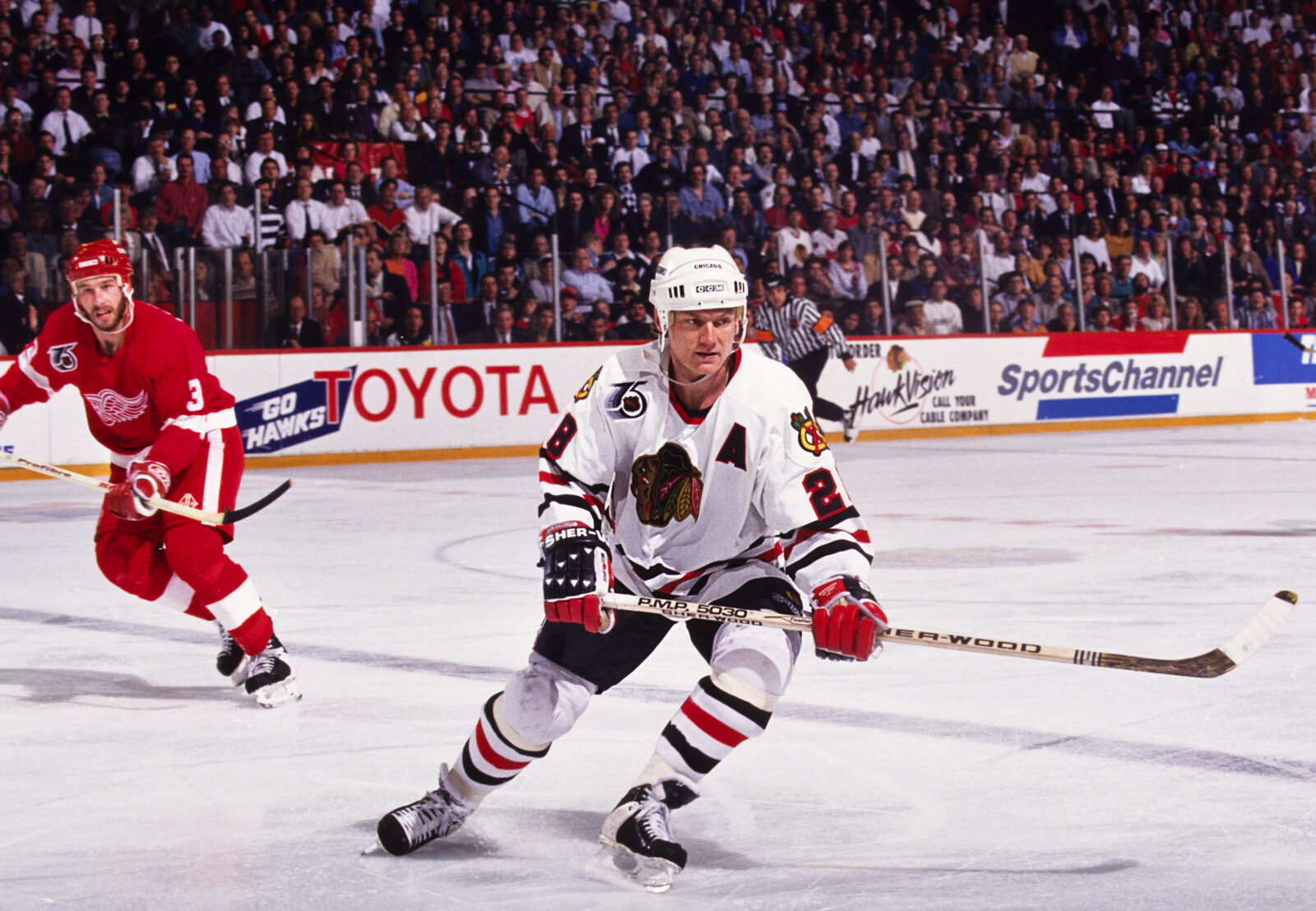
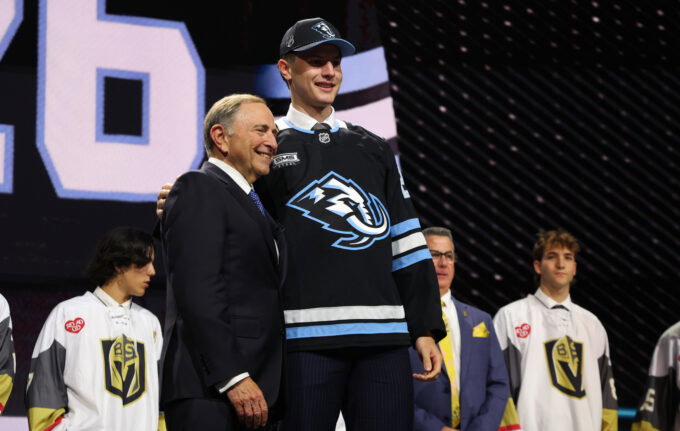
As draft season approaches, prospects rise and fall.
The Chicago Blackhawks have built through the draft since day one of the Kyle Davidson regime, making this time of year especially intriguing.
The bitter truth about the draft is that there is no “correct” draft pick. If there is one, it’s entirely unknown for years until true careers are underway and tangible evaluations can be made. The best players in a draft class seldom go first overall. In fact, in many cases, they fall past every team in the first round.
Lottery picks are fun to keep an eye on. Others rise above their draft night expectations and become fixtures in the lineup. While Blackhawks fans wait to see what they have in their prospect pool, one question comes to mind: Who are the greatest draft picks in Blackhawks history?
The Criteria
The key to any draft is finding the players in the late rounds. Anyone can pick Sidney Crosby, LeBron James, or Peyton Manning first overall and be secure in that choice. But, finding the Henrik Lundqvists (205th overall, 2000), the Nikola Jokics (41st overall, 2014), the Tom Bradys (199th overall, 2000). That’s where general managers make their money.
While Patrick Kane and Jonathan Toews panned out to be all-time greats, their status as top-three picks makes their selections less impressive. Let’s take a look at the best Blackhawks picked outside of the first round – the players that, in some cases, every team passes on at least one. Rankings will be determined considering draft position, personal achievements and team achievements specific to the Blackhawks.
Honorable Mentions
First, a chance to recognize some players who were drafted by the Blackhawks but made their bread elsewhere.
Dominik Hasek (10th round, 199th overall, 1983)
735 GP – 389 Wins – 2.20 GAA – .922 SV%
If this were a non-Blackhawk-specific ranking, Hasek would be near the top of the list. Possibly the most electrifying goaltender of all time. Along with Ken Dryden, Hasek owns the highest career SV% in league history, as well as the 8th best GAA. He won six Vezina trophies and became the only goaltender to win multiple Hart trophies. His playstyle was unorthodox, but it was beyond effective.
Had Ed Belfour not been at the prime of his career, Dominik Hasek would have been able to make a case for starting in Chicago. He was fine in his few games played, but there was simply no path to starting. Hasek was traded to the Buffalo Sabres for Stéphane Beauregard and a draft pick used to select Éric Dazé. Beauregard never played a game in Chicago, but Dazé became a career-long Blackhawk.
Alex DeBrincat (2nd round, 39th overall, 2016)
696 GP – 294G – 301A – 595P
DeBrincat occupied an interesting moment in Blackhawks history. In 2017, DeBrincat made his debut and slowly became a top linemate for Patrick Kane post-dynasty. Despite some high-level goal-scoring, his size led many teams to overlook him, leaving him a second-round steal for the Blackhawks. Some questions also arose about whether he could maintain his scoring touch without Connor McDavid, a linemate with the Erie Otters. In two of his five seasons with Chicago, Cat eclipsed the 40-goal mark and established himself as an elite scorer.
Once Kyle Davidson took the reins, DeBrincat became a casualty of the youth movement. After a career year, he was traded to the Ottawa Senators for the seventh and 39th overall picks in the 2022 draft. Those picks turned into Kevin Korchinski and Paul Ludwinski, the latter of whom has since been traded. DeBrincat has continued his top-tier goal scoring with a Red Wings team that has struggled to make the playoffs. He has spent much of his time on a line with a former Blackhawks teammate, Kane.
Bryan Bickell (2nd Round, 41st overall, 2004)
395 GP – 66G – 70A – 136P
This selection breaks the cycle of the previous two honorable mentions, as he did spend all but 11 games of his career in Chicago. He was in the league for a good time, not a long time, and he was a solid depth forward.
In 75 playoff games, Bickell posted 2o goals for 39 points. His best run was in 2013 when he logged nine goals and 17 points in 23 games. The man was made for playoff hockey. Most memorably, Bickell scored a late goal off an excellent feed from Toews to tie Game 6 of the 2013 Stanley Cup playoffs. This was the first of two goals scored in 17 seconds before winning the game and, in turn, the Cup. His iconic celebration from that goal lives on in Blackhawks history.
#10 – Andrew Shaw (3rd Round, 57th overall, 1980)
544 GP – 116G – 131A – 247P
Shaw, much like Bickell, will forever be known for his role-playing. Shaw combined with Brandon Saad and Kane to form “the Mutt and the Mullets” line, coined after Shaw’s playstyle and his linemates’ hairstyles. The nickname “mutt” comes from his sheer tenacity and pestering personality. Since his time with the Blackhawks, Shaw has become a fan-favorite draft comparison for undersized yet energizing forwards.
Shaw had several moments, but almost everyone remembers watching the headbutt. In an overtime playoff game against the Anaheim Ducks, Shaw headbutted a puck into the net and “won” the game. Of course, this goal was reversed, and the Blackhawks went on to win later in the game. Still, many fans credit Shaw with this goal, even if history does not.
#9 – Dustin Byfuglien (8th Round, 245th overall, 2003)
869 GP – 177G – 348A – 525P
It’s hard to imagine a 2010 Stanley Cup without Big Buff. A steal in a round of the draft that didn’t even exist by the time he was lifting Lord Stanley. Although originally a defenseman, Joel Quenneville, looking to integrate size up front, chose to move him to the wing. It paid off, and Byfuglien became an outstanding piece of the Blackhawks’ middle six.
In 2010, Buff posted 11 goals for 18 points in 22 playoff games. In that run, he logged five power-play points, all of which were goals. His size in the net-front position on the man advantage was a key piece in the Blackhawks’ run for the Stanley Cup. His size, combined with his tenacity, made him a power play coach’s dream – no puck went unwacked. Nowadays, the Minnesota native can likely be found fishing and even pursued a brief professional career.
#8 – Dave Bolland (2nd Round, 32nd overall, 2004)
433 GP – 85G – 123A – 208P
Exactly the type of forward that contending teams need for their bottom six. Some may scoff at the production given his status as a high second-round pick, but he was a role player’s role player. He posted 17 goals for 43 points in 67 playoff games. For the role he played, that’s really, really good.
When first drafted in 2004, it’s unlikely general manager Bob Pulford expected his second-round selection to score a Stanley Cup-winning goal. Fast forward nearly a decade, and he did just that. Scoring the second of two goals scored in 17 seconds, the image of Bolland flipping off his gloves in excitement will be ingrained in Blackhawks history forever.
#7 – Brandon Saad (2nd Round, 43rd overall, 2011)
984 GP – 269G – 269A – 538P
The other mullet. Nowadays, Saad is often remembered as the core return on the trade that sent Artemi Panarin to the Blue Jackets. Yes, Saad had two different stints in Chicago. His first one was incredible, spending time bouncing around the top six and flying alongside each of the Blackhawks’ best forwards. Saad contributed to the 2013 and 2015 Stanley Cup rosters.
Although Saad has spent the majority of his career away from the organization, his contribution as a young player will be remembered for years to come. Saad, approaching the final chapter of his career, has a chance to win a Stanley Cup this season with the Vegas Golden Knights. Although not a full-time member of the lineup, his experience with one of the greatest dynasties in modern league history is surely valuable.
#6 – Marcus Krüger (5th Round, 149th overall, 2009)
520 GP – 38G – 85A – 123P
Rostered for the 2013 and 2015 Stanley Cups, Krüger was a home run in the fifth round. Here’s an instance where draft position takes precedence over quality in the rankings. Although many would consider Saad or even Bolland a better player, Krüger’s status as a fifth-round pick who became an elite penalty killer deserves recognition.
Although the totals aren’t sexy, he showed out in big moments. Most notably, Krüger ended the longest postseason game in franchise history with an overtime goal against the Ducks in the 2015 Western Conference Final. He’s an outstanding example of why teams treat their late-round picks with respect.
#5 – Troy Murray (3rd Round, 57th overall, 1980)
915 GP – 230G – 354A – 584P
The legend of Murray goes beyond just the ice. In fact, many newer Blackhawks fans know him as a radio and TV analyst for the organization. Drafted into an era where the Blackhawks typically went deep but couldn’t get over the hump, Murray developed into a league-best defense-first forward. In 1986, Murray won the Selke trophy to prove it.
Eventually, Murray was traded to the Winnipeg Jets. After only a few seasons, he was traded back to the Blackhawks and spent some time on both the NHL and IHL rosters. He bounced around the league, won a Stanley Cup in the final year of his career with the Pittsburgh Penguins, and then entered the broadcast booth. Murray recently passed away in March, and his legacy as a beloved Blackhawk lives on forever.
#4 – Corey Crawford (2rd Round, 52nd overall, 2003)
488 GP – 280 Wins – 2.45 GAA – .918 SV%
History has not remembered Crawford very kindly. Oftentimes, he is seen as an average netminder who benefited from playing behind some of the best defensemen of the modern era. Simply put, he is not just that. Any goalie who backstops two Stanley Cup-winning efforts is much more than just a guy benefiting from a system.
Crow was clutch. Like, maybe one of the most clutch the league has ever seen. When facing elimination, Crawford is 14-6, tied with Martin Brodeur for the second-most wins in that scenario. When including potential series-clinching games in that record, Crawford is 25-9, ranking fifth all-time in wins under the combined stat. Far more often than not, Crawford was at least good enough to give his team room to win when the lights were the brightest.
#3 – Steve Larmer (6th Round, 120th overall, 1980)
1006 GP – 441G – 571A – 1012P
Larmer, nicknamed Gramps, is possibly the most impressive steal of the list. If not for a couple of dynasty legends in the No. 1 and 2 positions, he would surely be at the top. Larmer was almost always good for 30 goals and 70 points, even though that might even be considered a down year for him.
The 1980 draft class was a legendary one for the Blackhawks. Denis Savard was drafted 3rd overall, Murray in the 3rd round, and Larmer in the 6th. His lack of individual accolades, aside from his Calder Memorial Trophy, has overshadowed his legacy more than that of most 400-goal, 1000-point players in league history. Despite this, many still lobby for his induction into the Hall of Fame for his high totals and consistent play across a 15-season career.
#2 – Niklas Hjalmarsson (4th Round, 108th overall, 2005)
821 GP – 25G – 147A – 172P
Without Hjalmarsson, it’s very likely the Blackhawks are still looking for their first Stanley Cup since the Original Six era. He was known for eating pucks for dinner. He sits fifth in all-time shots blocked in the playoffs and second all-time in the Finals. When the postseason came around, he was the first to put it all out there for a chance to win it all.
At the height of his career, he was good for 20 minutes of TOI/GP, and even more in the playoffs. Every last minute that he spent on the ice was sound, productive, and stifling. Teams would kill to draft a player like Hjalmarsson as high as the late first round. In the fourth round, he was the epitome of a steal.
#1 – Duncan Keith (2nd Round, 54th overall, 2002)
1256 GP – 106G – 540A – 606P
Jay Bouwmeester, Joni Pitkanen, Ryan Whitney, Keith Ballard, Steve Eminger, Denis Grebeshkov, Anton Babchuk, Martin Vagner, Ondrej Nemec, Trevor Daley, Matt Greene, Tomas Linhart, Kirill Koltsov, Anton Kadeykin and Dan Spang. The previously listed players are all defensemen selected before Duncan Keith in the 2002 NHL Entry Draft. 15 defensemen were selected above the one who went on to be the best on the list.
Hindsight is 20/20, and Keith’s frame was a serious concern. Regardless, he rose above the detractors and became one of the greatest blueliners in league history. A Hall of Famer, a member of the NHL 100 Greatest Players list, a two-time Norris winner and a Conn Smythe Trophy winner. Keith accomplished every last thing that an NHL defenseman could, and he did so after being passed up on by almost every NHL team at least once.
Potential Current Steals
Now this raises another question: Do the Blackhawks have any potential steals in the making? It’s impossible to know for sure, but here are a few players who already seem to be outplaying their draft position.
Louis Crevier (7th round, 188th overall, 2020)
134 GP – 10G – 22A – 32P
The aforementioned blue liner has been excellent in his young career. In his first season with the NHL roster full-time, he scored seven goals for 25 points. Not bad for a 7th-round pick known for his 6-foot-8 frame and rangy defensive skill set.
A draft pick of the Bowman front office, it was unlikely Crevier was going to impress the new guard enough to keep around. Many draft picks from the previous general manager were seen as expendable during the early stages of the rebuild. The Quebec City native, however, defeated those odds and looks to be a future stud for the second or third pairing.
Roman Kantserov (2nd round, 44th overall, 2023)
(KHL) 164 GP – 57G – 60A – 117P
Kantserov had draft-faller written all over him. His small frame is one thing, but the pseudo-concerning “Russian Factor” also made him less desirable. Thankfully, the Blackhawks used their second-round selection on him, and it’s looking up. The winger put together a KHL resume comparable to Kirill Kaprizov‘s, and he turned out alright.
Questions remain as to who will occupy the wings for the Blackhawks’ future. Who will play alongside Bedard, Frondell and others? Kantserov, as soon as next season, can be that guy for one of the top-six centermen. With his ELC signed, he now has a chance to stun the NHL and prove why he deserved a first-round selection.
Nick Lardis (3rd round, 67th overall, 2023)
41 GP – 10G – 5A – 15P
Another high-end talent selected in the 2023 draft. Although his rookie season left a lot to be desired, the former Brantford Bulldog is right there. After scoring 71 goals in his final OHL season, many people questioned his ability to translate that skill to the NHL. With a 20-goal pace as a 20-year-old, some of those concerns may be slowing down.
The name of the game for Lardis is finishing. He has the shot, he has the skill, but there were too many goals left on the board. It’s very likely that he lands on Bedard’s wing at some point next season. For that to happen, he needs to consistently prove an ability to capitalize on the space and opportunities provided by the superstar. If he stays on track, he will prove very soon that he belongs in the upper echelon of forwards in the NHL.









Leave a comment