

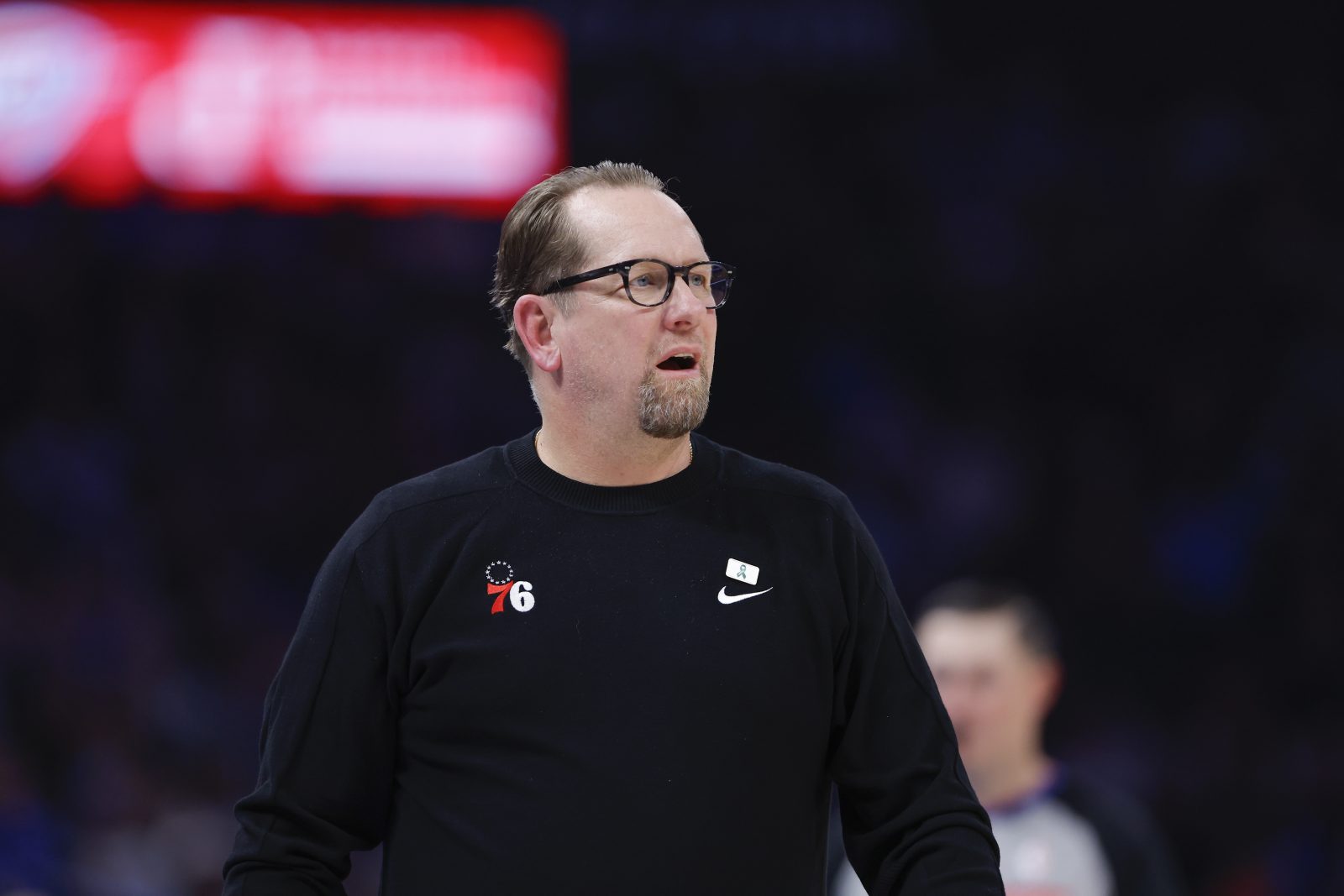
At this point in the season, most NBA teams are searching for consistency. The Philadelphia 76ers, however, are still searching for a lineup.
Night after night, Head Coach Nick Nurse rolls out a different combination of starters and bench units. With so many injuries, Nurse often has to tweak rotations mid-game.
While adaptability is usually a strength, the constant shuffling has raised a bigger question: Why can’t the Sixers settle on a set rotation? Also, is that instability starting to hurt more than help?
The simplest explanation is also the most obvious one: injuries and illnesses have forced Nurse’s hand. But that explanation only goes so far.
Injuries Have Made Stability Impossible
There’s no denying that availability has been a problem. Key contributors for the 76ers have missed time due to injuries, lingering soreness, and periodic illnesses that disrupt game-to-game planning. Just as one unit starts to build real chemistry, another player goes down. This sends Nurse right back to the drawing board.
The turnstile health has especially impacted the frontcourt and bench rotations. Rather than settling into defined roles, players are constantly moved around based on who’s healthy on a given night. One game might feature extended minutes for a bench player. The next night, that same player is barely in the rotation at all.
Star center Joel Embiid has battled persistent knee issues and has missed extended stretches, leaving the 76ers scrambling for a dependable frontcourt presence.
Emerging guard VJ Edgecombe, wing Quentin Grimes, and big man Dominick Barlow have each missed time this season due to injury or illness, making rotation planning even messier.
For example, one recent report noted that multiple rotation players were sidelined or questionable due to an illness “running through the 76ers’ organization,” leaving Nurse unsure of how to deploy his preferred lineups on a game-to-game basis.
From a coaching standpoint, this constant flux makes it nearly impossible to lock into consistent minutes. Nurse has repeatedly emphasized the importance of “playing the guys who are available,” and that mindset has dictated much of the rotation chaos.
Still, injuries alone don’t fully explain the extent of the experimentation.
A Coach Who Trusts Flexibility
Nick Nurse has never been a rigid coach. That philosophy helped him find success earlier in his career. However, in Philadelphia, it has resulted in a rotation that feels perpetually unfinished.
Even when the roster is relatively healthy, Nurse often opts to bench players rather than stick with predetermined lineups. Players can see their minutes swing dramatically based on one good or bad stretch, making it difficult to establish rhythm or confidence.
Fans and analysts alike have pointed to moments where it feels like rotations shift more because of indecision than strategy. One recent critique focused on Nurse’s handling of backcourt minutes, highlighting how inconsistent minute assignments for guards have left observers scratching their heads.
The Cost of Constant Change
Rotational instability doesn’t just impact individual players — it affects the entire team structure. Defensive communication suffers when lineups change constantly. Offensive flow slows when players aren’t sure where their touches are coming from or who they’re sharing the floor with.
The Sixers have shown flashes of cohesion, especially in short stretches where Nurse sticks with a unit for extended minutes. But those moments often disappear as soon as the rotation shifts again, resetting progress that took weeks to build.
There’s also a long-term concern. Playoff teams typically shorten and solidify their rotations well before the postseason. If Philadelphia enters the playoffs still unsure of who their trusted eight or nine players are, that uncertainty could become a liability.
Is There an End in Sight?
To Nurse’s credit, the constant rotation changes may be part of a larger evaluation process. Injuries have forced the coaching staff to give extended looks to fringe players. This reveals who can actually be trusted in specific roles.
As the roster gets healthier, the expectation is that the experimentation will slow. Hopefully, Nurse will commit to a more stable lineup. But until that happens, questions will remain.
At some point, adaptability has to give way to structure. Injuries and illnesses can excuse some instability, but they can’t justify uncertainty. The Sixers don’t need perfection; they need clarity.
And until Nick Nurse settles on a set rotation, clarity will continue to be in short supply.











Leave a comment