

The Philadelphia Phillies and Atlanta Braves met in the postseason for the third time in five years.
In a tense best-of-three series, the Phillies forced Atlanta to a win-or-go-home Game 3. Ultimately, though, Philly came up short again, marking their third consecutive early postseason exit.
A tight Game 1 leaned toward the Phillies after a late, pivotal go-ahead triple by J.T. Realmuto. But with two outs in the eighth, Austin Riley took a fastball from Jhoan Duran deep to right-center field. His go-ahead three-run home run proved too much to overcome, and the Phillies lost the opener 5-3.
The Phillies flipped the script in Game 2.
When a misplay in the outfield by Bryce Harper ultimately led to two runs scoring before the inning ended, it looked like the Phillies would be sunk again.
But Kyle Schwarber began the top of the eighth with a home run, bringing Harper up. Harper got his redemption with a game-tying home run, then Alec Bohm went deep in the tenth to give the team a 4-3 lead they managed to hold.
Named the Game 3 starter, Aaron Nola immediately struggled out of the gate, walking two of the first three batters he faced. With Michael Harris II batting, Nola gave up a 3-run home run the Phillies could not recover from. The Braves added two more homers and sealed the series off with a 6-2 win.
Another heartbreaking postseason exit leaves the Phillies with a lot to think about ahead of this offseason. What are some major takeaways from this three-game set? Some are positive, some are negative, and some could have serious implications for the team’s future.
Bullpen Woes Continue to Bite Phillies
The Phillies bullpen’s instability was a point of contention heading into this series. Philly has faced recent postseason heartbreaks because of its bullpen, and the team’s relief unit struggled all year. During September, their 5.79 ERA ranked as the worst in baseball.
All that led to questions about how Don Mattingly would navigate trying to get to the 27th out. Jhoan Duran had been a sure thing all year, and rookie Alex McFarlane showed he could handle big moments, too. Andrew Painter excelled late in the year in the rotation but was expected to get bullpen work in the playoffs. Around those three, uncertainty ran much deeper.
Mattingly tipped his hand early in Game 1 after the Phillies took the lead late. Entering the bottom of the seventh, Jhoan Duran came in earlier than anyone expected. While it’s unclear whether he would’ve taken the rest of the game from there, Mattingly may have hoped Duran would pick up a rare three-inning save.
Ultimately, they wouldn’t get to find out if that was the plan. The team’s bullpen struggles extended to their relief ace, Duran, who couldn’t get the last out of the eighth. After getting two outs early, he allowed a single and a hit-by-pitch before allowing the go-ahead home run to Austin Riley.
It marked the third postseason in a row the Phillies had a lead in the seventh inning or later and blew it. Despite the Phillies putting their most trusted relief ace on the mound, their struggles continued.
Andrew Painter Is Ready for the Big Moments
Entering the year with sky-high expectations, Andrew Painter initially fell very short of those goals. In a season that didn’t go as planned, Painter posted a 7.06 ERA and was sent back to Triple-A.
He was called back up on July 31 when the team needed a starter in a pinch, and the rest was history. He transformed his season with a 3.62 ERA in his final 11 starts, showcasing an elite changeup and revitalized confidence.
Despite the impressive late showing, Painter was expected to serve a bullpen role in the playoffs instead. The Phillies intended to get him relief innings late in the regular season. However, their near-collapse in the final weeks didn’t give them a chance. Instead, he was forced to wait for his big moment.
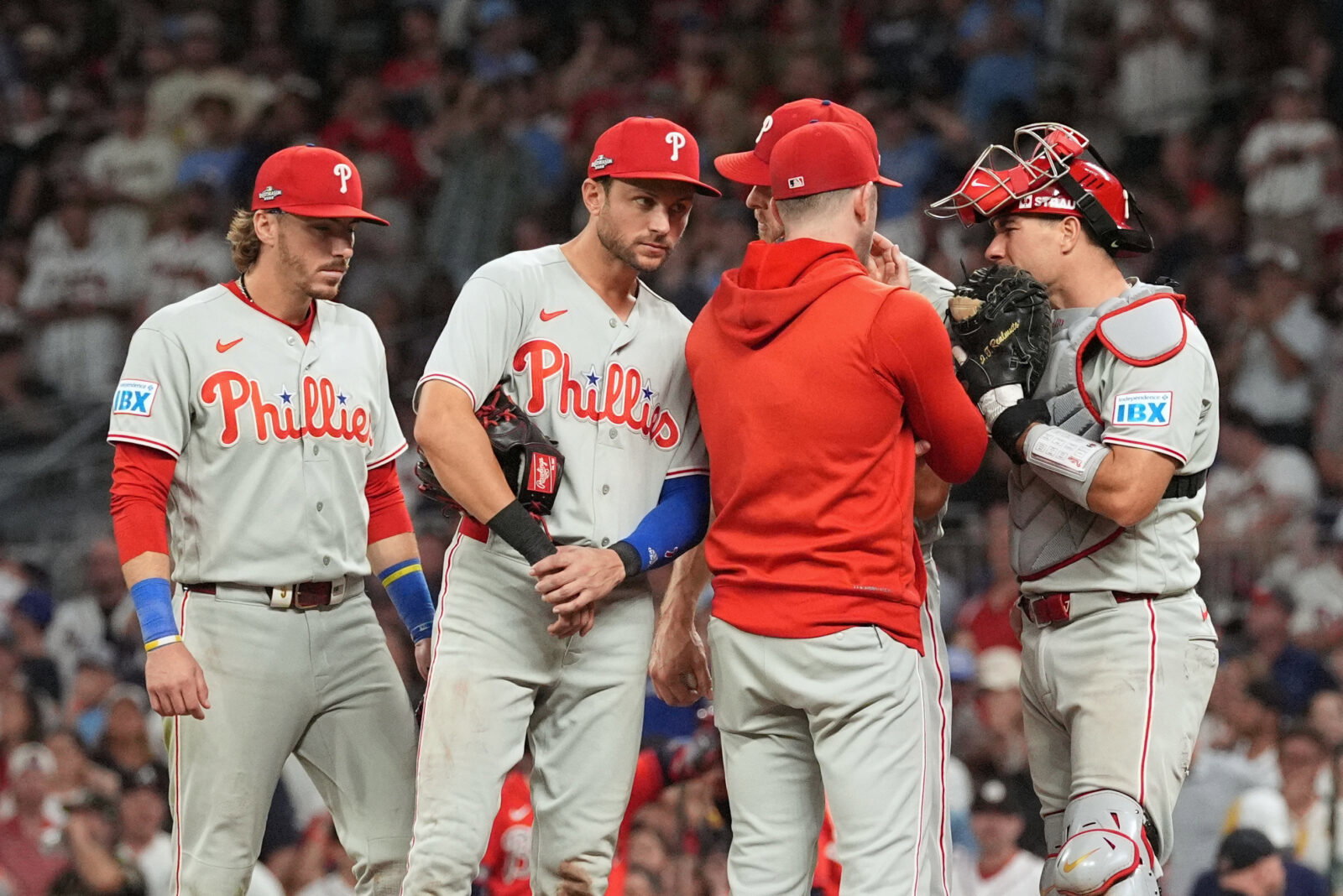
In Game 2, Painter got that moment to shine. After the Phillies tied the game in the top of the eighth, they handed him the ball. After throwing six straight balls to start, a mound visit from pitching coach Caleb Cotham settled him down.
In the eighth and ninth innings, he allowed just a leadoff walk and a two-out single in the ninth. When the Phillies took the lead in the tenth, they entrusted Painter with keeping it.
The righty began by striking out Matt Olson looking. He struck out Game 1 hero Austin Riley, but gave up a hit before and after Riley’s at-bat. With two on and two out for pinch hitter Dominic Smith, potential trouble was brewing.
Instead, Painter bore down and finished the outing with a three-pitch strikeout, securing Philadelphia’s lone win of the series. His dominant relief outing earned him plenty of praise and showed his maturity developing.
The Current Core’s Time Is Running Out
When the Phillies went on their run to the 2022 World Series, it felt like the beginning of an era. An elite core headlined by Bryce Harper and Kyle Schwarber added Trea Turner a year later.
Their rotation featured two quality starters in Aaron Nola and Zack Wheeler. Christopher Sanchez took the next step and developed into an ace. Young players Bryson Stott and Brandon Marsh were also showing promise.
But Philly still hasn’t won a championship with this core, and it’s slowly shedding pieces.
Mainstay Rhys Hoskins left in free agency after 2023. Ranger Suarez signed with the Red Sox after the 2025 season. Nick Castellanos was released before the start of 2026 after a tumultuous tenure with the team. Now, the Phillies will be set to lose three members of the 2022 team who have continued to contribute:
- Alec Bohm, 3B
- Edmundo Sosa, UTL
- Jose Alvarado, LHP
More changes could still come. After 2027, the Phillies could lose Zack Wheeler, Jhoan Duran, Brandon Marsh, and Bryson Stott in free agency. The Phillies will likely pursue extensions with most of these players, especially Duran and Stott. But Brandon Marsh’s dismal second half (.502 OPS, 31 wRC+) could force the team to move on from him early.
Despite the team’s string of postseason runs, an offseason of change looms for the Phillies. This core’s lack of a championship could lead to drastic changes, some of which may not become clear until later in the winter.








Leave a comment