

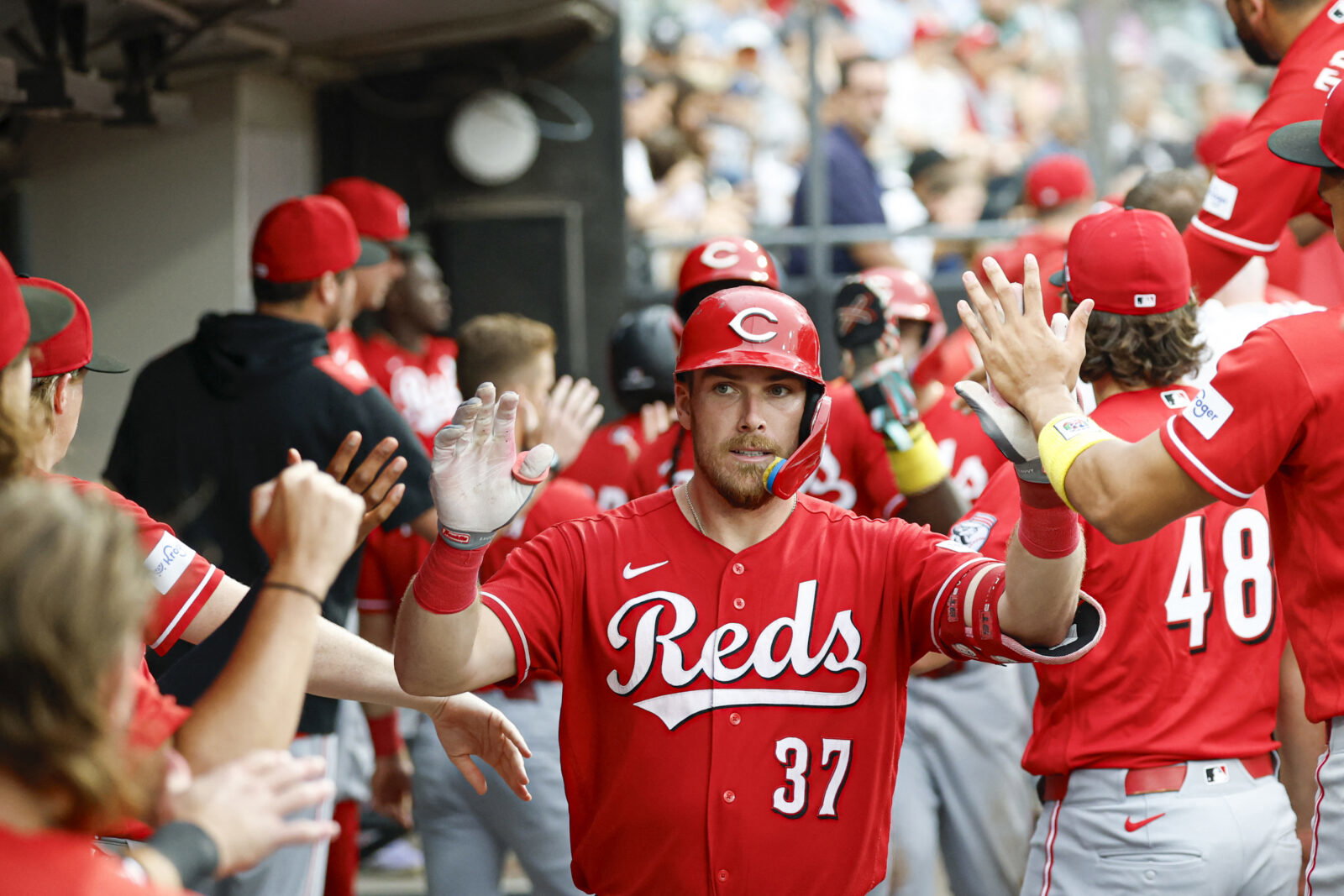
The Cincinnati Reds face a big decision at one of the most important positions on the diamond. Their starting catcher and longest-tenured player, Tyler Stephenson, will be an unrestricted free agent. The Reds need to decide whether to re-sign the player they drafted and developed or let him walk to another team.
After a trade deadline that had Stephenson’s name written all over it, the Reds decided to keep him. It seemed that discussions stalled and no agreement could be reached. Now that he is a free agent, any team can come knocking, and it would be up to him to answer. Since he wasn’t traded, if Stephenson decides to leave, the Reds will get nothing in return. Given his offense and reliability behind the plate, teams that need a catcher have him circled.
A projected qualifying offer looks to be around $23 million for next season. Stephenson’s market value is $11.6 million. Although Stephenson might not be worth $23 million, it’s better for the club to keep him on the roster. Given the value he brings to the team and the possible replacements in the clubhouse and across the league, the Reds need to prioritize re-signing Stephenson.
Offensive Value
With Stephenson
The Reds can’t afford to lose a bat like Stephenson at catcher. Although he hasn’t been as consistent with the bat since his shoulder surgery, the former first-round pick remains a quality bat. He can hit for power and spark a big play at the plate when the team needs it. Stephenson can be put anywhere in the middle of the lineup and make an impact.
Even with the slow start to his 2026 campaign, Stephenson was a strong bat for the Reds. His .241 average and .727 OPS ranked sixth and seventh, respectively, in the dugout. He brings offensive potential to the lineup and is better than most catchers.
Catchers this year have the slash line of .229/.302/.382. Stephenson finished with .241/.323/.404. In a position that struggled offensively this season, the seventh-year man proved to be an adequate bat.
Without Stephenson
Looking at a room of Cincinnati catchers without Stephenson, that position would take a huge step back. Jose Trevino and Will Banfield are the other two catchers on the roster. Neither of those two were impressive with the bat in their hands in 2026. Stephenson provides more offensive production than his backup and third string.
Appearing in 52 games, Trevino hit for .217/.221/.336 with five home runs and 19 RBIs. Banfield played in 11 games and hit .150/.143/.200 with no home runs and one RBI. In Stephenson’s 130 games, he hit 15 home runs and drove in 54 runs.
Keeping Stephenson as the primary catcher offers much more upside than relying on one of the backups. He brings more run production, power, and a much better chance to get on base.
Top Free Agent Replacements
Stephenson is one of the top free agent catchers available. If the Reds decide to move on from the 30-year-old, they will need to look elsewhere. The answer for the starting spot isn’t already in the dugout, and there’s little promise around the league. A couple of replacements could add value to Cincinnati, but not enough to replace what Stephenson can bring.
While the organization prepares for top prospect Alfredo Duno to make his way to Cincinnati, the Reds may look for a bridge to fill the gap until Duno is ready.
Ryan Jeffers
Minnesota Twins catcher Ryan Jeffers appears to be the best available catcher on the market. In his seventh year with the Twins, he played 92 games. He hit for a slash line of .256/.353/.461 with 14 home runs and 56 RBIs. His .814 OPS is only .087 higher than Stephenson’s, and Jeffers’ run creation is nearly identical. He compiled those numbers in 38 fewer games, due to him missing nearly two months with an injury.
The 29-year-old would definitely be an offensive upgrade at catcher if the Reds went that route. However, he isn’t as reliable as Stephenson is at defending the plate. The Twins catcher ranks in the 51st percentile in blocks above average, which is 35th among catchers. The Reds catcher ranks in the 97th percentile in that statistic, which is the third best. Jeffers putting on the pads in Cincinnati would help the offense, but would hurt the Reds’ defense.
The seventh-year man did have success in ABS challenges. He ranked fifth in baseball in runs above average. He also had the sixth-most strikeouts gained from challenges, and the third-most walks eliminated by challenges. Stephenson ranked 10th and 11th, respectively. While the Cincinnati catcher isn’t far behind in those categories, he has the second-most ABS wins and a higher win percentage. Jeffers had more meaningful challenges, but Stephenson brings more ABS challenge success.
Carson Kelly
Chicago Cubs’ Carson Kelly is another potential signing for the Reds. He is coming off his two-year contract in Chicago and has a mutual option for 2027. Playing on his fifth team, he is coming off one of his best years in the batter’s box.
Kelly’s .258 average with the bat is the best mark of his career. His .712 OPS is lower than Stephenson’s, but his career-high 58 RBIs and average tops the Redleg. The Cub is also a lot more disciplined at the plate. Kelly struck out only 16.5% of the time, his best full-season rate. Stephenson struck out 27.4% of the time. The 32-year-old hit for a better average, drove in more runs, and struck out less, but has a much weaker swing.
The Red’s catcher finished this year with his highest career exit velocity at 90.8 mph. This is the fifth-highest for catchers. The free-agent Cub averaged 86.7 mph, which ranks 21st. Stephenson’s barrel ranks in the 82nd percentile, whereas Kelly’s ranks in the 24th. Kelly would be a huge step down in the power department.
Although a qualifying offer might be the only way the Reds resign Stephenson, the organization should take that route. The more valuable catcher currently resides in Cincinnati. If the Reds want the best chance of success at catcher, the number 37 needs to be back in the dugout in 2027.










Leave a comment