

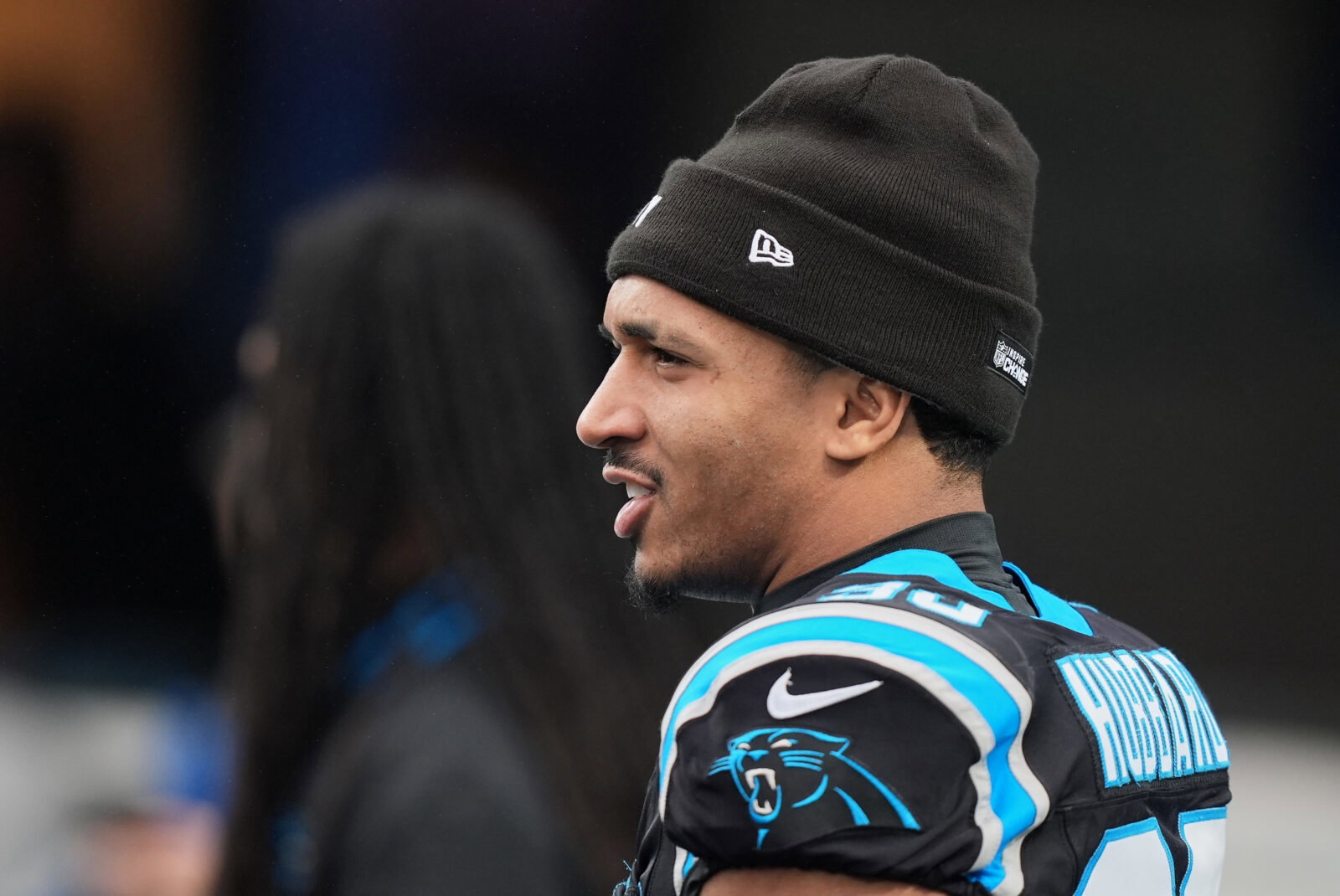
Chuba Hubbard’s story works because it resists the usual scouting shortcut. The Carolina Panthers running back did not leave Alberta as a finished American football product. He left as a sprinter, a high school star, and a Canadian prospect trying to translate speed into trust.
That translation matters beyond Carolina. Canadian fans now follow the NFL through broadcasts, fantasy leagues, data sites, podcasts, and Canadian NFL sportsbooks, but Hubbard gives the map a human name: Sherwood Park to Stillwater, then to Sundays.
For readers in Canada, that arc is more useful than a simple highlight reel. Hubbard’s career shows how a player can move from a smaller domestic football environment into the sport’s deepest player pool, then stay there by becoming more than the fastest athlete on the field.
Sherwood Park Still Matters in Hubbard’s NFL Story
Hubbard grew up in Sherwood Park, Alberta, a place more likely to be framed through hockey culture than NFL production lines. That matters because Canadian football prospects often face a visibility problem before they face a talent problem. The athlete may be strong, fast and disciplined enough, but the scouting machinery is not always built around their schedule or competition level.
At Bev Facey Community High School, Hubbard built the first version of his football identity. He was not just a running back with space to operate. He was a track-caliber athlete learning how to turn straight-line speed into angles, patience, and contact balance.
The early Canadian chapter is important because it keeps the story from becoming too neat. Hubbard did not simply “make it out.” He carried a local athletic base with him, and that base stayed visible in the way he played: quick acceleration, long-stride burst, and the confidence to win races to the edge.
| Stage | Canadian relevance | Football meaning |
| Sherwood Park, Alberta | NFL pathways can start outside traditional U.S. recruiting hubs | Built the foundation before major NCAA exposure |
| Bev Facey football | Keeps the biography rooted in a Canadian high school setting | Developed early running back instincts |
| Junior sprinting background | Connects Canadian track development to football speed | Helped create breakaway ability |
| Oklahoma State 2019 | Turned a Canadian prospect into a national college name | Proved he could handle volume and attention |
| Carolina Panthers extension | Shows long-term NFL trust, not only draft-day curiosity | Confirmed value as a professional contributor |
The point is not that every Canadian prospect should copy Hubbard’s path. The point is that his path widened the imagination of what a Canadian running back can look like before he reaches the league.
The Sprinter Who Became a Workload Back
The easy version of Hubbard’s profile starts with speed, and for good reason. His track background gave him a trait that scouts understand quickly: if he found daylight, the play could change shape in two seconds. But the better part of his profile starts with whether that speed could survive real football volume.
At Oklahoma State, Hubbard answered that question in 2019. He became one of the defining players of that college season, carrying the Cowboys’ offense with the kind of week-to-week production that is hard to dismiss as a novelty. His rushing total, touchdown production, and award recognition moved him from “fast Canadian back” into a more serious category.
That matters for Canadian readers because it separates athletic promise from professional projection. Plenty of players are fast. Fewer can handle stacked boxes, pass-protection expectations, changing game scripts, and the physical boredom of taking the right four-yard gain again and again.
Hubbard’s 2019 season remains the hinge of his biography. It proved his Canadian background was not a charming side note. It was the first chapter of a player who could carry an American Power Five workload and still create explosive plays.
Why Carolina Tested More Than Hubbard’s Speed
The Panthers selected Hubbard in the fourth round of the 2021 NFL Draft. That draft slot tells its own story. They respected him, but didn’t treat him like a risk-free star. For a running back from Canada, that meant the next test would be less about being noticed and more about being trusted.
NFL trust is built in small, often unglamorous ways. A back has to know when to press the hole and when to cut. He has to protect the quarterback, catch routine throws, stay available, and accept that his role can change with injuries, trades or signings.
Hubbard’s Carolina years have reflected that reality. He has had seasons where opportunity grew, seasons where efficiency mattered more than volume, and seasons where the backfield picture shifted around him. That is normal NFL life, but it matters even more for a Canadian biography because staying in the league is often a stronger statement than arriving in it.
His 2024 contract extension with Carolina sharpened that point. Teams do not extend running backs only because of one highlight or one college memory. They do it when the player has become part of the organization’s working plan.
What Can Canadian Prospects Learn From the Hubbard Model?
Hubbard’s career is useful because it is not built on one lesson. For young Canadian players, especially those outside the biggest recruiting circuits, the most valuable parts are practical.
Key takeaways from his path include:
- Speed matters most when it is attached to a football skill, not when it exists alone.
- Canadian high school film can open doors, but prospects still need verified competition and repeatable traits.
- A major college breakout can change perception, but it also raises the standard.
- NFL staying power depends as much on reliability as on explosiveness.
- National identity can be a strength when it adds context, not pressure.
Those lessons are not glamorous, which is why they are useful. Hubbard’s story is not only about a Canadian player reaching the NFL. It is about a Canadian player becoming ordinary in the best possible sense: part of the weekly professional conversation.
The Broader Canadian NFL Meaning
Canada has never lacked football talent. The harder question has been how often that talent becomes visible early enough, supported well enough, and refined in the right environments. Hubbard’s biography sits inside that question.
He is not the only Canadian name with NFL relevance, and he should not be treated as a one-player solution to a national development puzzle. Still, running back is a particularly revealing position. It is physical, crowded, replaceable in roster-building terms, and often unforgiving when a player loses half a step.
That makes Hubbard’s staying power meaningful. He has had to be fast, but also durable, detailed, and adaptable enough to keep earning touches. For a Canadian fan, that is the part worth holding onto.
Hubbard’s legacy does not need to wait for retirement to have shape. He has already given Canadian football a modern NFL running back case study with local roots, college dominance, and professional endurance. That combination is rare enough to matter, and grounded enough to teach.











Leave a comment