

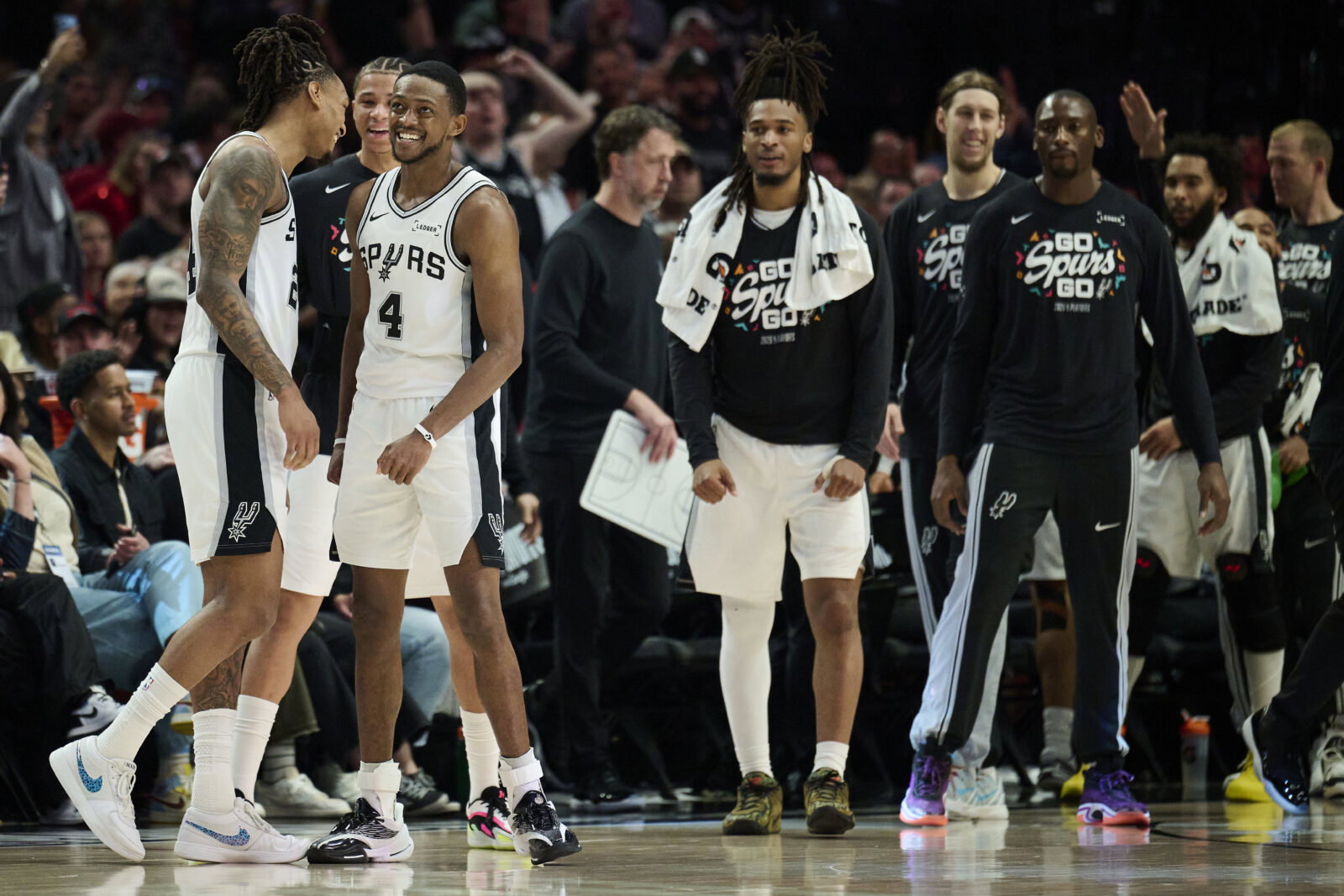
De’Aaron Fox was criticized after dropping Game 2 to the Blazers. Three games later, he closed the series.
The reaction came quickly. With Victor Wembanyama getting hurt and the Spurs struggling, attention shifted to Fox— and not in a positive way. Questions about his four-year, $229 million contract resurfaced, with some labeling it one of the worst deals in the league.
It did not take long for that narrative to change.
A Proven Track Record
Fox’s career does not reflect a player who needs to prove himself.
Since entering the league, he has steadily developed into one of the more reliable guards in the NBA. His production peaked in Sacramento, where he averaged 26.6 points per game during the 2023-24 season while earning All-Star and All-NBA honors. Even in more recent seasons, his ability to score efficiently and create for others has remained steady.
Now in San Antonio, his role has shifted.
With Wembanyama as the focal point, Fox is no longer the primary option every night. Instead, he operates as a secondary scorer and playmaker, averaging 18.6 points and 6.2 assists this season while shooting 48.6 percent from the field, in a role that requires a different kind of impact.
The Game 2 Reaction
Then came the criticism following Game 2 when Wembanyama got hurt. Expectations shifted towards Fox to carry a heavier offensive load. When the Spurs fell short, the reaction was immediate, and the conversation quickly moved from performance to contract value.
The Response
Fox answered in the way top players often do, by performing when it mattered most.
In Game 4, he delivered what Spurs head coach Mitch Johnson described as “might’ve been his best game as a Spur,” finishing with 28 points on 11-of-17 shooting while adding seven assists and controlling the pace throughout.
https://twitter.com/NBATV/status/2048554918856831152?s=20
He followed that performance with an even more decisive showing in Game 5.
Fox scored 13 of his 21 points in the fourth quarter, taking over late and leading San Antonio to a 114-95 win to close out the series. He also added nine assists, finishing as a +26 in the game.
Across Games 4 and 5, Fox combined for 49 points and 16 assists while shooting over 60 percent from the field and 45 percent from three when it mattered most.
A Different Kind of Value
The criticism surrounding Fox’s contract often centers on the idea that he is being paid like a primary option.
That may be true financially, but it overlooks how his skill set fits alongside Wembanyama.
Fox’s speed, ability to attack the paint, and playmaking create a dynamic that complements a dominant interior presence. Rather than needing to be the number one option, he thrives as a player who can collapse defenses and open up opportunities for others.
That type of fit holds value, even if it looks different from traditional star production.
The Bigger Picture
One playoff loss sparked a wave of criticism, but his last two games to seal out the series ended it.
The 28-year-old did not suddenly become a different player over the course of a week. Instead, the perception around him changed because of the results, which is often how narratives work in the playoffs.
De’Aaron Fox’s role in San Antonio is not to run the offense every night. His production, experience, and ability to control games make him a strong complementary piece next to Wembanyama. Performances like the ones that closed out the series serve as a reminder of that.












Leave a comment