

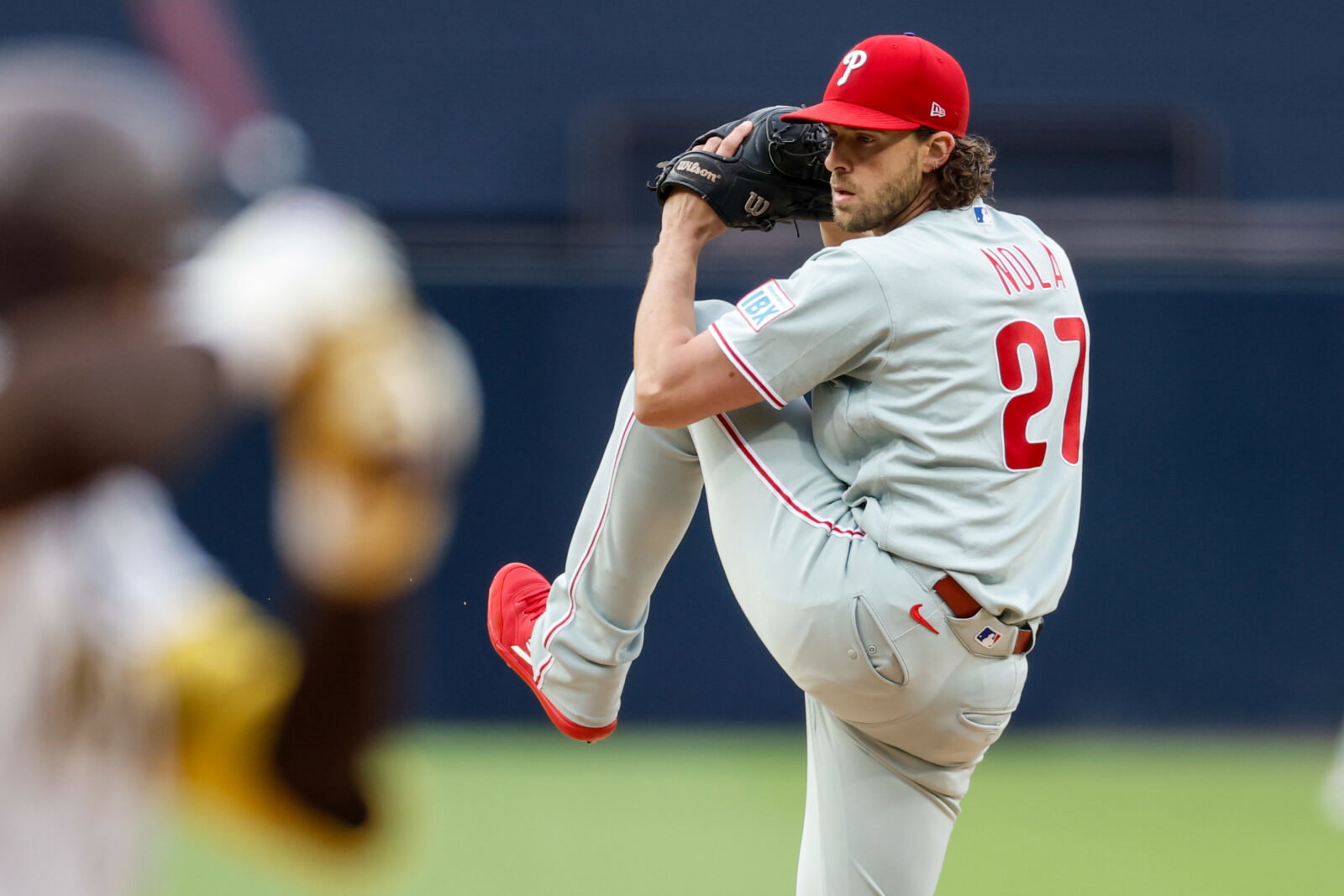
Just two seasons ago, Aaron Nola was a reliable, above-average starter for the Phillies, pitching to a 3.57 ERA over 33 starts. The righty has been a cornerstone of Philadelphia’s rotation for the last decade. But in recent years, he’s pitched more like a liability.
Since 2025, Aaron Nola has had the third-highest ERA (minimum 150 innings pitched) at 5.90. His 17.4% home run-to-flyball ratio is baseball’s worst in that time. And while his four-seam fastball was never the highlight of his arsenal, it has turned into batting practice, with its -13 run value ranking as the worst of any pitch in 2026.
This year, Nola has turned in a 5.72 ERA over 11 outings, the third-worst mark in baseball. His 10 home runs allowed are tied for fourth-most in the National League. Though he’s provided his share of quality outings this year, he’s turned in some disastrous outings as well.
What has Nola done right this year? Is there anything from his good starts this year that indicates a potential lifeline to avoid another lost season?
Aaron Nola Has Baseball’s Worst Fastball, Second-Best Curveball
As mentioned earlier, Nola’s four-seam fastball is ranked as the worst by Baseball Savant’s run value metric. Batters have hit .404 against it with a .904 slugging percentage in 58 plate appearances. Unsurprisingly, both of these marks are among the worst in baseball (third-highest average, highest slugging percentage).
Ironically, Nola also owns one of baseball’s most valuable pitches. His curveball has a run value of +7, second best to Ben Brown of the Chicago Cubs and overall in the top 30 for all pitchers and pitch types. Nola’s curveball is in the top 20 of several statistics, including:
- Batting average (.198, 16th)
- Slugging percentage (.272, 14th)
- Whiff rate (37.6%, 11th)
- Strikeout rate (31.3%, 20th)
- Hard hit rate (23.6%, 6th)
A Changing of the Arsenal
Sometimes the solution to a pitcher’s problems is simply to throw an ineffective pitch less. While that doesn’t always work out, it’s something that has given Nola some success in his last two outings.
Nola’s pitch usage has changed a significant amount from his first nine starts this year to his last two. He’s dropped his fastball usage from 27.9% to just 20.4% in his last two outings, while upping his curveball use from 31.7% to 42%.
Nola’s four-seam will have to improve undoubtedly, as his sinker (which he has thrown more frequently as well) also lacks. It has a little more horizontal movement than the average sinker (+1.1 inches vs comparable pitches) but stays more flat and lacks vertical break (-2.8 inches). Surprisingly, Nola’s movement profile on his four-seam is a little more favorable than average.
The biggest issue affecting Nola’s four-seam has been its location. When compared to his other two most-used pitches (curveball and sinker), there is a stark difference in how they are located. Nola’s fastball has found the heart of the plate too often, as evidenced by the pitch location maps on his Baseball Savant page. His below-average velocity (91.7 MPH) on his four-seam only adds to the ease of barreling it in a sport that is becoming ever-reliant on higher pitch speeds to succeed.
How Else Can Nola Save His Season?
Nola has issued no walks in his last two outings. In his first nine, he walked 18 in 45.2 innings pitched. His 9% walk rate would’ve still been below the league average of 9.3% this season, but noticeably above his career 6.4% clip entering 2026.
Reining in his control will be a big focal point of his season, but his ability to eat innings will also be important. So far, Nola has gone at least six innings in just three of his starts. His ability to survive bad outings and provide the Phillies with six or more innings has always given the team value even when he hasn’t performed at his peak.
There have still been signs of vintage Nola, too. In his second start of the year, Nola went 6.1 innings against the Rockies and allowed just one run while striking out nine. Against the Padres on May 26, he pitched six innings and allowed just three hits and no walks.
Nola’s prime is behind him, but the path to being an effective pitcher is still there. Though he’s cemented his status as one of the team’s better pitchers in recent history, there’s fair reason to believe that he may be able to add a bit more to his rap sheet before he ends his career.










Leave a comment