

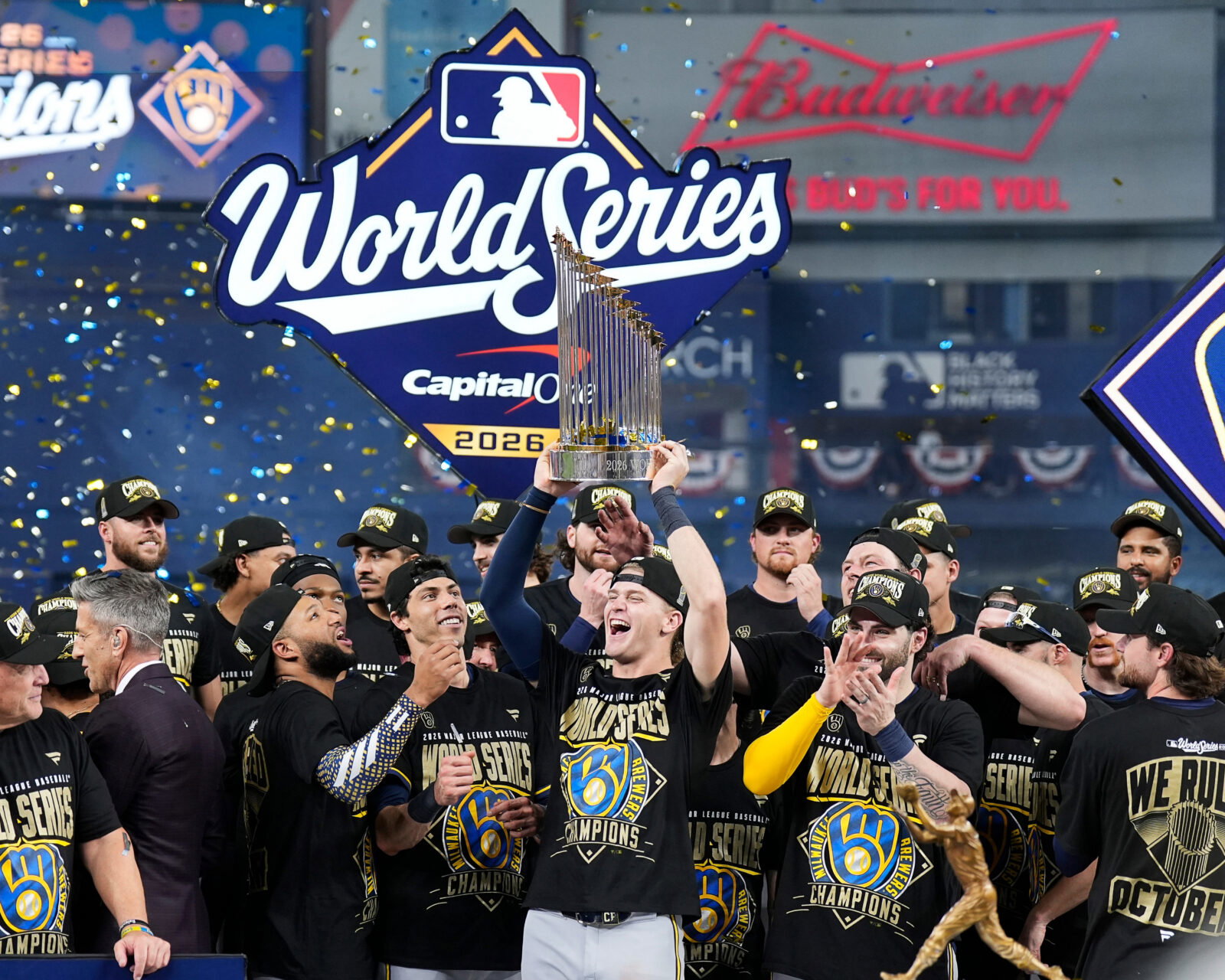
“Ueck sent me a text today,” Milwaukee Brewers manager Pat Murphy said, holding a bottle of champagne after the 2026 World Series.
“You did it for the city. You did it for the state. And you boys ought to be awfully proud to know that you’re the first-ever Milwaukee Brewers team to be world champions,” Murphy finished before the locker room exploded in cheers, jumps and fizzing alcohol.
Bob Uecker was the voice of the Brewers for 54 years. He passed away in 2025, having seen no Milwaukee titles. Two seasons later, after 56 franchise years of ringless seasons and seven consecutive playoff exits, the Brewers had won the World Series.
The Brewers didn’t listen to the way Major League Baseball was creating championship-level teams. There’s no hundred-million-dollar superstar. No player generating clicks with 500-foot home runs. No drama, no boasting, and as a result, no major attention.
This was a team of hungry, humble ballplayers. No one player was prioritized over another. A culture of old-school baseball that pushed modern analytics farther than any other club had. That culture built itself through earning opportunities.
“Standard creates the culture,” Brewers captain Christian Yelich said postgame. “You have yes or no checkpoints that you can look at yourself and your teammates in the mirror every day and say, “Did I do this? Am I doing the right thing?” And then we can all hold each other to that … which creates the winning, which creates the culture.”
This Milwaukee club will go down as one of the most dominant postseason teams in baseball history. In an era headlined by $700 million player contracts and big-market team authority, a $146 million roster from the Midwest wasn’t intimidated.
Although competitive, Milwaukee bested the red-hot San Diego Padres in the Divisional Series, three games to one. They later stared down the tyrannical Los Angeles Dodgers in pursuit of a three-peat, and swept them in four games.
Their final test for the Commissioner’s Trophy was a team that emulated their style of play, the Tampa Bay Rays. The first two games in Milwaukee were closely contested one-run wins where the Brewers did what they do best: win in the margins.
Game 3, shifting over to Tampa Bay’s Tropicana Field, went all Brewers early with a 10-0 win to go up three games in the series. The Rays were able to force a Game 5 with a dramatic extra-innings walk-off, but the Brewers capped it off Wednesday with a 4-1 victory.
All October, the Brewers lost twice, both of which came by one run. In seven of their 11 wins, they trailed at some point in the game. This was dominance through constant pressure. Every time the opponent scored, the Brewers came roaring back an inning later.
Deeper baseball fans knew of this team’s potential. Milwaukee won the most games in the regular season for the second straight year, but playing in the World Series gave national attention to this club of largely unknown players.
William Contreras is now a premier catcher in baseball. He was the heartbeat of this team all postseason and earned his stripes with the World Series MVP award. Young studs like Jackson Chourio and Cooper Pratt never flinched on baseball’s biggest stage. Jake Bauers, Brice Turang, Sal Frelick and Garrett Mitchell all came up big and got on base.
Every single player in the lineup had a moment. That’s not something that can be said about most title winners. But the lineup was one small part of what brought the first-ever World Series to Wisconsin.
Jacob Misiorowski, the Brewers’ 24-year-old likely Cy Young winner, finally had his marquee playoff start in Game 5. After being the clear-cut best pitcher of 2026, he was slightly off in his four earlier playoff starts. That said, a cramp was the only thing that took Misiorowski off the mound. He exited early in the sixth with no runs and just two hits allowed.
Although Misiorowski was complemented by Logan Henderson and Robert Gasser in the rotation, this bullpen was the most valuable piece. All postseason, the late-game assortment of Abner Uribe, Aaron Ashby and Trevor Megill combined for 38 ⅔ innings at a 0.93 ERA.
Ashby himself was Milwaukee’s most important player of October. He covered 18 innings without surrendering a single run, a new single-season relief pitcher record.
“This is everything you dream of,” Ashby said. “When you’re putting yourself in these scenarios as a little kid, like I’m in Game 7 of the World Series … this is the best thing ever.”
But perhaps nobody deserved it more than Yelich. He’s been a Brewer for the last nine years and been on seven of Milwaukee’s playoff-exit teams.
“I think of all those low moments,” Yelich said, reflecting on his 14-year playing career. “You don’t realize at the time, but those low moments prepare you for this moment. Without those, this wouldn’t be possible.”
In 2024, in Uecker’s final game, the Mets’ Pete Alonso hit a go-ahead home run in the ninth inning to eliminate Milwaukee in the Wild Card Series.
Two seasons later, smiling from above, he watched his Brewers win it all.








Leave a comment