

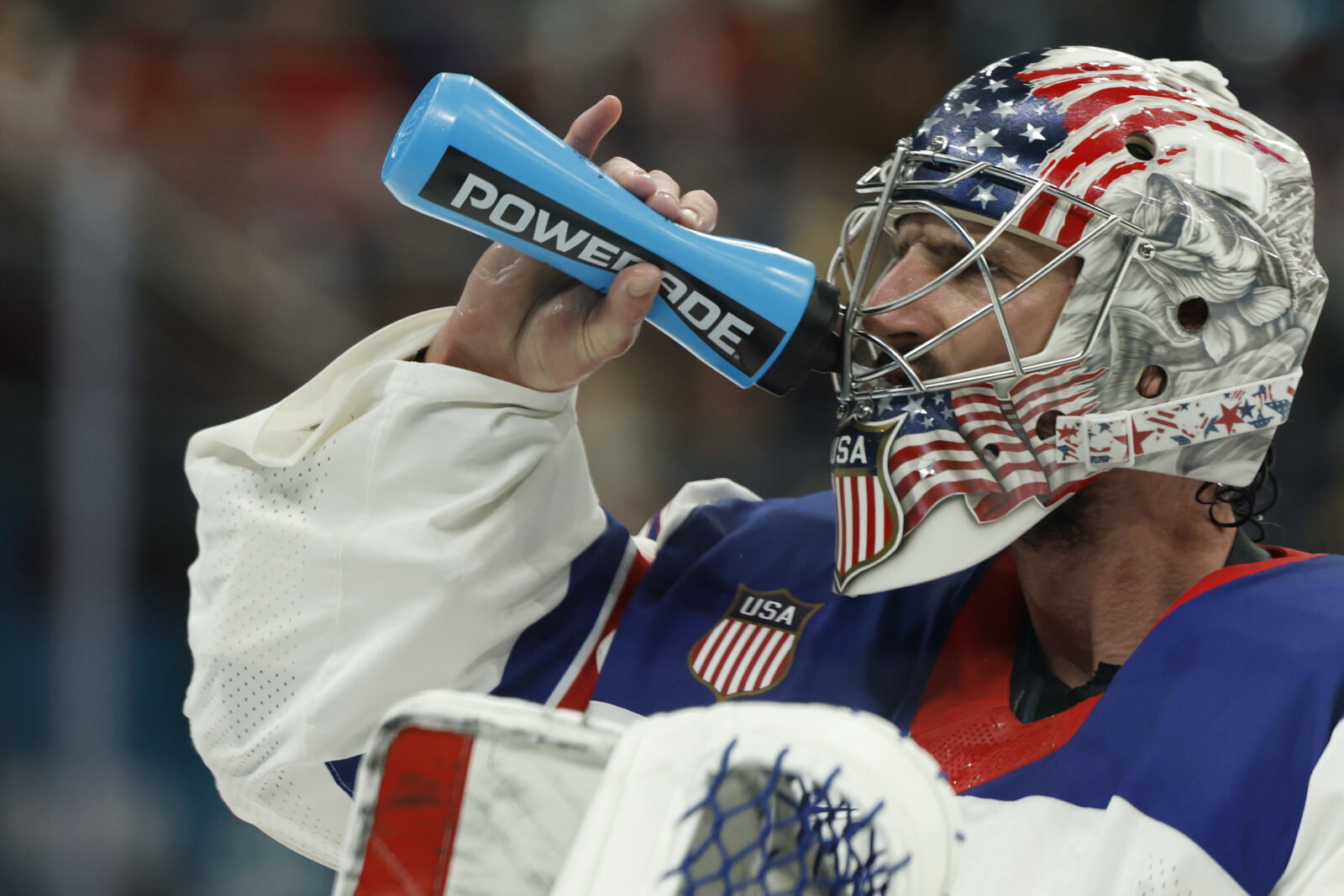
Late in the third period, a defenseman who skated cleanly for two periods is a half-step behind the play.
His first pass misses its target. His legs feel heavy on a routine stride. Nothing in the box score explains it, and the simplest cause is the one nobody on the bench can see, which is the liter and a half of sweat he has lost under his pads since warmups. Cold air hides the effort, and hockey punishes the player who forgets he is still sweating hard inside all that equipment.
Sweat Trapped Under the Pads
Hockey produces some of the heaviest sweat losses in sport. Professional players have been measured losing close to two liters of fluid an hour on the ice — more than most basketball or soccer players reach — because full equipment holds in body heat and pushes the sweat glands harder than a cold rink would suggest. A full set of pads and a helmet seals in warmth, so even on a sheet of ice near freezing, the player’s core climbs as if he were working in summer heat. Goaltenders, buried under the most gear, tend to lose the most of anyone on the team.
The losses outrun the refills. Studies of elite players found they put back only about 58% of the fluid they sweat out across a session, and many arrived at practice already mildly low on fluid before the first drill began. A player who starts a step behind and falls further behind reaches the point where performance drops by the third period, often without ever feeling alarmed. The deficit is quiet, and quiet is what makes it dangerous on the ice.
Replacing the Fluid and the Salt
Replacing the volume is only half the task because sweat removes sodium with the water, and plain water alone does not replace it. Between periods, a player reaches for more than a water bottle. A quick snack, a salty mix, or the best electrolyte drink a player trusts to sit well in the stomach all aim at the same target: putting salt back with the fluid so the body keeps what goes in. Carbohydrates belong in that window too, since the stop-and-start sprinting of a game drains stored fuel as fast as it drains water.
What works depends on the player. A light sweater gets through a game on water and a banana. A salty, heavy sweater needs sodium added back across the night, or the cramps arrive in overtime when the game is on the line. The window between periods runs only about 15 minutes, so whatever goes in has to be quick and easy to stomach.
The On-Ice Cost of Fluid Loss
The decline shows up in the parts of the game that decide it. Once fluid loss passes roughly 1.5% of body mass, skating speed drops and reaction time lengthens, while the fine control needed to handle a puck or pick a corner starts to slip. The causes of dehydration read like the log of a bad night: heavy legs, a foggy head, and a cramp that locks the calf mid-stride. None of it looks dramatic on its own, and all of it costs the fractions of a second that decide a race to the puck.
The brain pays a price as well. Tired and short on fluid, a player reads the ice a beat slower and forces a pass that was open two seconds earlier. A goalie tracking a point shot through traffic needs that same sharpness, and fluid loss dulls it at the exact moment a rebound needs to be smothered into the glove. Hockey gives no time to recover the lost beat, because the play has already moved on by the time he notices.
The Cold-Weather Blind Spot
The rink works against the player’s own sense of need. Cold air blunts thirst, so a player who is genuinely low on fluid may feel no urge to drink at all. The reminder to keep drinking through the winter months applies twice over on the ice, where the chill convinces the body it is fine while sweat keeps draining under the pads.
The cold does more than mute the signal. Exercising in the cold raises fluid loss through routes a player never notices, since the body sheds extra water through the kidneys and through every breath of dry arena air. By the time a hockey player feels thirsty, the deficit is usually well past the point where it has already taken a step off his game.
A Long Game on Thin Margins
Fluid is essential for a long, repeated effort, and a hockey game is exactly that. Sixty minutes of short, maximal stints stack across three periods, with a fresh sprint demanded every 45 seconds on the ice. The player who manages fluidity across the whole game holds his speed into the third period. The one who does not fade at the worst time, when tired legs and a slower brain meet a one-goal score.
The answer is a plan. Thirst comes too late to be the guide on the ice, so a player who steps on the scale before and after a game sees exactly how much he lost, then builds his drinking around warm-ups, every stoppage, and both intermissions. The habit is unremarkable, and it separates the defenseman still skating hard in overtime from the one hanging on by the final minutes.
The Margin of a Single Liter
A hockey player can lose close to two liters of fluid an hour, replace barely half of it, and skate into the next game already short before the first whistle.
None of that announces itself, least of all in a cold building that tells the body everything is fine. The players who treat fluid as part of their equipment, tracked and planned as carefully as a skate sharpening, are the ones still moving when the game is decided. The margin between them and the fading player is often no more than a single liter put back and the other left out.









Leave a comment