

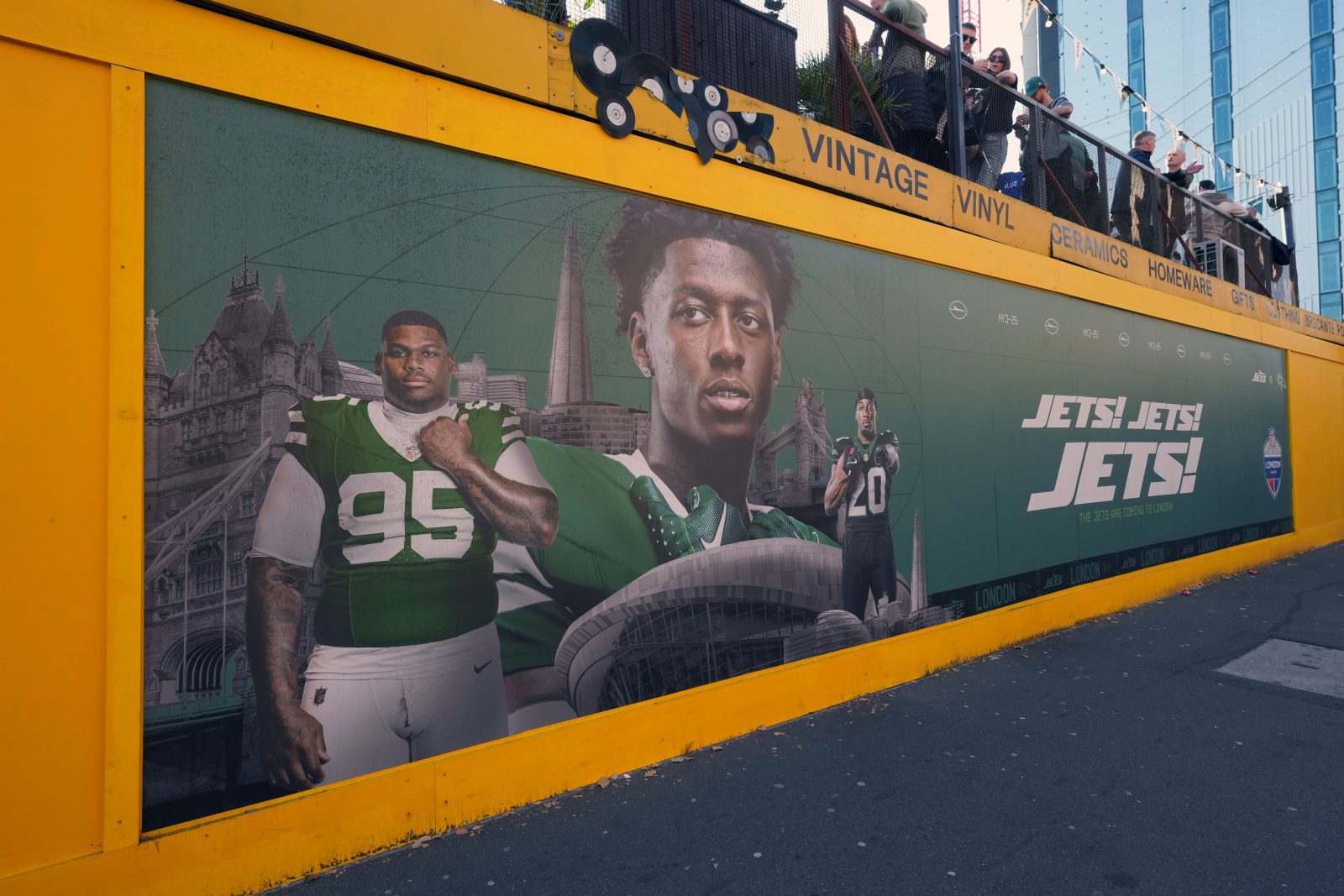
Throughout recent New York Jets regimes, one of the main issues that consistently plagued them was their inability to sell when necessary.
But over the last week, general manager Darren Mougey has had one of the most aggressive trade deadlines of all time. With the Jets on the verge of missing the playoffs for the 15th consecutive year, New York has officially hit the big red button.
Michael Carter II
On the verge of the deadline, Mougey hinted at his willingness to move on from redundant talent. Although Michael Carter II was a borderline elite nickel for the Jets for multiple years, the wear and tear of back injuries, combined with a changing scheme, has impacted his play for the worse.
With the arrival of Brandon Stephens and Jarvis Brownlee, both solid, capable slot corners, Carter II has now been on the outside looking in. Which is why getting any kind of return was ideal. Discounting John Metchie, moving Carter II for a 6th and 7th round swap was shrewd business by the Jets, especially considering the cap savings on top of the trade.
However, Carter II was the easiest move to make for the Jets front office as someone out of the starting lineup. There were other, more aggressive trades on the horizon.
Sauce Gardner
With four hours left on the trade deadline, the first major domino fell.
In a major shock, franchise cornerstone and two-time All-Pro Sauce Gardner was traded to the Indianapolis Colts. For a team that extended Sauce the summer prior, the deal felt unfathomable.
But that’s why the deal was made. Knowing how much it would take for Mougey to part ways with his franchise cornerback, Indianapolis offered an irrefutable offer of two first-round picks and receiver Adonai Mitchell. On top of those assets, the Jets also freed up the majority of his four-year, $120 million contract in cap space.
The “tradability” of this contract allowed Mougey to prepare for the wildest scenario. Although he likely didn’t plan to trade Gardner, the Jets found themselves at a surplus of solid corners after strong play from Stephens, Brownlee, and rookie Azareye’h Thomas this season.
Now staring down another reset at quarterback, Mougey saw the depth at corner as an opportunity to use Gardner’s value to replenish elsewhere. But it could only be acceptable if the Jets got the appropriate value for their superstar. With four first round picks in the next two drafts, New York had already situated themselves well for the future.
Quinnen Williams
Unlike Sauce, trading Quinnen Williams always felt within the realm of possibility.
And within the hour, Mougey confirmed the total defensive teardown by trading Williams to the Cowboys. Just like that, the final cog to a once great defense was gone.
Given Williams’ long standing internal frustration with losing, this trade felt digestible especially in the context of the Sauce trade. New York wasn’t competing soon, and the Jets star defensive linemen could not afford to waste more of his prime.
Despite the reports of the disgruntled superstar, Mougey got another great return in the end. The Jets now have three first round picks in a loaded 2027 draft class, while also having four picks in the first two rounds this year. Although league sources suggested that Williams would fetch a first round pick, New York’s front office has shown an unwillingness to settle at market value.
Unlike the Sauce trade though, trading Williams shouldn’t suggest much confidence in their in-house options. Mougey needed to maximize Williams’ value before it depreciated any further. For the rest of the season, the Jets will likely be one of the worst defensive fronts in the NFL and undergo a complete retooling in the off-season.
Verdict
In spite of the enormous haul, it’s hard to imagine three firsts, a second, and a sixth round pick replicating the impact of Carter, Gardner, and Williams. But trades are never simple swaps as they appear.
With these trades, the Jets have optimally situated themselves to build their roster in a timeline that fits their young, new personnel. Where they previously had a roster filled with Robert Saleh pieces hitting their primes on bad teams, now the Jets have leveraged their abilities to be worse now, but build a team that will hopefully have ascending skillsets at the same time.
To add on, the Jets now have the third most cap space in the NFL, approximately $113 million in 2026. Although Sauce and Williams are universal scheme and culture fits, New York has the resources to add more “Glenn guys” that the team is still sorely lacking. When accounting for all the value that will be added, it is very possible to replace Gardner and Williams on the aggregate.
And although it’s yet another rebuild for New York, the foundation of these trades has made now the best time to start over.












Leave a comment