

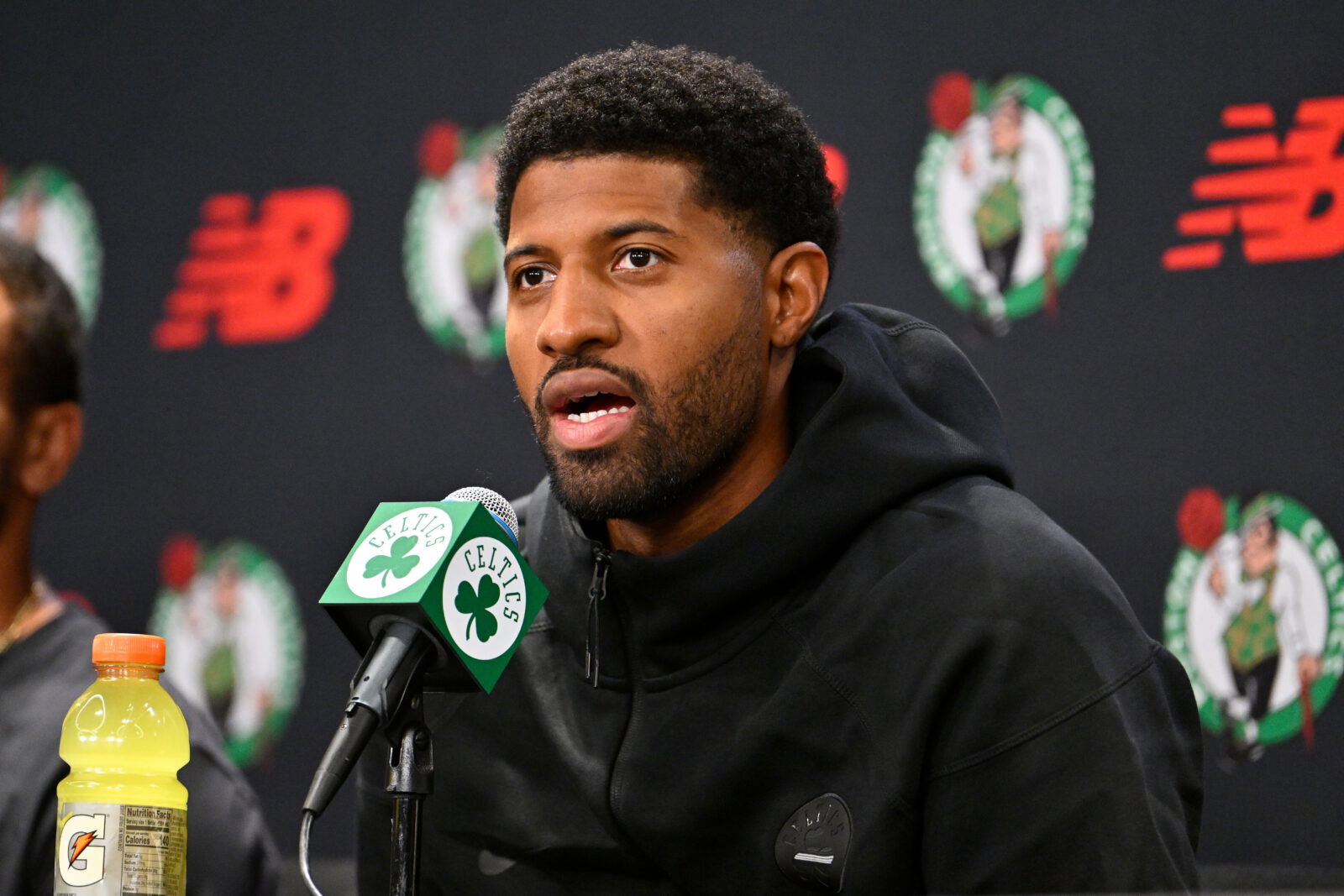
Paul George built a Hall of Fame resume throughout the first 16 seasons of his NBA career. His nine All-Star selections, six All-NBA honors, and a top-three MVP finalist finish all point to George’s status as a long-time superstar.
However, when George was officially introduced as a member of the Boston Celtics on Tuesday, he made it clear that he does not view himself as a headliner of this next chapter.
“We have a superstar, and that’s JT,” George said, praising Jayson Tatum. “I’m not here to steal the shine or reinvent who I am. I’m here to help JT. He’s the guy.”
George’s comments signaled a shift in Boston. With Jaylen Brown, a superstar and likely Hall of Famer in his own right, now gone, the Celtics can move forward with Tatum as their unquestioned centerpiece and on-court engine.
Celtics Are Embracing the Jayson Tatum Era
George’s comments are particularly notable given the rationale Celtics president of basketball operations Brad Stevens provided for trading Brown earlier this summer.
“When I looked at our team, looked at where the league is heading, looked at the way we’ve finished the past couple of years… the path looked more difficult to me with 70 percent of our cap and such a high percentage of our usage tied into two players,” Stevens said in July.
The financial implications of that decision were obvious. But the trade also did something equally important: it clarified the team’s hierarchy moving forward.
As Brown developed into an All-NBA player, Boston increasingly had to accommodate his strengths alongside Tatum’s. The surplus of superstar talent raised Boston’s floor to a perennial championship contender. However, the fit between Tatum and Brown — two players best utilized with the ball in their hands — could sometimes be difficult to balance.
After Brown led the Celtics to unexpected success in 2025-26 and recorded the highest single-season usage rate in franchise history, it would have been difficult to ask him to scale back down to being Tatum’s second in command.
With Brown gone, Boston loses a phenomenal talent, but the team gains a clearer hierarchy. George’s comments suggest that the Tatum-centric vision is resonating with the front office and locker room alike.
Boston’s Blueprint for a Tatum-Centric Offense
Last season already previewed what this new iteration of the Celtics may look like. Payton Pritchard and Derrick White took on greater responsibilities as decision-makers. Meanwhile, Boston gave its younger wings, including Baylor Scheierman, Jordan Walsh, and Hugo González, opportunities to grow into larger roles.
Tatum will now have more control over the offense than ever before. His scoring remains an obvious strength, but his playmaking could take this version of the Celtics to another level after Boston ranked second in the league in offensive rating last season. Brown made significant strides as a passer and playmaker, but Tatum has a greater track record as a primary initiator.
Perhaps no one will benefit more from Tatum’s expanded on-ball role than Boston’s centers, Neemias Queta and Mitchell Robinson. Tatum has previously developed strong chemistry with centers such as Robert Williams, Luke Kornet, and Daniel Theis. The pick-and-roll offense between Tatum and two lob-threat bigs like Queta and Robinson could provide the rim pressure the Celtics have been searching for.
Celtics Are Empowering Tatum Without Overwhelming Him
Tatum’s increased responsibility doesn’t mean the Celtics are asking him to do everything himself. Instead, it lets Boston build a clearer offensive hierarchy while giving other players opportunities to complement him.
That distinction is important when evaluating Brown’s departure. His emergence was not a problem for Boston. In fact, it was a major reason the Celtics reached the heights they did. But as Brown developed into an All-NBA player, it created a challenge: Boston had two players worthy of commanding significant offensive responsibility and organizational attention.
“If you have Jaylen Brown on your team, you should feature him, you should use all those possessions, and you should approach things that way,” Stevens said in his July press conference. “But I think about the importance of depth, and then obviously we have to continue to work on ways to diversify our attack overall.”
That became increasingly difficult to balance as both Tatum and Brown reached the peaks of their careers. Boston could maximize each player individually, but doing so required allocating a significant portion of its salary cap and offensive possessions to two players. Stevens ultimately determined that building greater depth and diversifying the Celtics’ attack was the more sustainable path forward.
The Celtics Have Chosen Their Centerpiece
George’s comments, paired with Stevens’ words in July, make the team’s current hierarchy unmistakable. Questions about who Boston’s top option is are gone. This is Tatum’s team, and the locker room, from the nine-time All-Star on down, appears to be embracing that.
Settling the hierarchy now doesn’t mean the Celtics are bound to this Tatum-centric identity for good. The same trade that clarified the pecking order also armed Boston with two additional first-round picks and financial flexibility that could be used to acquire another superstar. Stevens didn’t just simplify the chain of command — he stockpiled assets to be aggressive again should an opportunity present itself.
For now, though, there is a mutual understanding from the front office down to the coaching staff to the players of who their driving engine is. The Celtics know exactly who they’re building around, and perhaps for the first time in years, everyone wearing the jersey does too.











Leave a comment