

Two weeks after the New York Knicks celebrated their first NBA championship in 53 years, the Eastern Conference started changing around them.
Their 2026 title had already reinforced the league’s era of parity: New York became the eighth different champion in eight seasons, proving that a team did not need to dominate the regular season to finish June holding the trophy.
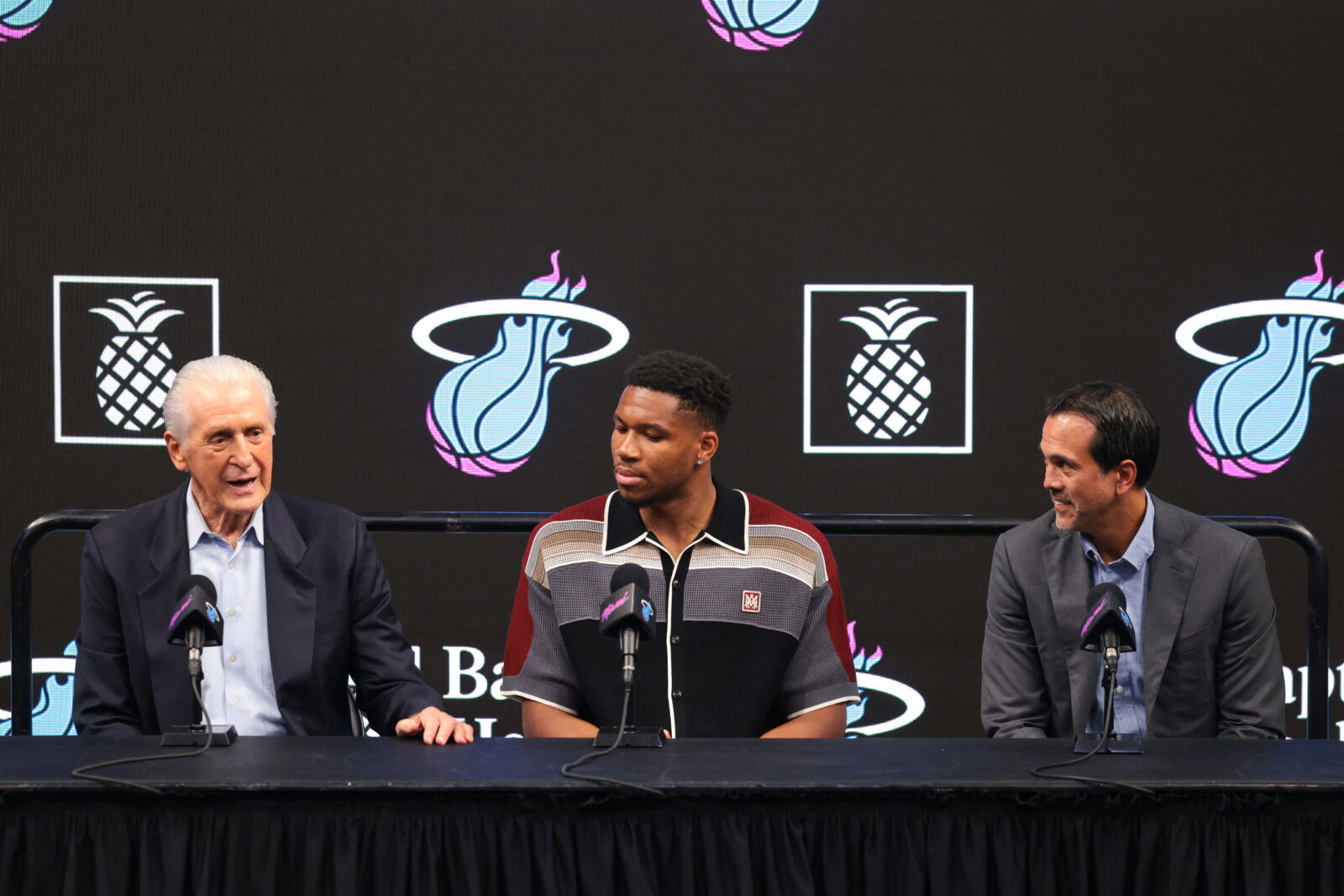
The rest of the East responded aggressively. Giannis Antetokounmpo moved from Milwaukee to Miami. Boston sent Jaylen Brown to Philadelphia for Paul George and future draft assets. Toronto reached an agreement to bring Kawhi Leonard back, although that transaction was subsequently put on hold.
Suddenly, the defending champions were surrounded by rivals making major attempts to close the gap, while New York’s own strength was rooted largely in keeping a proven group together.
How the Biggest Moves Changed the Balance of Power
The Eastern Conference did not change because of one transaction. Several major moves redistributed star power, depth, and roster flexibility within a matter of weeks, leaving the Knicks surrounded by challengers taking very different approaches.
- Miami Heat: Giannis Antetokounmpo and Bobby Portis: Miami acquired Antetokounmpo and Portis from Milwaukee, sending Tyler Herro, Jaime Jaquez Jr., Kel’el Ware, and Kasparas Jakučionis to the Bucks. Milwaukee also received the No. 13 pick in the 2026 draft, first-round picks in 2031 and 2033, a 2030 first-round swap, and a 2033 second-rounder. The move paired Antetokounmpo with Bam Adebayo while pushing Milwaukee into a new phase.
- Philadelphia 76ers: Jaylen Brown: Philadelphia acquired Brown from Boston, giving Joel Embiid and Tyrese Maxey an accomplished two-way wing with championship credentials. Boston received Paul George and future draft capital, ending the Brown-Jayson Tatum partnership that had defined much of the Celtics’ recent era.
- Toronto Raptors: proposed Kawhi Leonard reunion: Toronto agreed to reacquire Leonard from the Clippers in a package involving Brandon Ingram, Gradey Dick and draft assets. Unlike the Miami and Philadelphia transactions, however, the move was subsequently placed on hold pending the NBA investigation involving Los Angeles.
Miami and Philadelphia strengthened their top-end talent, Boston and Milwaukee entered markedly different phases, and Toronto positioned itself for another major change if its proposed transaction proceeds.
Through it all, defending champion New York retained the continuity that many of its closest challengers surrendered.
How Analysts and Markets Reassessed New York
The changes left analysts with a difficult projection exercise. Philadelphia added Brown to a group built around Joel Embiid and Tyrese Maxey, while Miami paired Antetokounmpo with Bam Adebayo. Boston retained Tatum and acquired George, and Toronto’s proposed Leonard reunion created another possible contender. Yet every major transaction also introduced questions about health, chemistry, depth, or roster balance.
Prediction markets and betting markets reacted to those same variables. Gambling prices moved as analysts and traders reassessed which teams had gained talent, which had surrendered continuity, and which paths through the conference had become less demanding.
Such markets can’t predict what happens over an 82-game schedule, but their movement can show how quickly expectations shift after major transactions. New York emerged as one of the clearest beneficiaries of the offseason reshuffle, with the Knicks’ updated championship odds reflecting a more open path through the Eastern Conference.
New York returned most of the group that had just won the title, while several direct challengers were attempting much larger structural changes. The movement was particularly notable because the Knicks improved without making the trade themselves, while Boston fell sharply and Philadelphia made the largest upward move of the three teams.
| Team | Before Trade | Latest Odds | Market Movement |
| New York Knicks | +900 | +800 | Improved |
| Boston Celtics | +650 | +1200 | Drifted |
| Philadelphia 76ers | +5500 | +3300 | Biggest rise |
Note: These figures represent the prices shown in the supplied source at the time of its update. Championship odds are subject to change as rosters, injuries, transactions, and market conditions change.
Why the Knicks Still Set the Standard
New York’s position begins with what happened before the offseason. The Knicks went 16-3 in the 2026 playoffs and defeated San Antonio in five games in the Finals, ending a 53-year championship drought. Their postseason run also followed a regular season that didn’t make them look unbeatable, reinforcing how much roster construction and playoff matchups can matter once the postseason begins.
One Eastern Conference decision-maker framed New York’s roster by separating players who create wins from those whose contributions consistently support them. Jalen Brunson remains the primary offensive force, while Karl-Anthony Towns, OG Anunoby and Josh Hart provide shooting, defense, rebounding and lineup flexibility.
New York also preserved nearly all of the production from its main playoff rotation. Mitchell Robinson was the notable departure from that rotation, with Andre Drummond arriving in free agency.
That continuity matters because Philadelphia, Miami, and Boston must solve questions New York has already answered through a championship run.
Philadelphia’s New Ceiling Comes With an Embiid Question
Brown gives Philadelphia a dimension it badly needed. He brings downhill scoring, physical perimeter defense, and the ability to handle difficult wing assignments without requiring the offense to run through him. After Philadelphia was eliminated by New York in the 2026 postseason, adding a player with Brown’s two-way profile directly addressed the gap between the teams.
The concern remains Embiid. He appeared in only 38 games in 2025-26 and has averaged just 32 appearances across the past three seasons. Among executives assessing the East, that availability problem makes Philadelphia one of the hardest teams to rank. On paper, the talent suggests a place near the top; in practice, the structure still depends heavily on getting Embiid healthy for the postseason.
Brown can reduce that dependence. With Maxey supplying speed and creation, Philadelphia no longer needs Embiid to carry every difficult stretch. Still, most of the 76ers’ salary is tied to Embiid, Brown and Maxey, leaving less room for error if injuries or lineup problems emerge.
Miami Made the Most Aggressive Win-Now Move
Miami’s Giannis trade immediately created one of the East’s most imposing frontcourts. Putting the two-time MVP next to Adebayo gives the Heat extraordinary size, mobility and defensive range, while Giannis supplies the rim pressure and transition force that can change the geometry of a series.
But Miami paid heavily for that upgrade. Herro was a major perimeter scorer, Ware offered size and developmental upside, and Jaquez and Jakučionis represented useful rotation pieces. Multiple draft assets also went to Milwaukee. The Heat therefore improved dramatically at the top while removing several players who helped balance the lineup around Adebayo.
That explains why executives can respect Miami’s move while still questioning its immediate structure. Antetokounmpo and Adebayo can control the interior, but the Heat must establish where enough perimeter creation, spacing and secondary scoring will come from.
The pickup changed Miami from a team searching for another top-end scorer into a direct championship challenger. It also created a roster that may require another transaction cycle before its best configuration becomes clear.
Boston Broke Up a Proven Formula
Boston’s decision to trade Brown may be the most revealing move of the summer because it was not simply an attempt to exchange one star for another. It represented a change in how the organization viewed building around an expensive core under the NBA’s second-apron rules.
Brad Stevens explained the dilemma through resource concentration. With a massive chunk of Boston’s salary cap and a large share of its offensive usage committed to Brown and Tatum, maintaining depth around two expensive stars had become increasingly difficult. Recent champions had reinforced the argument for building out a deeper rotation rather than concentrating nearly everything in two players.
George gives Boston another established wing, while the future draft assets provide flexibility. But Brown’s departure removes far more than scoring. He supplied physical defense, transition pressure, and a direct attacking style that complemented Tatum.
The Celtics therefore remain capable of competing near the top, but they are no longer returning the same structure opponents spent years trying to solve. Boston has traded certainty for a different roster model.
Toronto Could Add Another Proven Champion to the Race
Toronto’s attempted reunion with Leonard added another layer to an already crowded conference. The Raptors agreed to send Brandon Ingram, Gradey Dick, two future first-round picks, two second-round picks, and a first-round swap to Los Angeles for the two-time Finals MVP.
There was clear basketball logic behind the move. Toronto improved by 16 victories in 2025-26 and posted its strongest efficiency differential in six seasons. Adding Leonard to Scottie Barnes would give the Raptors another large, versatile scorer and defender capable of operating in half-court postseason possessions.
The transaction, however, was put on hold while the NBA continued its investigation involving the Clippers. That distinction matters: Toronto’s possible rise cannot yet be treated in the same way as Miami’s completed Antetokounmpo acquisition.
Still, the agreement itself shows how teams interpreted New York’s championship. Toronto was prepared to exchange established players and substantial draft capital for a short-term attempt at moving higher in the East, eight years after Leonard’s first Toronto stint produced the franchise’s 2019 championship.
Detroit and Indiana Complicate the Top Tier
The largest transactions generated the headlines, but the East is not only a Knicks-76ers-Heat-Celtics discussion. Detroit entered the summer after a 60-win season, although a second-round loss to Cleveland exposed its need for another high-level scorer beside Cade Cunningham.
The Pistons were comparatively restrained. John Collins arrived, Tobias Harris left for San Antonio, and restricted free agent center Jalen Duren remained the most obvious unresolved roster matter. Detroit’s regular-season performance means it cannot be dismissed, but its summer did not produce the same top-end addition seen elsewhere.
Indiana presents a different case. Tyrese Haliburton is returning from the Achilles injury suffered during the 2025 NBA Finals, giving the Pacers reason to believe they can re-enter the upper tier if he returns close to his previous level.
That matters because Indiana already demonstrated its postseason capability before the injury. With the Pacers regaining their lead creator and Detroit attempting to build on a 60-win season, the conference’s second tier has enough quality to disrupt any simple hierarchy.
An East With More Talent and Far Less Certainty
The defining feature of the new Eastern Conference is not that one team clearly replaced another at the top. Instead, nearly every major challenger enters 2026-27 with a different strength and a different question to answer.
A clearer view of the reshaped conference emerges when the leading contenders are compared side by side:
| Team | What Changed | Main Strength | Main Question |
| New York Knicks | Championship core largely retained | Continuity and proven postseason structure | Can they repeat after a 16-3 playoff run? |
| Philadelphia 76ers | Added Jaylen Brown | High-end two-way talent around Embiid and Maxey | Can Embiid stay available and the top-heavy roster hold up? |
| Miami Heat | Added Giannis Antetokounmpo and Bobby Portis | Giannis-Adebayo frontcourt | Did Miami surrender too much depth to complete the deal? |
| Boston Celtics | Brown departed; Paul George arrived | Tatum-led core with another established wing | How effectively can Boston replace Brown’s role? |
| Toronto Raptors | Proposed Kawhi Leonard reunion | Potential major increase in top-end talent | Will the transaction ultimately proceed? |
| Detroit Pistons | Added John Collins after a 60-win season | Established regular-season foundation | Is there enough scoring around Cade Cunningham? |
| Indiana Pacers | Tyrese Haliburton returning | Proven postseason structure | How quickly can Haliburton regain his previous level? |
| Cleveland Cavaliers | Core remains capable after an East finals run | Established high-level roster | What closes the postseason gap with New York? |
The Knicks begin 2026-27 as the team everyone is chasing, but the conference around them has changed substantially. Rather than producing a single obvious challenger, the offseason created several plausible routes to the top and considerably more uncertainty about which will work.








Leave a comment