

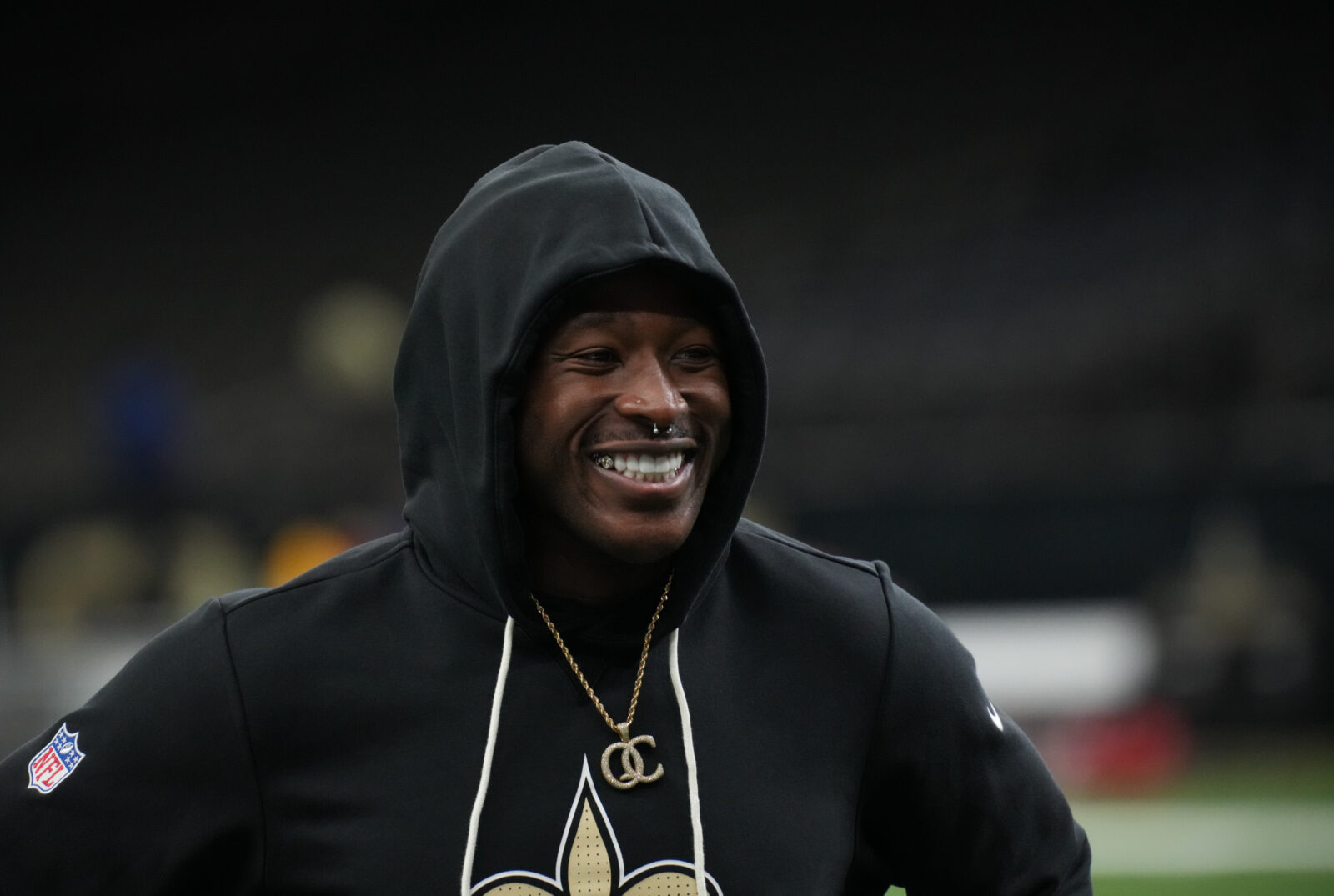
In my previous article, I chronicled the dramatic Alvin Kamara saga that occurred this offseason and argued the Saints must resolve this situation they created, rather than continue to let it drag out. The next day, the Saints did just that.
Not only did the Saints resolve this Kamara situation, but they resolved it in the best way.
While Kamara had a down year in 2025, securing him for the 2026 season was a win for the Saints. In fact, there’s good reason to believe Kamara can have a bounce-back season in 2026.
Saints Revamp Kamara’s Contract
On July 15, Saints Reporter Nick Underhill and former Saints offensive tackle Terron Armstead announced that Kamara had agreed to a reworked deal.
On July 16, Ian Rapoport reported that the reworked deal included a $6 million base salary that could pay up to $8.5 million with incentives. The revamped deal was a pay cut for Kamara, who was set to make $11 million before the Saints reworked the deal.
Keeping Kamara without a pay cut would’ve been a good deal. Keeping him at a discounted rate is an incredible deal.
Many Saints fans were likely elated by the news because of Kamara’s legend status to the franchise and his role as a fan favorite for almost a decade now. There is also reason to be excited from an on-field viewpoint. The soon-to-be 31-year-old could very well have a bounce-back 2026 season.
To examine why Kamara could rebound in 2026, let’s first look at where Kamara was poor in 2025.
Where Kamara Was Poor Last Year
As mentioned in the previous article, Kamara had his worst statistical season last year. Kamara had a career low in yards, touchdowns, and yards per touch. It was the first time in his nine-year career that Kamara recorded less than 1,000 yards from scrimmage, and he was well under it. Missing six games to injury certainly contributed to the low totals, but even over a 17-game span, Kamara was only on pace for 831 all-purpose yards.
Yet, it wasn’t just the box score where Kamara struggled. Kamara was in the bottom 10 and five in several metrics.
Among the 49 running backs with at least 100 attempts, per Pro Football Focus, Kamara was last in rushing grade, 46th in yards after contact per attempt, 40th in missed tackles forced per attempt, 43rd in Breakaway% (% of rushing yards from rushes of over 15+ yards), and 46th in Elusive Rating. He was additionally one of only four of the 49 who failed to record a run of at least 20 yards.
Alvin Kamara’s Receiving Metrics Fell Even Harder
Moreover, despite the poor rushing metrics, Kamara’s biggest regression was in his receiving metrics. Per Pro Football Focus, Kamara had his by-far worst receiving grade in 2025 with a 39.5 grade. The grade was far below Kamara’s second-lowest receiving grade of 64.7 last year and his highest grade of 91.2 in his rookie year.
Kamara additionally had his lowest yards per route run, yards after catch per reception, and passer rating when targeted in his career.
His decline in yards per route run was the largest, as Kamara often recorded over two receiving yards per route run and never recorded lower than 1.54. In 2025, Kamara logged only 0.78 yards per route run. This average ranked 36th out of 40 running backs who had at least 30 targets last year. For reference, Kamara had never ranked lower than 14th among running backs in yards per route run and was top five in the metric six of the eight previous years he had been in the league.
Different Numbers Tell a Different Story
In regard to the numbers, Kamara did have his worst year by nearly all metrics, but the poor numbers weren’t solely on him. Firstly, the Saints had the second-lowest run-blocking grade in the NFL at 49.8, per Pro Football Focus.
Additionally, as the poor totals were partially due to Kamara missing the last six games to injury, the low averages were likely affected by injuries as well. Kamara was battling an ankle injury throughout much of the year. Kamara injured his ankle in Week 5 against the Giants. The Saints then listed Kamara as questionable in Weeks 6, 9, 10, and 12 due to his ankle. The Saints had a bye in Week 11, and, likely, the injury was still present in Weeks 7 and 8, given that it flared up again the next four games.
In the first four weeks of the season, before suffering any injuries, Kamara was averaging 3.9 yards per rush and 2.72 yards after contact per attempt. He forced 12 missed tackles in those four weeks, compared to only seven over the next seven weeks. He had three runs of over 15 yards compared to only one over those next seven weeks. Kamara also posted an Elusive Rating of over 100 twice in those four weeks. He failed to do it once in the next seven.
Additionally, a poor performance against the Super Bowl champion Seattle Seahawks in Week 3, in which the Saints recorded a 49.4 run-blocking grade, deflated those four-week numbers. Across the other three weeks, Kamara posted 4.6 yards per rush and 3.4 yards after contact per attempt, even with the Saints recording a season-low 37.2 run-blocking grade in Week 1.
The Saints Should Have an Improved O-Line in 2026
This offseason, the Saints signed offensive guard David Edwards to a four-year, $161 million contract. Edwards posted a 69.0 run-blocking grade last year and has never posted a season grade lower than 62.4. Edwards recorded his highest run-blocking grade in 2023, when he posted an 81.0 grade, which was sixth among all guards.
Additionally, Saints’ center Erik McCoy missed the last ten games of the season on injured reserve. In 2024, McCoy posted the second-best run-blocking grade among all linemen with a 94.6 grade. In 2023, McCoy had the seventh-highest run-blocking grade among all linemen at 89.4. Getting an elite run-blocker in McCoy back into the fold should help.
Starters Taliese Fuaga and Cesar Ruiz missed a combined five games as well.
The Saints also added offensive guard Jeremiah Wright out of Auburn in the 2026 NFL Draft, selecting him in the fourth round.
Don’t expect the Saints to have an elite run-blocking offensive line in 2026, but it should be improved.
Etienne Helps, not Hurts Kamara
Furthermore, the addition of Travis Etienne Jr. should help the Saints utilize Kamara where he was best — D-gap. Kamara averaged 5.5 yards per carry on runs in D-gap. On the contrary, he averaged only 3.2 yards on runs from A-gap to C-gap.
Etienne, on the other hand, averaged 4.5 yards on runs from A-gap to C-gap but only 4.1 yards on runs in D-gap. Thus, Etienne and Kamara can complement each other well. In turn, Kamara can do less and be more efficient.
Kamara hasn’t had a true-complementary inside runner since 2020, when the Saints had Latavius Murray. Mark Ingram (on a second stint) and Jamaal Williams briefly filled that role after but both were past their prime. It was in 2020 that Kamara arguably had his last elite year. Etienne can help unlock Kamara in this regard.
A Change in Play Calling Could Boost Kamara’s Receiving
Regarding the decline in receiving metrics, play calling could aid Kamara. On passes behind the line of scrimmage, Kamara had a receiving grade comparable to his previous five seasons. However, the Saints utilized him much less in this area. Kamara averaged 34.5 targets behind the line of scrimmage in his eight other NFL seasons. Last year, he had only 14 targets behind the line of scrimmage.
In particular, there was a significant lack of screens. The Saints ran the third-fewest RB screens in the NFL with only 12. Kamara had six of those. Nonetheless, Kamara posted the third-highest yards per reception mark of his career on screens at 13.0. Adding screens back to the mix could greatly boost Kamara’s receiving production.
An Added Benefit: Kamara’s Leadership
The other aspect I’ve yet to mention is Kamara’s leadership. Kamara has been with the Saints since 2017. In 2017, the Saints broke their three-year playoff drought. They then won four straight NFC South titles.
The Saints haven’t made the playoffs since 2020, the year Drew Brees retired. Only the New York Jets and Atlanta Falcons have longer playoff droughts. For a young team, especially a young offense, it helps to have a guy who is familiar with winning. Kamara is the only offensive player from the 2017 team that’s still with the Saints. He experienced the turnaround.
In a weak NFC South, where it seems the team may be turning the corner, the 2026 Saints should hope to emulate the 2017 Saints. Kamara can help with that. He has been voted a team captain three times in the last four years. Removing Kamara could have created a leadership void, but now the Saints don’t need to worry about that.
The Saints bulked up the offense to help Tyler Shough this year. Thankfully, after the recent news, it seems it will be fully loaded.
A Saint, Forever and Ever
Kamara famously stated last year that he would retire and sip “piña coladas somewhere” before playing for anyone other than the Saints. Now, it seems likely those words won’t need to be tested.
For a player who has contributed so much to the team and the city, it’s fitting he should spend his whole career in New Orleans.
There’s been some buzz that this could be Kamara’s last season. Only Kamara knows if this is really true. But if it is, let’s enjoy Kamara’s last ball. Let’s be happy that there will be a clean rather than messy ending. And let’s have hope that 2026 will be a bounce-back season for the Saints’ legend.











Leave a comment