

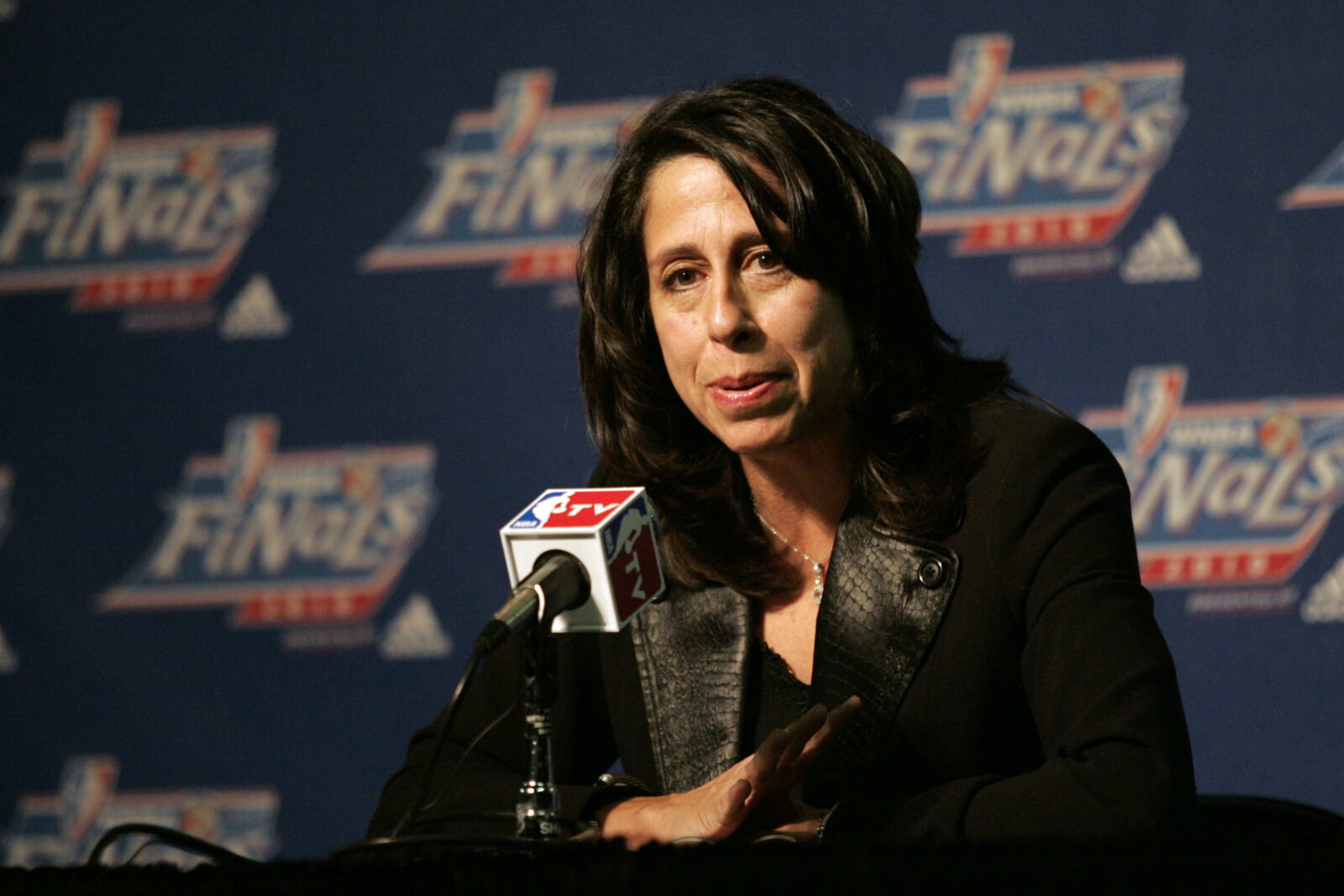
The rise of Women’s sports has been undeniable over the last decade. Viewership has reached record numbers, and there are more opportunities for women in sports than ever before. One of the biggest reasons for this surge is the efforts of one woman: former WNBA President Donna Orender.
Now, Orender is creating even more opportunities with The UPSHOT League, but her contributions to women’s basketball began decades ago.
I.) A New Yorker’s Love
Our story begins on Long Island, NY, where the Islanders reign supreme, and fans argue over who’s better between the Yankees and Mets. Athletics go hand in hand with prestige, especially in the Big Apple, where millions of people pursue the same goals.
Growing up in the 70s as a basketball lover meant New York was heaven on earth. Anyone who was anyone was courtside in Madison Square Garden watching the Knicks dominate the NBA’s Eastern Conference. Walt Frazier and his cadre of Knickerbockers provided an electric atmosphere for the melting pot that was the inner city.
“I loved the New York Knicks growing up,” said Orender. “I just thought they were a fantastic team. They had captivated the imagination and the culture of New York, and I was a New York kid. Earl Monroe, Bill Bradley, they were also great, but for my favorite, I would have to say it was Walt Frazier.”
A 13-year-old Donna couldn’t ignore the fire in her belly after watching her favorite team win the 1970 NBA Finals. She had already begun playing basketball in her section of Long Island, and watching the Knicks win the championship only added fuel to her burning fire.
II.) The Athlete Of Long Island
“I ended up playing basketball because I just loved the fact that I was on a team, and that we were connected,” Orender said. “I loved everything about sports. They challenged me, both physically and emotionally. It also connected me to a greater world.”
Orender began practicing day after day and night after night. Her work ethic was insatiable, and she used every opportunity to hop on the court.
“I like the fact that it tested me,” she said. “I had to constantly decide how good I wanted to be, how much I was going to invest in how good I wanted to be. At the same time, I realized that I was part of something that was bigger than myself, and I loved that part of it.”
One of the best college teams in her area was the Queens College Knights. The women’s team was nicknamed the ‘Knightees’ due to their dominance on the court.
They were coached by the legendary Lucille Kyvallos ,and finished the 1973 season with a 22-5 record. On March 25, the national championship was held at their maroon-and-cream-colored campus.
“I’ll never forget it,” said Orender. “I was 15 years old, and the Knightees were playing Immaculata for the national championship. I happened to go to the FitzGerald Gymnasium by myself, and the place was rocking.”
Witnessing Kyvallos compete against the Immaculata Mighty Macs in a championship atmosphere captivated the wide-eyed teenager’s attention.
“The Immaculata nuns were beating their pails with their wooden spoons. The quality of the play, the fandom. I’m like ‘this is where I want to be.’ So, I talked to coach Kyvallos,” she said.
Although Kyvallos would leave the gymnasium without the illustrious AIAW Championship, she left the arena with a promising young prospect.
III.) Crowning Moment
The next season, in 1974, the Knightees saw a sudden improvement with Orender on the roster and got their revenge against Immaculata during the regular season. It was a historic victory that saw the Knightees end Immaculata’s historic 35-game win streak.
Their upset marked the beginning of a war-filled four years with Kyvallos on the sideline and Orender on the court.
After experiencing a slew of ups and downs from her freshman year to her junior year, Oredner and the Knightees got off to a good start during her senior year.
It was the 1977-78 season, and the Knightees finished the year with an incredible 30-3 record. Their momentum carried into the postseason, where they defeated the Fordham University Rams to win the Manufacturer’s Hanover Invitational Championship in White Plains, NY.
After defeating the Rams, it was time for Orender’s fourth and final attempt at the AIAW Championship. On March 18, 1978, Game 1 saw the Knightees defeat the University of Mississippi 74-71, but their historic season came to an end on March 19 after losing to rival Montclair State.
Although it was a bitter ending to Donna’s college career, her relationship with Coach Kyvallos became cemented forever.
IV.) The Queen of Queens
“My coach is still around, which is so great. I can’t thank her enough for helping me shape the way I think. The way I compete and the opportunities she put in front of all of us. She set a level of performance and standards of excellence that we all felt inspired to meet.”
The two built a bond through basketball, but Kyvallos’ teachings extended far beyond the hardwood.
“All those lessons that she taught me are still very much a part of me,” Orender said. “I give her a lot of credit for my success in business. She was just extraordinary. Her basketball knowledge to this day still stands.”
People often say, “Time flies by when you’re having fun,” and when their time together ended in the Spring of 1978, it was a tidal wave of emotions for the 21-year-old.
“I wasn’t ready to end basketball after coming to the game late, and so by the time my four years in college were done, I was just beginning to understand my abilities,” Orender said. “Maybe I could have gone to Europe, I don’t know. I did get invited to play overseas, but then I enrolled in graduate school before I got a call saying, ‘Hey, there’s a new league.’ “
V.) A Woman’s World
The year 1978 ushered in a new era for women’s sports. The U.S. Department of Health, Education, and Welfare IX Amendment was a landmark policy requiring schools to provide equitable funding, facilities, and scholarships for female athletes.
It led to an influx of opportunities. One of the biggest accomplishments was the creation of the Women’s Professional Basketball League. Once established, Orender didn’t hesitate to hit the court alongside the other ladies.
Her destiny was written in the stars: she would become a professional basketball player. The WBL’s inaugural game took place on December 9, 1978, and her journey began with the New York Stars on December 17. Fans from all around the Big Apple packed the Garden and Felt Forum to watch the ladies shoot some hoops.
Playing for the Stars befitted the former All-American, and when Donna suited up, she was the biggest star of them all. Whether passing like Nate Archibald or pulling up in the mid-range like Jerry West, there was no stopping her.
She shined as the starting point guard, and Orender’s on-court charisma made her a hot commodity. Everyone wanted to see the brunette with a killer crossover.
VI.) An All-Star Affair
The Stars were soaring high, but their run of ’79 would end after losing to the Houston Angels in the semifinals. Although they came up short, Donna’s notoriety skyrocketed after an electric rookie season.
By 1980, she was the star player for the New Jersey Gems and was invited to the first-ever WBL All-Star game due to her skill on the court. Although she was lighting it up on the floor, her glory wouldn’t spread to her teammates. The Gems missed the playoffs entirely, leaving a bitter taste in Orender’s mouth.
In an attempt to return to her winning ways, the 23-year-old joined the Chicago Hustle. It was her third year, and she was ready for real glory. After living the life of a No. 1 option, she took a backseat and focused on feeding her teammates.
Her sacrifice was not in vain, as she got what she wanted: a shot at the WBL World Championship trophy. Unfortunately, luck was not on the Hustle’s side as they were eliminated by the Nebraska Wranglers, who claimed the trophy for themselves later that spring. Shortly after they raised the trophy in celebration, the league would fold in 1981.
VII.) Windy City Chronicles
Although the league played only three seasons, the WBL’s impact on Orender would last a lifetime.
“Being part of the first league was quite an honor, but just having a chance to be a professional athlete was incredibly special,” Orender said. “ And listen, it’s something you could say you did that not many people in their careers said they did. Everybody loves sports. They wanted to be great; they wanted to be the best, and I got to compete at the highest level. I loved it.”
Being an athlete was all she ever knew, so it was difficult figuring out her next steps. There were many different avenues to the game that she cherished, but leaving her family to play overseas made her homesick just thinking about it.
If the former All-Star couldn’t play the game, she thought sports media would be a good alternative. Orender was still living in Chicago after the WBL folded, and she used her industry connections for a seamless career change.
“I had my own little cable television sports show in Chicago, so when I came back to New York, I did some sports announcing, and then ultimately got a job working for ABC Sports, which was the pinnacle of sports television at the time, so I worked at the highest level,” Orender said. “I worked for the Dolans and Challenger companies, like Rainbow Programming and Sports Channel, and then, ultimately, I had my own company. So, from a business perspective, I had opportunities to learn at the big, macro-level corporate public company, the smaller, more challenging company level, and then working out of my own pocket.”
ABC was an absolute powerhouse with shows like Monday Night Football, ABC SportsBeat, Wide World of Sports, and the U.S. Figure Skating Championships. Alongside their dynamic programs, they had superstars for their on-air talent, including Keith Jackson, Howard Cosell, Al Michaels, and Frank Gifford.
It was the right place at the right time for Orender, who was already accustomed to the big leagues. She would steal the show from behind the camera as a production assistant.
VIII.) Hardwood Hiatus
Just being around multiple legendary journalists provided many lessons that she would learn over the next six years. The job expanded her horizons beyond basketball, and in the Spring of 1987, her phone rang with a new opportunity.
“I got a call that the PGA TOUR wanted to create its own production company, much like NBA Entertainment and NFL Films, and they asked me if I’d be interested in working and helping to lead that,” she said.
After finding success during her first three years on the job, Donna Orender packed everything up in 1990 and moved down to Jacksonville, FL, for the sake of her future. For the next 15 years, she helped the PGA grow its fanbase by securing various TV deals and negotiating on behalf of the PGA production company.
“I thought it was a really interesting opportunity. I didn’t have any experience in golf, but I had a lot of experience in media and sports. So, ultimately, that’s how I ended up at the PGA Tour.”
By 2005, Orender made it to the Office of the Commissioner. Her name rang bells across the sports world, and Donna’s reputation would eventually bring her back to her true love — basketball.
IX.) Presidential Expedition
All of her life, Orender had been a fierce competitor, but athletic tribulations would pale in comparison to the challenges in her future. On February 15, 2005, the WNBA announced that she would become the second WNBA president, succeeding Val Ackerman.
It wasn’t until April 1 that she would officially take over, and with the WNBA struggling financially, her task was to pull the league out of its darkest time.
“When I first started, every single day, people said, ‘ You’re gonna fail, the league is gonna fail,’ and then Sports Business Journal was asked what the first league that’s gonna fold? and they put the WNBA,” Orender said. “And I would call them up and say, ‘ How could you do that? They think they’re doing their job, but I’m doing my job.”
The New Yorker was up to the challenge, but she still faced unimaginable adversity.
“With the Great Recession, there was racism, sexism, and this whole idea that we were not worthy. I mean, there was really a whole ‘anti-women’s sport’ thing going on. It was the hardest job I’ve ever had, but it was the most rewarding,” Orender said. “There’s something about stepping into a place where everyone tells you that you can’t do something, or it’s not worthy of moving forward, or all the reasons that are wrong, and knowing that they were wrong.”
She secured TV deals as viewership was at an all-time low, with an average rating of 300,000 viewers per game. In 2007, she triggered a paradigm shift in women’s sports after securing an eight-year TV rights deal for the W. It was the first of its kind, but the deal wouldn’t go into effect until 2009.
During that time, the legendary Houston Comets folded in 2008 during the Great Recession because the league couldn’t find a new buyer. In 2009, the deal felt like divine timing.
The league added new high-definition cameras, giving viewers at home a proper experience like fans in the arena. The exposure put the girls on the world stage, changing the trajectory of every player in the league.
“And here we are 30 years later, and look at all the success. I mean, it’s about hanging in there, and making sure to live another day, and prove another point, and continuing to grow,” Orender said.
X.) Family First
By 2010, Donna had proven herself to the entire sports world. The WNBA had a beating heart fueled by her efforts and the love of its new fans.
Orender could finally sit back and smile as she admired the new superstars who were inspiring the next generation. Before Donna knew it, it was the holiday season, and she enjoyed the time with her family. Although her love for the powerful women of the WNBA was immeasurable, her body, mind, and soul felt the need to rest after six rigorous seasons.
She wanted to take some time for herself, and on December 3, Orender announced that she was stepping down as WNBA President.
“I think it was just time,” she said. “I was a little bit tired. It was exhausting. I like to say things were exhilarating and exhausting; both can be true. And so, coming back home to be around my family more, my kids growing up, I felt like that was probably the next best thing for me to do.”
As the sun rose on New Year’s Eve, she officially resigned. Even with her biggest accomplishment in the rearview mirror, it wasn’t like her to sit idle. Donna went into business for herself and created her advisory firm, Orender Unlimited.
She helped businesses grow via brand strategies, and it was another massive success. With yet another goal in mind, she created Generation W.
XI.) Generation W
“I was invited by one of our WNBA partners to attend a conference hosted by Maria Shriver,” said Orender. “When I got there, they pulled me in to do some stuff on the stage, which was really exciting, but I looked around, and there were 15,000 women there, and I said, ‘Wow. This is amazing. I want to do something like this for Jacksonville, and that’s really when it started.”
Orender saw a future where she could blend fun and fellowship. She kicked off the first event in 2011, and 15 years later, Generation W has reached unimaginable heights.
“I think that we had a unique vision and a unique culture that was able to embrace everyone who came,” she said. “To this day, people say, ‘I can go to any event or conference in the world, and yet I choose to come back here year after year’ because there’s just this certain feeling of authenticity, the quality of the content, the integration of all other kinds of creative entertainment elements that people leave wanting more, but mostly they leave feeling infused with the spirit that inspires them moving forward.”
Now in 2026, 1,500 women attend the annual Leadership and Women’s Empowerment event. It’s a powerful movement for all women, not just athletes, and Orender still has plenty of ideas for the future.
“We do have plans, as you probably know. Generation W spun out ‘Generation WOW’ in our second year. We said, ‘Wow, if we’re going to do all this, we really need to talk about girls.’ I think there’s a girl in all of us, whether you’re a male or a female,” Orender said.
“So that was in 2013, and so we’ve completed 13 years of working with girls in Generation WOW. We’ve touched over 14,000 girls in their lives. We have year-round programs in schools. So, when I look at moving ahead, I want to deepen, broaden, and build on that work.”
As the modern era of basketball continues to expand with new opportunities for women, there will always be those who push the game forward. For Donna, her work had saved the careers of hundreds of millions to come in the distant future. Her work will withstand the test of time, but her newest creation, The UPSHOT League, will prove to be something truly special as time goes on.
XII.) The UPSHOT League
The UPSHOT League is a women’s professional basketball league that features four inaugural teams as of August 2026: the Charlotte Crown, Greensboro Groove, Jacksonville Waves, and Savannah Steel.
All four rosters consist of 11 players each, and the teams use a traditional five-on-five format. The league has impressed many spectators during its first season, which is expected given who’s involved. Many legends of the game invested in the project, including Cheryl Miller, Ann Meyers Drysdale, and Tamika Catchings.
The UPSHOT League is approaching the end of its inaugural season, and it’s clear their investment will pay off.
“I was working with my friend, Andy Kaufman, who has an operating sports company, generally working in minor league hockey and some baseball,” Orender said when asked about where the idea for the league’s inception came from.
“We were looking to work with investment groups for women’s basketball. Everybody wanted a WNBA team. They still do, and I love it. I can’t tell you how wonderful and gratifying that is. It became obvious that Jacksonville wasn’t going to get one, and I have a real passion for our city. So Andy called me one day and said, ‘Why don’t we just do it ourselves?’ And I didn’t even blink. I said, ‘yeah, let’s do it.’”
XIII.) The Process Of A Pioneer
Starting from scratch in basketball is harder than ever before, whether aiming for the glory of a player, journalist, or commissioner. There are numerous competitors in every field who enter the industry every day.
With millions of dollars involved at every level, from athletes to media members, millions of people want to carve out a life in basketball. So, creating a whole new league was bound to come with adversity, given that the WNBA, WNBL, WCBA, and Euroleague Women already exist.
Donna was up to the challenge regardless of these competitors. Before the UPSHOT executives could get the ball rolling, they needed a name, and it had to be perfect.
“I came up with the UPSHOT name,” she said. “Yeah, it’s funny. Andy was telling me the other day, he goes, ‘I think you nailed it on that one.’”
“It just seemed like the right thing. It just popped in my head, and just like Generation W, that seemed like a really good name. What was so interesting is that whoever I mentioned the name to loved it.
XIV.) A Bright Future In Basketball
Creating The UPSHOT League has opened a floodgate of opportunities for women of the present and the future. The four ball clubs have set the foundation, but it’s only the beginning stages of their blueprints.
“We have four teams right now, so maybe in eight to 10 years, we’d like to see about 30 teams.”
Orender shared her ultimate goals for the future of her new league:
“We have a collective goal of creating high-quality sports opportunities and entertainment in communities that would otherwise not have either of these. I talk about this as an opportunity league, which is the opportunity for the athletes on the court. It’s for the coaches, referees, and people in the front office. Mostly, it’s an opportunity for communities to be elevated.”
It’s funny how Orender’s acts of passion have been at the heart of multiple milestones in women’s sports, but if you ask her, they were all just another day in the office.











Leave a comment