

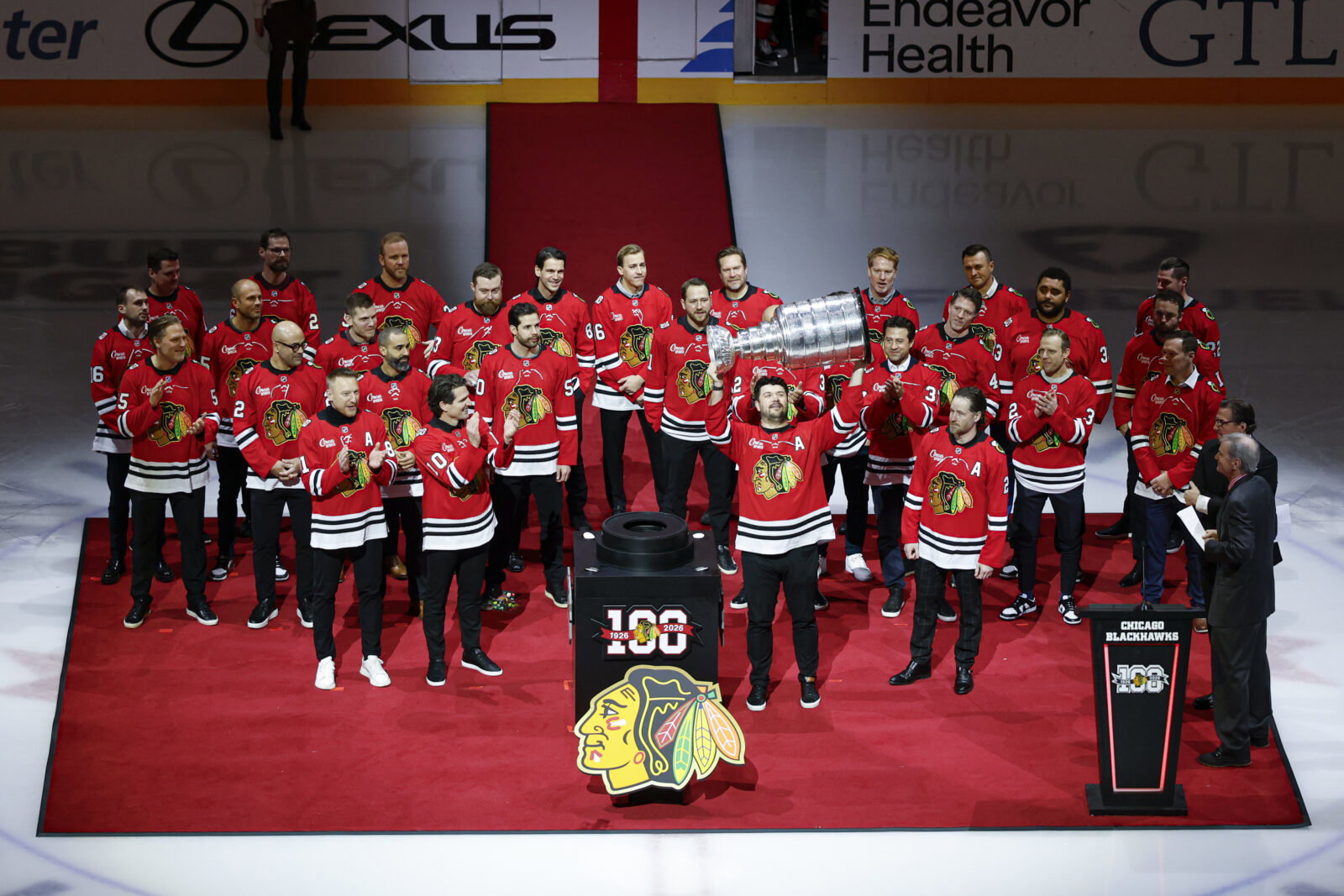
The Blackhawks’ rebuild should be nearing its end.
In many ways, the time spent building through the draft mirrors the construction of their dynasty roster. Trading away established players is not a new concept. Using this as the basis of a rebuild certainly is.
The ‘youth movement’ as a roster-building philosophy has led the charge for many rebuilding teams. The Blackhawks’ rise to their first Stanley Cup, purposeful or not, relied on their young stars panning out.
Since taking over in 2022, Kyle Davidson has been reluctant to provide a timeline. Entering year five, the young general manager has done plenty of legwork. He traded off vets, brought in prospects and draft picks and has established what some consider to be the best prospect pool in the NHL.
Regardless, the team has fed the bottom for too long. Even so, history shows us that it takes time to build a competitive roster. Look no further than the legendary Blackhawks roster of the 2010’s to understand this concept.
2000-2003: The Mike Smith Era
Often an unsung hero of the Blackhawks dynasty. Smith first joined the Blackhawks in 1994 as a scout. After a brief stint in the Maple Leafs front office from 1997-1999, the Blackhawks hired Smith again, this time as the Manager of Hockey Operations. Not long after, he was named the seventh general manager in team history.
Smith brought the team back to the playoffs in 2002 following a five-year drought. Although the Blackhawks lost in five games to the St. Louis Blues, things were turning up… until they weren’t.
Smith struggled to find his head coach. Alpo Suhonen was his first hire. He was a decent coach, but had to resign early in his tenure due to health complications. Smith hired Brian Sutter next. Sutter did not gel with Smith and his attempt to push a younger roster. The team did not return to the playoffs, and Smith was fired in 2003. Although short-lived, one part of Smith’s tenure was excellent, but no one knew it at the time.
Smith’s Draft Picks
Duncan Keith, Brent Seabrook and Corey Crawford are all known for their contributions to the Blackhawks dynasty. All three were drafted by Mike Smith and, in Keith’s and Crawford’s cases, were second-round steals. Seabrook was a late lottery pick and eventually became one of the best defensemen selected in the 2003 draft.
The Keith-Seabrook connection was the most consequential development for the Blackhawks before the 2010’s. These two combined to form an elite top defensive pairing. Without these two, forget competing for Stanley Cups. The Blackhawks would have been lucky to make a deep playoff run. These selections by Smith were integral in bringing the Blackhawks to the Cup finals, and he did so over seven years in advance.
Dustin Byfuglien was another key draft pick made by Smith. He selected ‘Big Buff’ in the sixth round of the draft. Byfuglien was an absolute steal and a versatile defenseman who also spent some time as a winger. Byfuglien became a fan favorite in Chicago and went on to win the 2010 Stanley Cup with the Blackhawks.
Adam Burish was another Smith selection on the 2010 Championship roster. In the ninth round, Smith drafted Burish out of the University of Wisconsin. Burish went on to captain his Badgers to a National Championship in 2006 and brought some of that winning mentality to the Blackhawks locker room. His hard-nose, pestering offensive game was not flashy, but certainly valuable.
With the ninth overall pick in the 2000 draft, Smith drafted Tuomo Ruutu. Although he did not win a Stanley Cup with the Blackhawks, his value was important. More on him later.
2003-2005: Pulford’s Third Try
Bob Pulford was a hockey legend. A Hall of Fame player, a long-time coach and executive and an essential piece of Blackhawk history. Pulford had three stints as the Blackhawks general manager, and the third one came just five years before the team began to ascend.
Pulford continued a similar, arguably more intense youth movement. Veterans of the team, including Steve Sullivan and Alexei Zhamnov, were flipped for draft capital. Zhamnov, for example, was traded in a package that brought over Colin Fraser and a draft pick later used to select Bryan Bickell. Both of these players ended up being important depth pieces for the Blackhawks dynasty at different times.
Pulford’s best move was trading Alexander Karpovtsev to the New York Islanders for a 2005 4th-round pick. Although the trade didn’t make headlines in 2004, it provided something the Blackhawks needed. One of the greatest true defenseman in team history, Niklas Hjalmarsson, was selected with the acquired pick.
Pulford also selected Dave Bolland in the second round of the 2004 draft. He, of course, went on to score the second of two goals scored in 17 seconds, en route to the 2013 Stanley Cup. Troy Brouwer was selected deep in the same draft and was a major depth piece on the 2010 roster. In 2005, Puflord stepped aside, making way for the general manager often credited with the rise of the Blackhawks.
https://twitter.com/NHLBlackhawks/status/1983339088280428586?s=20
2005-2009: Dale Tallon Solidifies the Final Pieces
Tallon is one of the more interesting characters of the story. After a respectable nine-year playing career, four of which were spent in Chicago, Tallon entered the broadcast booth. He spent nearly two decades as a radio and TV analyst for Blackhawks games. He then entered the front office, rose through the ranks in Pulfords’ staff and was later named general manager.
Tallon came out swinging, firing head coach Brian Sutter after four years with the team. In turn, he hired Trent Yawney for the 2005-06 season. Coming out of the 2004-05 lockout, Tallon faced a unique challenge that his predecessors of the 2000’s did not. Regardless, he made some cornerstone moves.
Ruutu, the Smith draft pick from earlier, was flipped in a trade by Tallon. The trade brought over Andrew Ladd, a young winger with a lot to prove. Ladd went on to win the 2010 Stanley Cup with the Blackhawks and was a consistent piece of their forward depth.
Tallon brought in several excellent players. Kris Versteeg was acquired via trade. Hjalmarsson was drafted using the pick from the Pulford trade mentioned earlier. Brian Campbell, an outstanding defenseman often paired with Hjalmarsson, was signed out of free agency. Marcus Kruger was drafted late in 2009. John Madden was signed as a gritty centerman with plenty of playoff experience. The depth created during Tallon’s stint was considerable, and yet it does not scratch the surface of what he accomplished.
The Core
In December of 2005, the Blackhawks sent Matt Ellison and a third-round pick in 2006 to the Philadelphia Flyers in exchange for Éric Meloche and Patrick Sharp. Sharp was an underperforming, underutilized winger in the Flyers’ system who was desperate for a change in scenery. Tallon took a chance on him, and it paid off more than anyone could have expected. Sharp became one of the most important pieces of the Blackhawks dynasty.
The following offseason, the Blackhawks had the third overall pick in the draft. With that pick, Tallon selected Jonathan Toews. Entire articles can be made discussing ‘Taser’s’ illustrious career. Captain Serious led the team as the youngest captain in league history at the time. A legend of the sport and the definition of leading by example.
In 2007, the Blackhawks again had a lottery pick, this time the first overall selection. The choice was a no-brainer as Tallon sprinted to the podium to announce Patrick Kane as the next member of the Chicago Blackhawks. Showtime. The man who broke the drought with the phantom goal in the 2010 finals. Arguably the greatest American-born hockey player in league history. A homerun of a selection.
Enter Joel Quenneville
In 2008, Tallon fired Denis Savard, Yawney’s replacement after being fired during the 2006-07 season. The next hire had to be the one, as players were beginning to pan out. They had no time to waste on another coach that would only last a season or two. Joel Quenneville, a head coach previously who was hired by the Blackhawks as a pro scout, was promoted to the position.
Coach Q went on to be the second-winningest head coach in franchise history. In what would have been likely his last chance as a head coach in the NHL, he made it worth it. He won three Stanley Cups and solidified himself as an all-time great behind the bench.
In 2008-09, the Blackhawks made the playoffs for the first time since 2001-02 during the Smith regime. The young Hawks made a Cinderella run, going all the way to the Conference Finals but falling to the Detroit Red Wings. With this run came a realization – the kids are here, but they need more.
Marian Hossa
For a long time, Hossa was considered a great player who could not perform when it mattered most. He was famously traded to the Pittsburgh Penguins in 2008 before losing to the Red Wings in the finals. The following year, Hossa hit free agency and signed a deal with the Red Wings. That season, the Wings fell to the Penguins in the finals. Hossa felt like he was cursed.
Before the 2009-10 season, Tallon made what many consider to be the greatest free agent signing in franchise history. Hossa saw something in the young, scrappy Blackhawks team that tasted a deep run but, like himself, couldn’t go all the way. He signed for 12 years at $62.8 million, and had a chance to shut up all of his detractors.
Hossa went on to do exactly that. He didn’t fill the stat sheet the way he did in years prior, but he provided a motor that was contagious. His two-way game could only be described as triggering for his opponents. Most importantly, he delivered when the lights were the brightest. He scored plenty of big goals, all on the way to capturing three Stanley Cups. His contribution was so vital, in fact, that the organization retired his No. 81.
Tallon’s Firing
Tallon seemed to be doing everything right, so why move on? In the 2009 offseason, Tallon failed to qualify multiple restricted free agents on time. The organization managed to retain all of the players in question. Still, they had to pay millions more than they would have had Tallon managed to submit their qualifying offers in time. The aforementioned Versteeg was one of the players in question.
Tallon was then fired and replaced by Stan Bowman. His story as general manager is controversial to say the least, and perhaps a discussion for a different article.
The Promised Land
The Blackhawks secured the best record in the Western Conference in the 2009-10 season. They took care of the Nashville Predators in six games. In his first season as a full-time NHLer, Antti Niemi posted two shutouts in the series and proved himself as the starter over Cristobal Huet. In another six-game series, the Blackhawks took down the Vancouver Canucks. The Conference Final was different this time, as they swept the San Jose Sharks. The Blackhawks were back in the Stanley Cup final for the first time since 1992.
They took the first two games at home. A quick 2-0 series lead, but the job wasn’t finished. The Flyers came back and won their two home games. Back to the United Center and the Blackhawks filled the net, winning 7-4, heading back to Philadelphia for game six. When overtime hit, the Blackhawks had a new level of poise and game management they hadn’t possessed before. Patrick Kane worked his mitts, shot five-hole, and the Stanley Cup was sent home to the Windy City for the first time since 1961.
A deeply cultured sports city that, funnily enough, has an inexplicable lack of success compared to others. The ‘loveable losers’ were occupying Wrigley Field. The Bears, at that point, were 25 years removed from the legendary squad of ’85. The Bulls were chasing MJ’s glory with a young Derrick Rose. The White Sox were finding success in the mid-2000s after nearly a century of struggle, shrouded in the shame of Black Sox scandal. Thanks to three different general managers, about a decade of patience and some excellent talent evaluation, the Blackhawks added to Chicago’s resume.
Why Does This Matter?
History is learned for a simple reason. By learning the cause, the effect is far easier to understand and so is decision-making. Political history, put simply, is studied to examine how policy decisions affect a community and how they can be applied to modern-day society. Art is studied to see how populations respond to culture and major world events. But what about sports history?
The story of the Blackhawks’ rise to glory is a turbulent one. It experienced four general managers, five head coaches, and a litany of criticism from local and national media. One thing this article failed to mention was the many duds these managers drafted or acquired. Adam Munro, Anton Babchuk and Dylan Olsen were all first-round picks made by these front offices that never panned out the way they expected them to.
Blackhawks fans pay much attention to Artyom Levshunov, Sacha Boisvert and Kevin Korchinski, for example, and rightfully so. These players have been drawing headlines as first-round picks since their draft night. Although the hope is that they become impact players, it’s impossible to know what the future holds. The gems might be second-round picks who fell due to their size, or fourth-round picks who got overlooked by all but one team.
The rebuild is a waiting game. The intention is to rise sooner rather than later, but regardless of when, look out for who. It could be the acquisitions you least expect that etch their names into Blackhawks history.









Leave a comment