

Despite being one of the oldest franchises in the NBA, the Atlanta Hawks don’t have the rich history you would expect.
They are one of four franchises to have at least 50 playoff appearances in their history, but are the only franchise with a winning percentage below .500 in that category.
The Hawks won their lone championship all the way back in 1958 when they were in St. Louis. Led by Bob Pettit, the Hawks were able to make the NBA Finals four times in five years, between 1957 and 1961.
Perhaps they could be a franchise with a richer history if they made better decisions on draft night.
Bob Cousy, 1950 NBA Draft
With the fourth pick of the 1950 NBA Draft, the Tri-Cities Blackhawks selected Bob Cousy from Holy Cross. Cousy would go on to become a Boston Celtics legend, but Boston passed on Cousy with the second overall pick. They instead chose Chuck Share, who had a decent nine-year career in the NBA. Ironically, Share never played for the Celtics, but rather the Hawks later in his career.
As for why the Celtics passed on Cousy in the 1950 NBA Draft, Boston coach Red Auerbach had this to say about the process:
‘We need a big man. Little men are a dime a dozen. I’m supposed to win, not go after local yokels,’ he said.
After learning the Blackhawks drafted him two picks later, Cousy was not pleased.
‘Jesus, I was a pretty good student, what the hell is the Tri-Cities?’ he said.
Cousy was traded to the Chicago Stags, but they folded before the 1950-51 season. Thus, the Celtics selected Cousy in the dispersal draft, and the rest was history. He would end up having a Hall-of-Fame career, making the All-Star team 13 times, winning six championships and a league MVP in 1957.
Turns out the Blackhawks wouldn’t be in Tri-Cities much longer, as they moved to Milwaukee in 1951 and shortened their name to the Hawks.
In 1955, the Hawks would move again. This time to St. Louis, where they became rivals to Cousy’s Celtics.
Bill Russell, 1956 NBA Draft
As it turns out, the Hawks would draft not one, but two players who spearheaded Boston’s dynasty in the 1960s. In a cruel twist of fate, St. Louis met the Celtics in the NBA Finals the following season, and Boston prevailed in seven games.
Bill Russell was aggressively pursued by the Celtics, and the Hawks were willing to give him up. As the story goes, Boston owner Walter Brown convinced the Rochester Royals to pass on Russell with the first pick. From there, they worked out a trade with St. Louis that sent hometown hero Ed Macauley and Cliff Hagan.
On paper, this doesn’t seem like a horrible trade. Macauley and Hagan both had Hall-of-Fame careers. In fact, they were both a part of the Hawks’ championship team in 1958. However, when the other team gets a player who becomes a five-time MVP, 11-time champion and one of the greatest players the NBA has ever seen, it is hard to justify it.
Russell could’ve teamed up with Pettit, who won two MVPs in his career. If that happened, perhaps St. Louis becomes the next NBA dynasty rather than the Celtics.
David Thompson, 1975 NBA Draft
After ending the 1974-75 season with 31 wins, the Atlanta Hawks got the first overall pick in the 1975 NBA Draft. Atlanta selected David Thompson, who had an illustrious career at NC State. There was only one problem: Thompson also went first overall in the 1975 ABA Draft.
Here’s where things go sour for the Hawks. After his rookie season with the Virginia Squires, Julius Erving was ready to move on to the NBA. He left the Squires in search of an NBA team. When the Milwaukee Bucks drafted Erving 12th overall in 1972, they learned that Atlanta signed him to a four-year deal before the draft.
The Squires got a court injunction that forced Erving to return to Virginia for the 1972-73 season. Meanwhile, Atlanta was fined $400,000 by the league for attempting to sign Erving while he was drafted by the Bucks.
“The Hawks must pay $250,000 to the league and $150,000 to the Milwaukee Bucks, who had drafted Erving properly; they must give their two second‐round draft choices next year to Milwaukee, and the rights to Erving, if he ever comes into the N.B.A., remains with Milwaukee.”
The Bucks didn’t get Erving either as Virginia traded him to the New York Nets in 1973. Eventually, the Nets would join the NBA in the 1976 merger.
Because the Hawks were fined for trying to sign Erving two years earlier, they didn’t have the money to offer Thompson a contract. The Denver Nuggets acquired his rights from the Squires and signed him to a contract Atlanta couldn’t afford.
In the end, neither Erving nor Thompson played for the Hawks. Instead, Atlanta would miss the playoffs in four consecutive seasons from 1973-74 to 1975-76. They went a combined 126-202 during those seasons.
Arvydas Sabonis, 1985 NBA Draft
The story of Arvydas Sabonis is a weird one. Although he’d eventually make his way to the NBA, he didn’t officially debut until the 1995-96 season. By then, Sabonis was 31 years old, which limited his NBA career to just seven seasons.
In 1985, the Hawks drafted Sabonis with the 77th pick. The Hawks thought they struck gold in the 7-foot-3 big man, but the NBA voided the pick. The Portland Trail Blazers then selected him with the 24th pick one year later in the 1986 NBA Draft.
At the time, international players had to be at least 21 years old to be draft-eligible. Sabonis was born in December 1964, which meant he was still 20 years old during the 1985 NBA Draft.
Due to many factors such as playing in the USSR and major injuries, Sabonis delayed his move to the NBA. He had a Hall-of-Fame career, but he built most of that through his play internationally.
In an alternate universe, the NBA allows the Hawks to keep Sabonis. By the time he did come over to the NBA, Dominique Wilkins was years removed from his time in Atlanta. However, it would have been interesting to see what that duo could’ve been like in the late 1980s if he came to the NBA earlier.
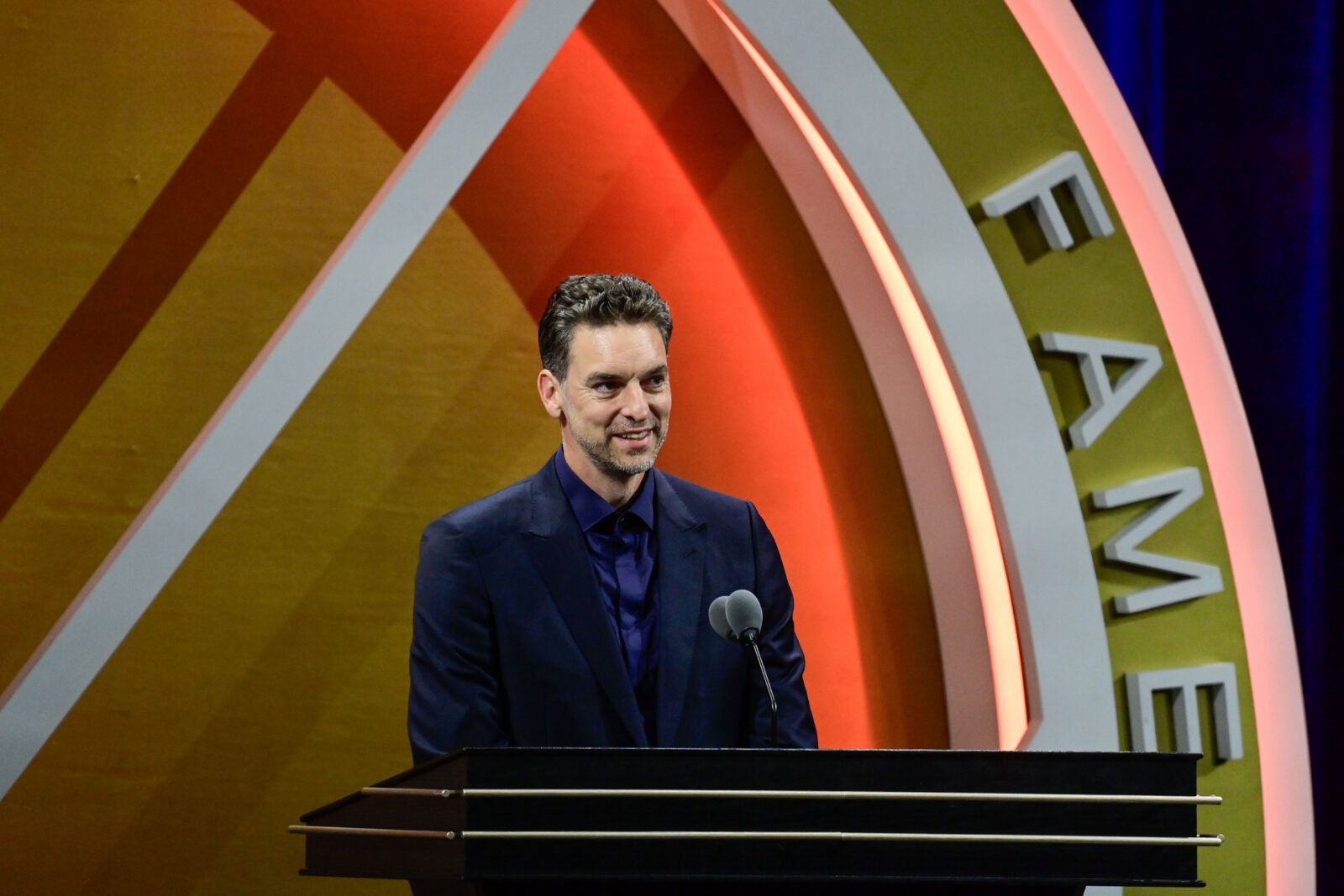
Pau Gasol, 2001 NBA Draft
The 2000-01 season was one of the worst seasons the Hawks have ever had. They won just 25 games, the sixth fewest in a season in franchise history. As a result, Atlanta was awarded the third overall pick in the 2001 NBA Draft.
The Washington Wizards infamously selected Kwame Brown first overall (who was traded for Gasol in 2008), but the big man from Spain was still there at third overall. Atlanta drafted Gasol but later re-routed him in a trade with the Memphis Grizzlies.
Along with the draft rights to Gasol, the Hawks traded the late Lorenzen Wright and Brevin Knight in exchange for Shareef Abdur-Rahim and the 27th overall pick.
Later that night, Atlanta selected Jamaal Tinsley, but he also never played for the Hawks. Instead, they chose to move him to the Indiana Pacers for a 2003 first-round pick that became Boris Diaw.
Abdur-Rahim did make his first and only All-Star team the following season, but never had quite the career Gasol did. Memphis later moved Gasol to the Los Angeles Lakers after failing to build around him.
Atlanta traded what could have been a franchise-altering player in the midst of a rebuild. It very well may go down as one of the worst trades in franchise history. Funny enough, the Hawks engaged in trade talks with the Lakers in 2012. A deal involving Gasol and Josh Smith did not go through.








Leave a comment