

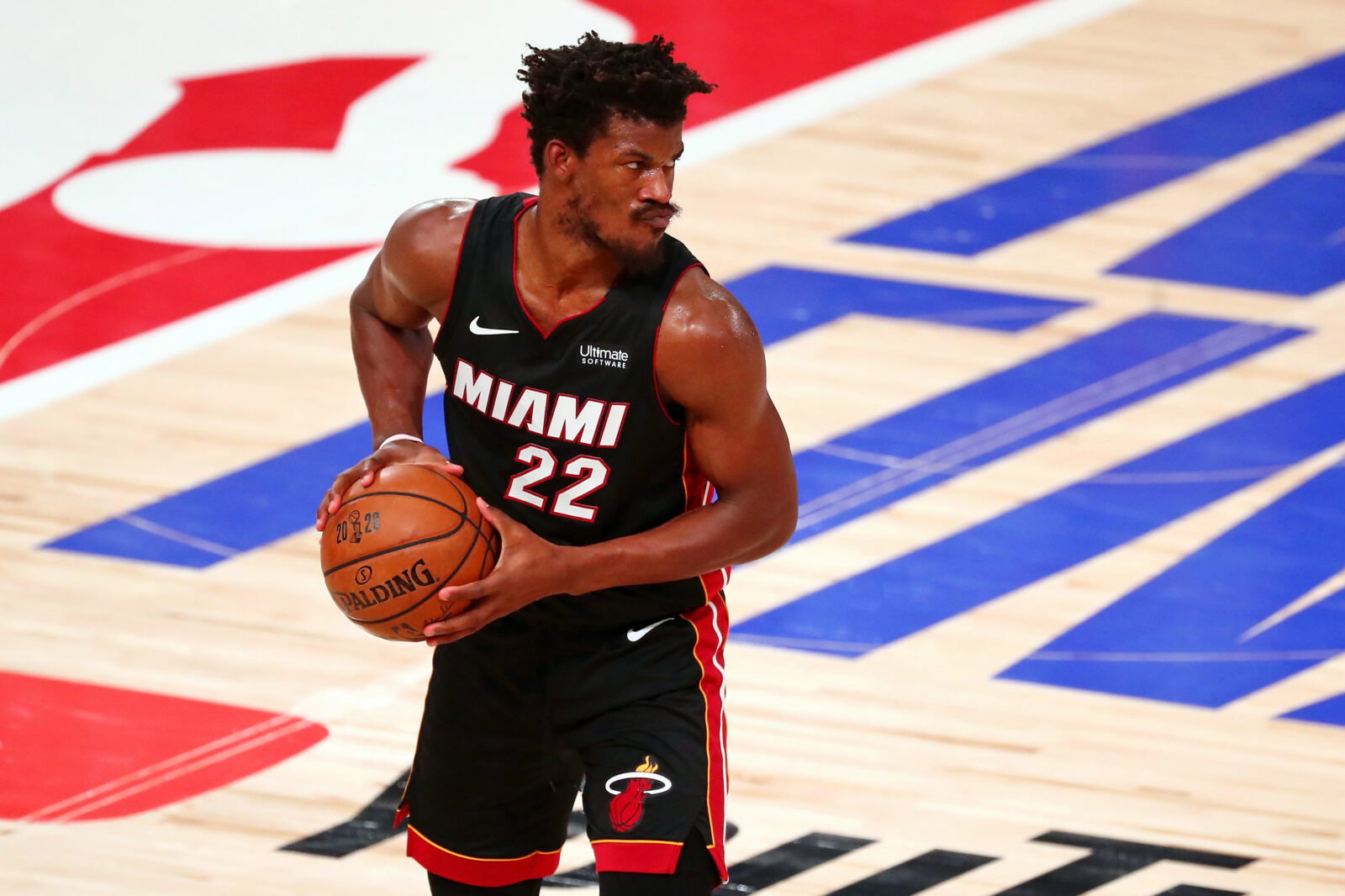
What makes an NBA title quest so legendary?
Is it merely a player’s on-court production? Their fight in moments of adversity? Perhaps it is the circumstances surrounding their history-making.
Jimmy Butler’s 2020 bubble run was a hallmark example of all three at the highest level. Six years since he led the Miami Heat to the Finals, it is worth looking back at how illustrious his championship pursuit was and why it holds a special spot in NBA history.
The Road to Reaching the Finals
Jimmy Butler has overcome adversity his whole life. The bubble playoffs were no different.
Entering the postseason as the fifth seed in the East, the Heat had already etched their name in the history books as one of (then) four teams to reach the Finals as a fifth seed or lower. They were the first team to do so since 1999.
The Heat were a tough, gritty team that finished seventh in offense and 11th in defense during that regular season. But the playoffs are a different animal. Other teams in the East were thought to be better built for the NBA’s biggest stage.
The league’s top team, the Milwaukee Bucks, appeared to have everything in front of them. Rising superstar Giannis Antetokounmpo had won his second consecutive MVP and had just been named Defensive Player of the Year. They were battle-tested the previous season, falling short to the eventual champion Toronto Raptors in the Eastern Conference Finals.
The Boston Celtics were also on the verge of their first Finals appearance in the Jayson Tatum-Jaylen Brown era.
Other teams employed more talent on paper than Miami, but nothing would matter if Jimmy Buckets was activated.
The Miami Heat Were Underestimated
Jimmy Butler and the Heat weren’t bothered being overlooked as title contenders. The 2020 pandemic season brought plenty of uncertainty. After the league resumed play in a bubble-like environment in Orlando, Florida, they were more locked in than ever before.
They had heard the chatter even before playoff basketball began. None of it mattered to them.
“The group of guys that we got, we’re gonna win,” Butler declared just weeks before the NBA season shut down. “We’re gonna be fine. All I ask is that you keep that same energy when it’s like, ‘Ohhhh, [the Heat are] surprising all these people.’”
To say the Heat, specifically Butler, surprised a lot of people would be an understatement.
Butler was already a five-time All-Star and one of the game’s best two-way players. He averaged over 20 points per game in several seasons and earned multiple All-NBA and All-Defense team nods. In other words, he shouldn’t have been a dark horse, but somehow still was.
Butler averaged 20.7 points combined in the first three series, slightly more than his 19.9 PPG in the regular season, while shooting 45.7% from the field. He and the Heat plowed their way through the East’s top teams, knocking out the Bucks, Celtics, and Pacers.
The NBA Finals, however, presented a different set of challenges.
The Heat Battled Injuries
The Heat were the underdogs in the NBA Finals — a familiar spot for Jimmy Butler. The Los Angeles Lakers were the team the basketball world had its eye on ever since Anthony Davis joined forces with LeBron James.
The Lakers were no easy team to play around with. They finished both the regular season and playoffs with the No. 1 field goal percentage. The star pairing of LeBron and Anthony Davis had worked as well as the Lakers could have hoped.
Like the Heat, they peaked at the perfect time.
On Miami’s side, Butler was the team’s best player; others followed behind.
The Lakers punched the Heat in Game 1 and took control in the final three quarters. But what gets lost in memory is that starters quickly went down with injuries.
Their second-leading scorer, Goran Dragic, suffered plantar fasciitis in the second quarter; he subbed out and never returned. In the same game, Bam Adebayo also strained his shoulder and would miss Games 2 and 3; Dragic missed Games 2 through 5 of the six-game series. Even Butler rolled his ankle in the second quarter of the same game. However, he continued playing.
With two of the team’s top three scorers gone, the Heat needed a semi-compromised Butler to pull off a miracle.
Butler Needed to Be a Hero
Butler put up an efficient performance in Game 1 — 23 points on 8-13 from the field — and scored 25 in Game 2. To keep his team’s title hopes alive, he needed to dig deeper.
Erik Spoelstra naturally leaned into Butler much more in the absence of Adebayo and Dragic. The former 30th overall pick played 45 minutes in a Game 2 defeat, but the Heat had kept the margin thinner than the first time.
They needed to win Game 3 to keep their season alive. With questions surrounding when/if Dragic and Adebayo would return, it became evident it was Butler’s time to shine.
Butler came out aggressive, attacking the paint and capitalizing on mismatches. Miami took a double-digit lead in the third quarter, but the Lakers refused to quit.
The Lakers rallied from a 12-point third-quarter deficit to take the lead with under nine minutes in the fourth.
Butler dragged his team to the finish line — not just in an ultra-electric scoring performance. He consistently found his teammates for shots, and they finally went down. Butler emphasized crashing the boards, especially without the 6-foot-9 Adebayo.
Mike Breen dubbed Butler’s 40-point, 13-assist, 11-rebound triple-double a masterpiece. He played just under 45 minutes for a second straight game, going an exceptional 70% from the field.
Although Jimmy Butler didn’t have time to bask in the history he made, the record books took note.
He became the first perimeter player in 40 years to drop 40 in a Finals game without attempting a single three. Butler was also the first and only player to outscore, outrebound, and out-assist LeBron in a Finals game. The six-time All-Star joined LeBron and Jerry West as the only other players with a 40-point triple-double in the Finals.
Butler’s Leadership Helped His Teammates
Butler didn’t just save the team’s season with his individual showing. He instilled confidence in his teammates who had stepped up. Players who struggled shooting the ball in Games 1 and 2 found rhythm. Shooting guard Duncan Robinson went scoreless in Game 1 of the Finals and scored just nine in Game 2.
Robinson credited his star teammate with helping him reset mentally after an underwhelming few games.
A dejected Robinson was in his Orlando hotel room, re-watching tape and lamenting his first two showings. Butler then knocked on his door and insisted his teammate join him to talk.
Robinson reluctantly agreed.
Butler didn’t summon him over to cuss him out for poor play or harp on the significance of Game 3. Instead, he briefly urged the sharpshooter to maintain belief in himself and continue letting it fly. Then, they talked about everything except for the Finals.
“It was just about be yourself. Go out there, be aggressive. Be who you are; be who you’ve been that got us here and everything will take care of itself,” he recalled Butler saying.
“That meant a ton to me. Obviously, because to have your best player’s support like that—I’m playing in my first playoff run, and he’s like, ‘Dude, shoot the ball every time. This is who you have to be. And now let’s get back to talking about whatever.’ After that, I was just able to have more clarity around everything, and to know I had his support meant a lot.”
After scoring nine points total on 20% from three in the first two games, he combined for 56 on 44.8% in the next three.
One Last Push to Stay Alive
Jimmy Butler was coming off a performance for the ages, but sustaining his level of play was unfeasible. They were missing 32 points of scoring, including their primary ball-handler, meaning Butler had to do everything.
Miami seemed to be optimistic it could tie up the series once Adebayo was deemed active for Game 4. But the Heat let a close match slip away, with Davis and Rajon Rondo scoring clutch buckets down the stretch. Adebayo was clearly not 100%.
Miami found themselves in the dreaded 3-1 hole.
With their backs against the wall and the season on the line, Butler wouldn’t go down without swinging.
He erupted for a 35-point triple-double with five steals on 57.9% shooting in Game 5. The Heat trailed 103-104 with just 1:14 to go when Butler nailed a tough fall-away jumper to retake the lead. But a bucket from LeBron on the other end meant Butler had to empty his tank.
The iconic photo of an exhausted Butler hunched over a digital sign by the baseline was born. He took a moment to rest, regain air, and prepare to knock down two of the biggest free throws of his life. Butler’s clutch free-throw shooting helped the Heat narrowly escape elimination and live to fight another day.
After the game, Spoelstra couldn’t do anything else but heap praise on Butler. He argued that every young player should study his footage to understand how to impact the game on both ends of the floor.
“When he’s in that type of mode, it’s really just give it to Jimmy and get out the way,” added Robinson.
Everyone knew Butler was their only hope.
Coming Up Short
What was apparent, though, was that playing 47 minutes in an NBA Finals game after logging over 43 in the previous three had taken its toll.
Butler and the Heat ran out of gas in Game 6.
But Miami’s 4-2 Finals loss shouldn’t be viewed as a disappointment. They exceeded the expectations placed on them, especially without two starters for most of the series.
Butler’s heroics weren’t enough to get the job done. His stellar play, however, established him as one of the league’s best postseason risers.
He emitted a bold fearlessness and irrational confidence that have defined his 15-year career.
Jamal Crawford once called his former Timberwolves teammate a self-made superstar. Butler wasn’t a basketball prodigy growing up. He went unranked coming out of high school and took the junior college path first at Tyler.
Crawford raved to JJ Redick about his bubble performance, who briefly played with Butler in Philadelphia.
“It validated those like us who believed in him wholeheartedly,” Crawford said on “The Old Man and the Three” podcast. “We always knew the talent, right? And we both saw it up close by playing with him… For him to take that team and lead that team to the Finals, I was so f— happy for him.”
Butler earned tremendous respect from his peers for going toe-to-toe with LeBron, arguably as well as any player has in the Finals.
LeBron called him “one of the best competitors that we have in our game,” and lauded Butler for his phenomenal play.
Butler made a name for himself on the biggest stage in basketball, putting the league on notice that he was a player to be reckoned with.
The Bubble Presented Unusual Circumstances
Another component of the 2020 Finals that contributed to the lore of Playoff Jimmy was the bubble’s uniqueness. Players were isolated in hotel rooms without friends or family (for most of the time there). Normal routines were thrown out the window.
That also meant no distractions prevented them from focusing on basketball.
The team had discussed beforehand how the environment of the bubble could play into the Heat’s favor.
“We felt that whoever was gonna be willing to embrace the bubble for what it was would actually have a competitive advantage,” Robinson said. “We really just tried to lock in on that.”
Elevating in the playoffs is difficult enough in a normal postseason environment. Dazzling without the energy of a packed crowd, family/friends, or the comfort of sleeping in one’s own bed was foreign territory. The bubble wore out many players who struggled mentally, inhibiting their ability to perform. Not Butler, though.
He averaged 26.2 points, 8.3 rebounds, and 9.8 assists — a near triple-double — on 55.2% shooting in the NBA Finals. Butler also finished with the third-most clutch playoff points in a single postseason of that decade. Only Kawhi Leonard in 2019 and Dirk Nowitzki in 2011 totaled more.
Who knows what could have happened had Miami been healthy? No one will ever find out.
But Jimmy Butler’s grit and tenacity, with an undermanned squad, are a reminder of how his mindset propelled him to soar.
The Future of Playoff Jimmy
Butler is certainly aware there are other players with more easily identifiable talent than him. What he possesses is unquantifiable, unlike size, speed, or shooting. But he still finds his name in the record books alongside other legends.
“I’m not a God-given talent. I ain’t the best shooter. I’m not the best ballhandler. Not the most athletic. Not the fastest,” Butler declared. “But I battle. I fight. I’m tough as s— and I don’t back down. There goes my talent for you. I ain’t scared of nobody. Can’t scare me.”
The Golden State Warrior is currently rehabbing a torn ACL he suffered in January 2026. He is in the last year of his contract with Golden State. There is no guarantee he will still be able to produce at a high level at age 37.
The world deserves to see more of Playoff Jimmy before he hangs it up for good. Butler still hasn’t reached the ultimate pinnacle: winning a title, a mission he insists he will complete.
Whether that vision comes to fruition or not, fans should savor the 2020 Finals outburst.
It was truly one for the ages.










Leave a comment