

By Mark Wallis, Co-Host of Weekday Wagers and CEO of JustTheStatsSports.com. This week, we start with a new segment called “Walkin’ The Dogs”.
A crowded college football board does not require a crowded betting card.
The goal of Walkin’ The Dogs is to identify underdogs where the market gives us more protection than the JustTheStatsSports.com model believes is necessary. Sometimes that means backing a team with a realistic chance to win outright. Other times, it means taking advantage of a spread that looks significantly larger than the model’s projected margin.
This week, two teams separate themselves from the rest of the board: Jacksonville State +3 against Ohio and Buffalo +10.5 against FIU.
Jacksonville State fits directly into one of the strongest historical underdog profiles in the JTSS database. Buffalo, meanwhile, presents one of the largest gaps between the sportsbook spread and the model’s projected margin.
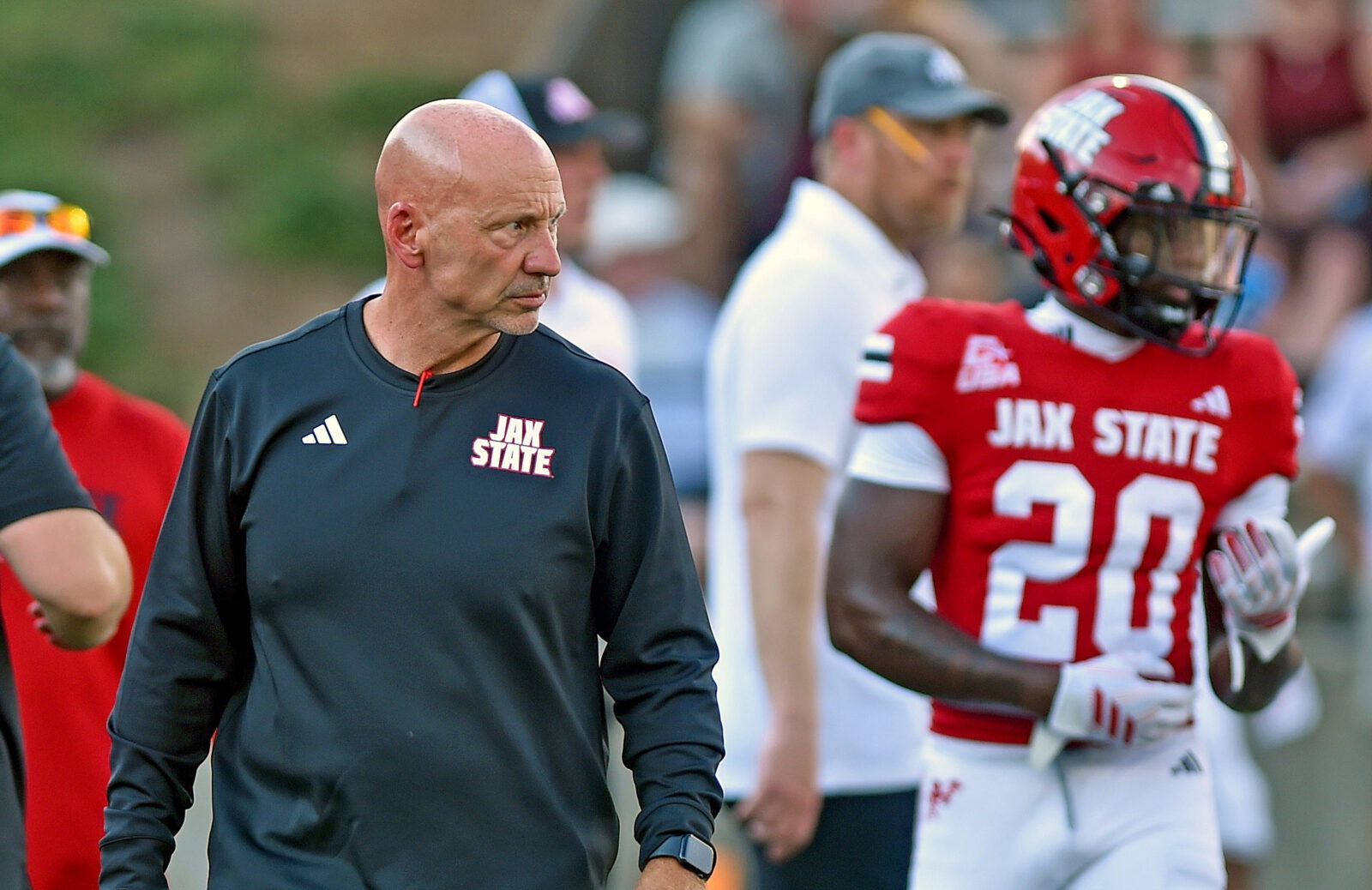
Jacksonville State +3 vs. Ohio
Jacksonville State is the cleaner of the two underdog profiles because the JTSS model essentially views this game as a coin flip.
Ohio carries a 51.1% model win probability, while Jacksonville State sits at 48.9%. The projected score is approximately 27.3-26.9 in favor of Ohio. That means the model projects Ohio to win by only 0.4 points.
The sportsbook is giving Jacksonville State a full +3. That difference alone creates value, but the historical model data makes the Gamecocks even more interesting.
In the JTSS NCAA database, over the last three years, underdogs with a 45% to 49.9% model win probability covered at a 62.3% rate. When those same underdogs were catching three points or fewer, they improved to 65% ATS. Narrow the range even further to underdogs with a 47.5% to 49.9% model win probability, and the historical ATS win rate improves to 70.6%.
Jacksonville State sits almost directly in the middle of that profile at 48.9% and +3. The Gamecocks also gave us reason to believe their season-opening performance was more aberration than identity. Jacksonville State was thoroughly outplayed in its first game, managing only 2.7 yards per carry and 3.7 yards per pass attempt, with a 28% success rate.
The response could not have been much stronger. Jacksonville State followed that loss by dismantling Eastern Kentucky 49-7, producing 526 yards of offense while converting an incredible nine of eleven third downs. Quarterback Caden Creel completed 21 of 28 passes for 327 yards and five touchdowns, while Jamill Williams caught seven passes for 144 yards and four touchdowns. The Gamecocks built a 35-7 halftime lead and looked completely different offensively than they did in the opener.
Ohio deserves credit for its performance against Nebraska. The final margin was ugly, but the game itself was competitive for much longer than the score suggests. In the first half, Ohio averaged 4.5 yards per carry and 6.5 yards per pass attempt, posting a 33% success rate. Nebraska averaged 4.6 yards per carry and 8.5 yards per attempt with a 43% success rate. Eventually, Nebraska’s Big Ten depth took over, and the game broke open in the fourth quarter.
But Jacksonville State does not need Nebraska’s talent advantage to make this wager work. The Gamecocks simply need to stay within a field goal of an Ohio team that the JTSS model considers almost their equal.
The Play: Jacksonville State +3 (-115)
Buffalo +10.5 vs. FIU
Buffalo presents a very different type of underdog opportunity. The JTSS model does not necessarily expect the Bulls to win. What it does expect is a game considerably closer than the sportsbook spread suggests.
FIU owns a 54.6% model win probability, while Buffalo sits at 45.4%. The projected score is approximately FIU 25.2, Buffalo 23.3.
That produces a projected margin of only 1.9 points for FIU. The sportsbook is giving Buffalo +10.5.
That is an 8.6-point gap between the JTSS projected margin and the market spread. For an underdog bettor, that is the type of discrepancy that immediately deserves attention.
Buffalo also falls inside the same historical 45% to 49.9% model underdog range that produced a historical 62.3% ATS cover rate in the JTSS database.
The Bulls opened their season with a 21-17 win over UAlbany, and while it was not a dominant performance, there were several encouraging signs. Buffalo outgained UAlbany 340-276, rushed for 151 yards, converted 10 of 21 third downs and scored touchdowns on all three red-zone opportunities. Defensively, the Bulls held UAlbany to only 72 rushing yards.
More importantly, Buffalo showed it could handle a close game. Trailing 17-14 in the fourth quarter, quarterback Elijah Holmes helped engineer a 61-yard touchdown drive. He completed passes of 20, 25 and 15 yards during the possession before Chance Morrow caught his third touchdown of the night to put Buffalo back in front.
UAlbany then drove deep into Buffalo territory on its final possession, but the Bulls’ defense held near the goal line and preserved the victory. That matters because this wager does not require Buffalo to dominate FIU.
It does not even require Buffalo to win. It simply asks the Bulls to stay within 10.5 points in a matchup the JTSS model projects to be decided by fewer than two. There is a substantial difference between believing an underdog should win outright and believing the sportsbook is offering too many points.
Buffalo falls squarely into the second category.
The Play: Buffalo +10.5 (-110)
Two dogs. Two different angles. Both worth taking for a walk.
Data Source: JustTheStatsSports.com– JTSS NCAA Football model projections and historical model performance data. Odds were current at the time of writing and are subject to change. Please bet responsibly.









Leave a comment