

I’m scrolling through social media one day when I come across a clip of Brian Windhorst on Jason Timpf’s podcast Hoops Tonight.
Anytime Windhorst is talking about basketball, I’m paying attention. He understands basketball on a whole different level, and every time he speaks, there’s something to learn.
But this clip caught my attention for a different reason.
It wasn’t about the playoffs, trade rumors, or the MVP race. Instead, Windhorst was giving flowers to Lakers beat reporter Raj Chipalu and talking about his ascension in the industry. Windhorst even said, “I dream of people like Raj covering every team in the league.” It was more than just a casual shoutout — it felt like a defining moment in Chipalu’s rise as a trusted basketball reporter.
He is one of the fastest-rising basketball media members, so I had to know all about the story behind what makes Raj Chipalu so special and so touted in the industry.
“Brian followed me like four years ago,” Chipalu told me. “I thought that was pretty cool, but I didn’t think he was following my content. It was so unexpected of him to go on a four-to-five-minute monologue on my career. The craziest part is he dreams of 30 people like me covering the league, which is a compliment I can’t even put into words.”
“That was amazing. He’s a monster in the industry, and I was incredibly appreciative of that.”
Where It All Began
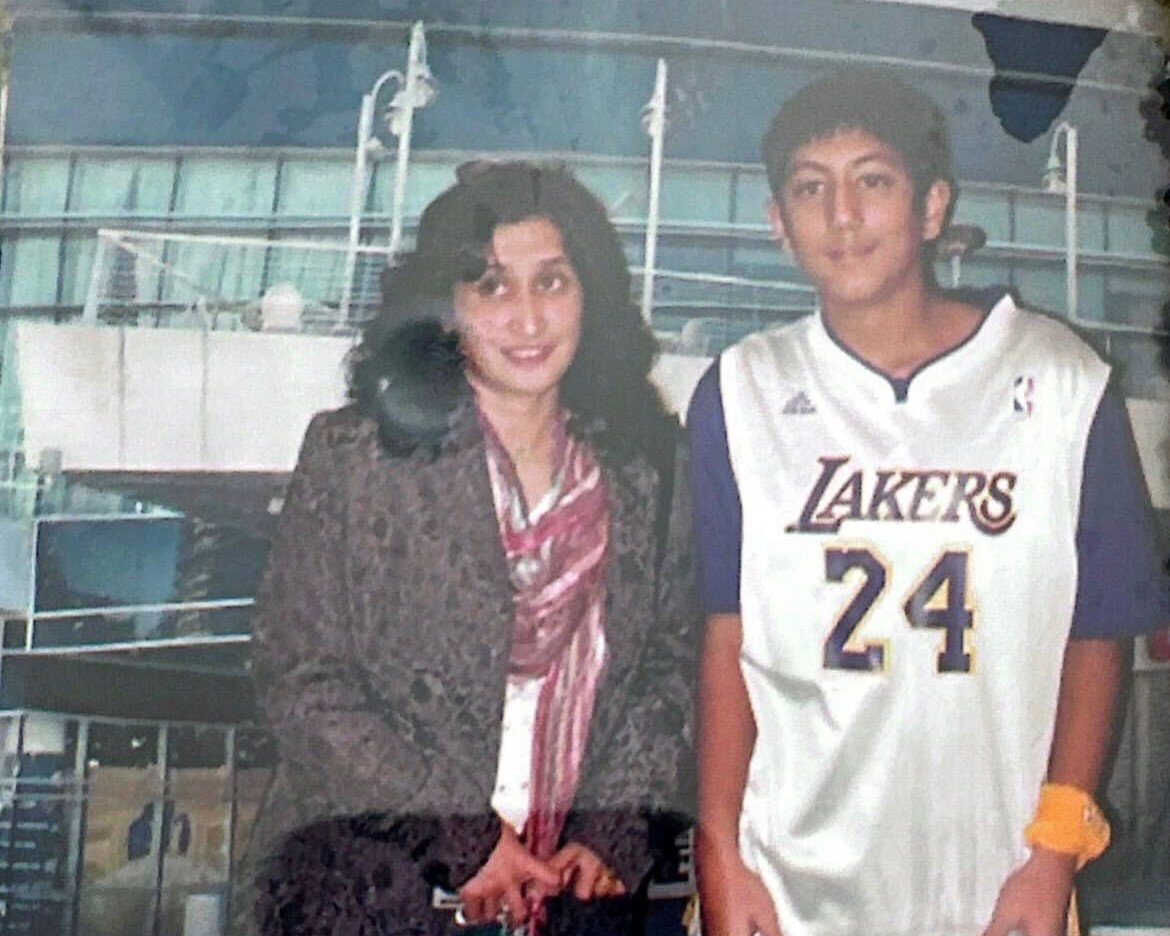
Raj Chipalu’s profile picture on all social media platforms speaks a thousand words. Not just because he covers the Los Angeles Lakers as a credentialed reporter, but because he grew up in the vicinity of L.A. The picture is of him, about seven years old, holding a basketball in a Lakers youth jersey. His smile and love for life sparkle through the screen.
“Growing up, [I had a ] single mom. My mom worked a lot, but I felt like I had everything,” Chipalu recalled. “We always had people over in our apartment building, and all the kids knew each other. There was a huge pool there, and that’s kind of where I spent my summers. I feel blessed because I grew up in a generation that didn’t have phones attached to their hands. We were always outside playing, whether that was at the pool or the basketball court.”
Raj Chipalu Was Not an Average Fan
Chipalu wasn’t the casual fan growing up. He would go to one game every year with his mom and make a day out of it, going out to eat and having a blast at this self-created annual event. His purple-and-gold following extended far beyond just attending a game once a year. Even when he wasn’t attending a game in person, he would stay on top of the Lakers and watch every game —sleep deprivation was not a concern.
“I was always jealous of the people who were always at Lakers games, but I didn’t know what job title they held or anything, Chipalu said. “I always thought, ‘Hey I’d love to do that’, but I didn’t think it was a real possibility. I would stay up late at night listening to replays of the play-by-play of Lakers games on the radio. Now I see that those nights pushed me towards my passion.”
Admiring the Golden State Warriors
The Lakers weren’t the only team that caught his attention. Chipalu would tune into the local broadcasts whenever he could, especially when the Warriors were playing. He was drawn to the energy and swagger of Baron Davis and Monta Ellis — a couple of the most underrated guards the NBA has ever showcased — and Chipalu couldn’t help but notice.
“[Ellis] was my favorite player,” he said. “He had the speed and made the game look so fun. He had the ball handling, the jump shot, and he could drive — there was something about his game that I connected with. This was when the Warriors were close to being the number-one offense in the league. The run-and-pace offense under Don Nelson. It was a fun brand of basketball to watch.”
Deeper Understanding of the Game
Watching the game gave Chipalu a greater understanding, but he wouldn’t stop there. He wanted to gain an even deeper connection to the game. He was reintroduced to playing in his freshman year—a decision that helped him gain that connection.
“I didn’t emulate my game after Kobe, but someone told me to watch highlights of him,” Chipalu said. “I was like, ‘Why would I? I don’t want to make the NBA. I just want to play basketball.’ I ended up watching, and that’s what really made me fall in love with the game.” Chipalu added, “There’s something about five-on-five basketball that you can’t emulate anywhere in life. It takes away from anything you’re thinking about in life.”
After graduating high school in 2012, Chipalu wanted to ensure he would have a stable career after completing his education, so he attended Riverside College to pursue a degree in biology. All while working at his family’s scarf business, he never drifted away from talking basketball and wanting to pursue a career in covering it.
“Even though I was finishing college, I would step out of class to watch the games,” he said. “I’m looking at the scores while tests are going on. So, I knew that was something I’d want to do as a career. This was the time NBA Twitter started to take off, and I’d end up making my first account.”
The Formula to His Rise
Chipalu’s initial goal was to get 100 people to talk about basketball with him. Out of nowhere, his account started to blow up. That’s when he started to take this basketball coverage thing seriously.
“I was looking for niches that weren’t created yet,” Chipalu said. “At this time, highlight culture was starting to rise. You had ESPN and House of Highlights posting offensive highlights. So, I was like, I’m going to start posting some defensive stuff, and that started to really grow.”
“Then the Lakers got good, and I went from 5,000 followers to 20,000, and then that gave me the assurance I can really go for this.” He added, “I think it shows how long the journey takes when you’re going about it from an unorthodox position. I didn’t go for journalism. I didn’t take the usual media path.”
All his life, Chipalu wanted to attend games — that was his dream — he just didn’t know how to get to that point. He found a niche that wasn’t being utilized much in the industry: breaking down the Xs and Os of basketball. It started as a hobby, and wanting to talk basketball with 100 people. But it didn’t stop there. What happened next would launch him into the platform he holds today.
“I was just saying, ‘Hey I love basketball. Can I write for you?’ to various places. I was volunteer writing for USA Today. They had volunteer writers who didn’t make anything, but they got me posted, put my name on it, and I was allowed to share it.
A Taste in the Media
His first sports writing gig was for Lonzo Wire, in addition to multiple Lakers coverage sites. But for him, simply writing about basketball wasn’t enough. He knew he wanted to turn his passion into a career — one where he could not only write about the sport he loved but also make a living doing it.
“I think it’s really important for people trying to come up in this game to learn how to talk in front of a camera,” Chipalu stated. “Learn how to articulate yourself. Learn how to make a point and deliver it. Since I had a little bit of a following, I said, ‘What are some ways I can take advantage of this?’ Podcasts were starting to blow up, so I started to do some podcasts, and I got my first official job with Silver Screen and Roll with SB Nation as a podcaster.”
Chipalu would podcast about everything Lakers until the site’s podcasting section ultimately ended. His experience and the following he had built were apparent, and some of the world’s biggest sports media companies began to take notice.
“I got hired as the GLeague beat reporter for ClutchPoints,” Chipalu said. “That really taught me professionalism in terms of how you turn in writing, how you work with editors, and they gave me a lot of freedom in what to write. From there, I just continued to work.”
Covering Bronny James Helps Him Grow
Since the South Bay Lakers had their practices and home games in the same building as the Lakers, Chipalu thought that would be a great entrance point. He would get the resources needed to succeed in the industry, being someone who didn’t have the normal path.
“I got to cover Bronny during his first season,” he explained. “I got to practice learning how to ask questions, learning how to ask questions that happened during the game, and then I got to experience a media scrum when everyone was trying to talk to Bronny. That was so cool being able to navigate that.”
Chipalu highlighted the importance of his learning to interview Bronny and the South Bay Lakers’ players, transcribe their quotes, and put those words into writing.
“No one sits you down and shows you how to do all of these things in this profession, unless you go to journalism school or media training,” Chipalu said. “But, I came from the outside, and I had no experience in any of this. It was extremely important for me, as an outsider.”
https://clutchpoints.com/nba/los-angeles-lakers/bronny-james-gives-take-his-process-so-far-exclusive
Dreams Brought to Life
These experiences would lead Chipalu to reintroduce himself to the Silver Screen and Roll as a writer. And once his contract ended with them in August, he would receive the opportunity he’d always dreamed of.
“I was able to get credentials. After my contract ended with SB Nation, I contacted the team and due to my experience and my own platform, I was able to get credentialed. This year I’ve been to pretty much every home game, which has been amazing. Being able to sit in the pressers and go to practices has been really cool.”
It still doesn’t feel real to Chipalu. Once a kid who went to Lakers games as a fan, the reality didn’t hit him that he’s a credentialed reporter for the Lakers. In high school, Chipalu didn’t even know what a screen was. Fast forward and he’s built a platform talking about the Lakers’ “horns” action, defensive assignments and much more.
That has since evolved into interviewing Lakers’ stars, writing about the Lakers, learning the ins and outs of being a professional basketball media member, and podcasting on the side. Chipalu is now dominating as a Lakers reporter, as well as contributing to the Offside media outlet, and there’s no place he’d rather be.
“I just wanted a shot in the [presser room],” he said. “I just wanted 100 people to talk basketball with. That was my main objective in doing this. It was not to make money in this space. It was really to be a part of a basketball community.”
“To get to this point now, eight or nine years later, is insane.”









Leave a comment