


Now in its 29th season, the WNBA has seen 833 players take the court since its debut in 1997. Distilling nearly three decades of talent into a top 25 list means identifying the top 3% of players in league history — the elite of the elite.
The categories used to evaluate players include Most Valuable Player (MVP) awards and MVP shares, Defensive Player of the Year (DPOY) and DPOY shares, Finals appearances, championships, Finals MVPs, statistical league rankings, adjusted win shares (taking into account the changes in the number of regular season games throughout the course of the WNBA), All-WNBA selections, and All-Defensive honors (Note: All-Defense wasn’t introduced in the WNBA until the 2005 season).
A total of 117 players have received MVP votes, but only 16 have actually won the award. All 16 made the WNBA25. Fifteen of the 16 MVPs have won at least one WNBA championship, and 12 also won a Finals MVP.
The subjectivity comes when digging a little deeper. Take Hall of Famer Tina Thompson. She won four titles and made eight All-WNBA teams, yet never claimed a league MVP – even though she received MVP votes in 13 of her 17 seasons. Her Houston Comets teammate Cynthia Cooper won two MVPs and four Finals MVPs. Another Comet teammate, Sheryl Swoopes, won three MVPs and three DPOYs.
As great as Thompson was, she was the third-best player during the Comets’ four-peat from 1997 to 2000. Therefore, that places her in a lower tier than both Cooper and Swoopes.
Limiting the list to 25 means some impactful players missed the cut. Current players Skylar Diggins-Smith and Alyssa Thomas just missed. Becky Hammon, Katie Douglas, and Teresa Weatherspoon are players from the first half of the WNBA’s inception who also fell short of the WNBA25.
*All stats above were manually calculated*
Click the following to view the three other tiers: Tier 1 | Tier 3 | Tier 4
Tier 2: Generational Superstars
10. Maya Moore (2011-2018)
9. Candace Parker (2008-2022)
8. Sheryl Swoopes (1998-2011)
7. Diana Taurasi (2004-2024)
Tier 2 features four players who were all drafted first overall and are often mentioned in the G.O.A.T. conversation. They fall just short of the top tier in accolades but have had a transformative impact on the game.
Sheryl Swoopes, the first player signed to the WNBA, was the face of the league’s early years. She helped Houston win the first four championships (although she played in just nine games in 1997 after giving birth). A seven-time All-WNBA selection (five first-team) and a three-time MVP, she led the league in scoring and steals twice each. She averaged 16.1 points and 2.2 steals from 1998 to 2006 (missing 2001 with an ACL injury). A winner of three DPOYs, Swoopes ranks second all-time in steals per game (2.0).
Often overshadowed early by teammate Cynthia Cooper — who won the league’s first two MVPs and four straight Finals MVPs — Swoopes ranks 14th all-time in adjusted win shares (aWS), just ahead of Maya Moore and behind Yolanda Griffith (Tier 3), Katie Smith (Tier 4), and Lindsay Whalen (Tier 4). She also sits tenth in MVP shares, narrowly trailing one-time MVP Tina Charles, despite winning three times.
In 2017, Sports Illustrated named Maya Moore the greatest winner in women’s basketball history— and for good reason. Her high school record was 125-3, winning three Georgia 5A titles and a national championship. Then she posted a 150-4 record at UConn with two NCAA championships.
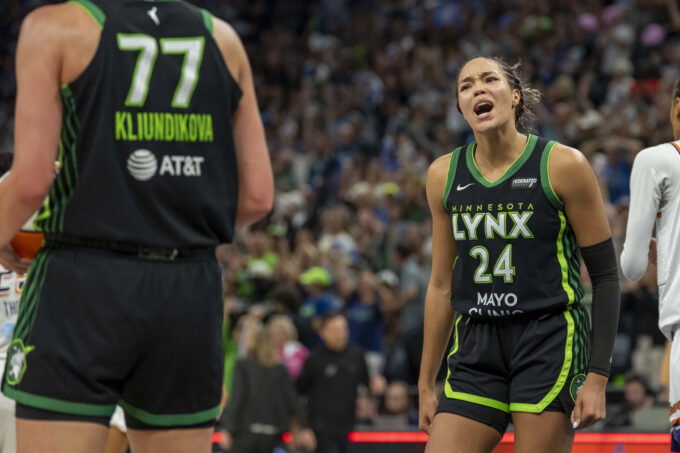
Drafted first overall by Minnesota in 2011, Moore won Rookie of the Year (ROY). Together with teammates Seimone Augustus and Lindsay Whalen, she led the Lynx to the first of four titles. The last two titles also included Sylvia Fowles. In her “offseasons,” she added two Olympic gold medals, a EuroLeague title, and three championships in China’s WCBA. Moore stepped away at 29 and in her prime after only eight seasons. Each of those seasons ended with Moore receiving MVP votes.
Yet she kept on winning. She redirected her focus to social justice, helping overturn the wrongful conviction of a family friend. She ended up marrying the man she set free.
Her career résumé includes seven All-WNBA selections (five first-team), two All-Defensive nods, 2013 Finals MVP, and the 2014 scoring title in her lone MVP season. She ranks second all-time in aWS per season (7.9), sixth in MVP win shares per season (0.389), and sits in the top 12 all-time in PER (24.6), points per game (18.4), and steals per game (1.7).
One of the few seasons that didn’t end in a title for Moore came in 2016. Her 23-point, 11-assist, six-rebound effort in Game 5 of the Finals wasn’t enough to stop Candace Parker and the Sparks. Parker posted 28 points and 12 rebounds to clinch the series and was named Finals MVP, averaging 17.2 points, 7.4 rebounds, 2.2 assists, 2.2 steals, and 2.0 blocks in the series. It was the first of her three WNBA championships. Moore got revenge in 2017, leading Minnesota to a Game 5 win over the Sparks for her fourth and final title.
Three years before Moore’s ROY season, Parker made history.
She is the only player to win ROY and MVP in the same season. After back-to-back NCAA titles and Wooden Awards at Tennessee, she became one of the most versatile posts the WNBA has ever seen. Over 15 seasons, Parker led the league in blocks twice, rebounds three times, and assists once, while finishing 10th all-time in scoring (6,574).
After 13 seasons in Los Angeles, Parker joined the Chicago Sky in 2021. Despite an early-season injury and a 2-7 start, she led the Sky from a .500 regular season to one of the most improbable championships in league history. She made First-Team All-WNBA for Chicago the following year, then stunned the league by signing with the defending champion Las Vegas Aces. She thrived early in a supporting role in 2023 but missed the second half of the season with a foot injury. The Aces went on to win the title without her, and Parker never played again.
Her individual accolades include two MVPs, a DPOY in 2020, ten All-WNBA nods (seven first-team), and two All-Defensive honors. She ranks third all-time in rebounds (3,467), eighth in assists (1,634), fifth in blocks (619), and 13th in PER (24.4 – just 0.2 behind Moore). Parker is sixth in all-time aWS (77.2) and fifth in MVP shares (3.767).
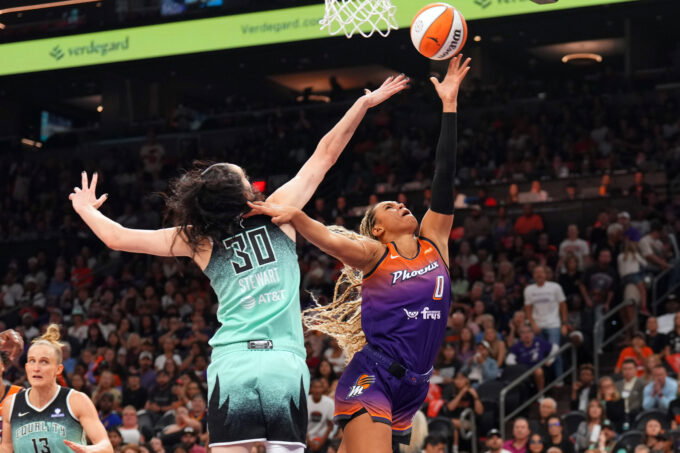
Parker’s 2021 title came at the expense of a Phoenix team led by Diana Taurasi, someone who had dealt her plenty of playoff heartbreak. Taurasi and the Mercury eliminated Parker’s Sparks in 2009, 2013, and 2014. The Mercury won the championship in both ’09 and ’14, with Taurasi being named Finals MVP each time. Taurasi’s first WNBA championship came in 2007— only her fourth season in the WNBA.
Like Parker and Moore, Taurasi burst onto the scene as a rookie. In 2004, the Mercury drafted her first overall after she led UConn to three straight national championships. She was named Rookie of the Year, made First-Team All-WNBA, and finished third in MVP voting while averaging 17.0 points, 4.4 rebounds, 3.9 assists, and a 47.7% eFG. Eighteen years later, at age 40, she averaged nearly identical numbers— 16.7 points, 3.4 rebounds, 3.9 assists, and a 48.8% eFG.
Taurasi made All-WNBA in each of her first eight seasons — including seven first-team selections — and holds the league record with 14 total nods. She led the league in scoring five times and won MVP and Finals MVP in 2009, averaging 20.4 points per game.
Over her 20-year career (missing only the 2015 season), Taurasi shattered records. She passed Tina Thompson to become the league’s all-time leading scorer in 2017, and then added 2,779 more points. She finished with 10,646 points – more than 3,000 ahead of Thompson. Taurasi played 638 combined regular season and playoff games, second only to Sue Bird (640). Taurasi also leads in career threes made (1,447) and free throws made (2,517).
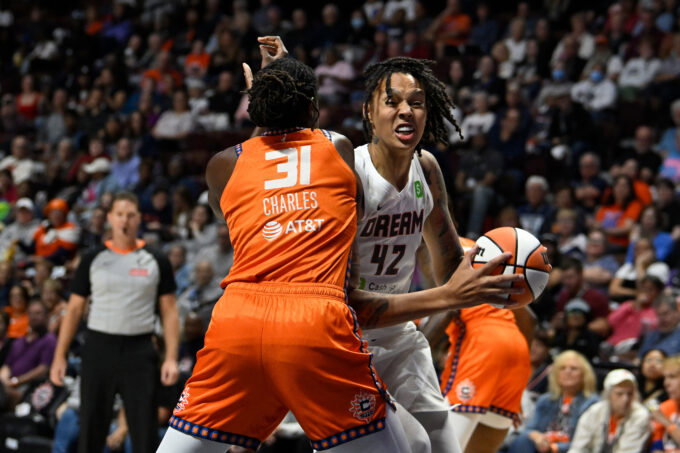
Despite her historic offense, her defense limits her Tier 1 case. She led the Mercury in win shares only six times. During their ten seasons together, teammate Brittney Griner (Tier 3) led the team in win shares seven times. Taurasi’s 76.9 adjusted offensive win shares rank first all-time, but her 11.5 adjusted defensive win shares rank just 86th. Her 4.4 aWS per season ranks 30th.
Taking just her top ten seasons, her 6.5 aWS per season would rank only 8th, comparable to Tier 3 players like Yolanda Griffith and Nneka Ogwumike. Even in total MVP shares, Taurasi ranks outside the top five — two spots behind Candace Parker and one behind A’ja Wilson — who has played 13 fewer seasons than Taurasi. Taurasi’s impact, while undeniable, was more one-dimensional compared to the all-around dominance of Tier 1 players.
That leaves us with six Tier 1 players– each with a compelling case as the greatest of all time. In alphabetical order: Tamika Catchings, Cynthia Cooper, Lauren Jackson, Lisa Leslie, Breanna Stewart, and A’ja Wilson. They have racked up accolades, elevated teammates, and left lasting imprints on the game.
Whether through sustained excellence, unmatched peaks, or era-defining impact, these six legends stand alone at the summit of WNBA greatness.











Leave a comment